- HYROX is eight rounds, each a 1 km run followed by one functional workout station, and the same 8 stations appear in the same order at every event worldwide.
- Only the sled push, sled pull, farmers carry, sandbag lunges and wall balls carry an external load. SkiErg, Rowing and the Burpee Broad Jump are bodyweight and engine only.
- There are four load profiles: Women, Women Pro, Men, and Men Pro. PRO divisions use heavier loads than Open.
- A Pro woman moves what an Open man moves on the sleds, the carry and the lunge: 335 lb (152 kg) against 335 lb (152 kg) on the push.
- Wall balls are 100 reps in every Open and Pro division, and the target height follows gender rather than tier.
- Loads are the same in Doubles and Relay. Nothing gets lighter because you brought a partner.
What weights does HYROX actually use?
HYROX loads five of its 8 stations: the sled push, the sled pull, the farmers carry, the sandbag lunges and the wall balls. Each of those has four possible weights, one for each division profile, which are Women, Women Pro, Men, and Men Pro. The loads are fixed by the rulebook and do not change from city to city, so the number you train is the number you race.
The rest of the race carries no load at all. HYROX is eight rounds, each a 1 km run followed by one functional workout station, and the running, the ergs and the burpees are all bodyweight. That is the part most people underestimate: the weights themselves are moderate, but you meet them after a 1000 m run every single time.
The master table below covers every weighted station against every division. If you would rather see only your own numbers, filtered to your division and switchable between kilograms and pounds, use the HYROX weight standards tool.
Every HYROX weight in one table
The stations always run in this order: SkiErg, Sled Push, Sled Pull, Burpee Broad Jump, Rowing, Farmers Carry, Sandbag Lunges, Wall Balls. Five of them are loaded, and this is what each one weighs in each division. Every figure below renders in pounds first with kilograms alongside.
| Station | Open Women | Open Men | Pro Women | Pro Men |
|---|---|---|---|---|
| Sled Push | 225 lb (102 kg) | 335 lb (152 kg) | 335 lb (152 kg) | 445 lb (202 kg) |
| Sled Pull | 172 lb (78 kg) | 227 lb (103 kg) | 227 lb (103 kg) | 337 lb (153 kg) |
| Farmers Carry | 2 x 35 lb (16 kg) | 2 x 53 lb (24 kg) | 2 x 53 lb (24 kg) | 2 x 71 lb (32 kg) |
| Sandbag Lunges | 22 lb (10 kg) | 44 lb (20 kg) | 44 lb (20 kg) | 66 lb (30 kg) |
| Wall Balls (ball) | 9 lb (4 kg) | 13 lb (6 kg) | 13 lb (6 kg) | 20 lb (9 kg) |
Want your own column pulled out and toggled between kilograms and pounds? That is exactly what the weight standards tool does.
How to read the table if you are new
Three things trip people up. The sled figures are the total sled, frame included, not plates added on top of a bare sled. The farmers carry figure is per hand, so it already reads as a pair and you never double it. And the wall ball row is the ball only: the reps and the target height are set separately, and that is where most of the confusion in this sport starts.
The stations with no weight at all
People ask how much you lift in a HYROX, and the honest answer is: less than you think, more often than you want. Three stations use nothing but your own body. The SkiErg is 1000 m, the row is 1000 m, and the Burpee Broad Jump covers 80 m of the floor.

Those three stations are where the race stops being a strength test. You cannot muscle a rower, and the burpee broad jump punishes anyone whose heart rate is already pinned from the sleds. Add 8 km of running spread across 8 legs, plus the ROXZONE, the central transition zone athletes run through between every run and station, and the picture is a conditioning race with five loaded interruptions. Station technique and race order are covered in full on the HYROX stations guide.
Open versus Pro, station by station
PRO divisions use heavier loads than Open, but only on five stations. The SkiErg, the row and the burpee broad jump are identical between Open and Pro, and so is every run. Pro is not a longer race, it is the same race with heavier objects on five of the 8 stops.
The cleanest way to picture the jump is the one almost nobody leads with: the Pro women's load is the Open men's load on all five weighted stations. Pro Women push 335 lb (152 kg) and Open Men push 335 lb (152 kg). Pro Women pull 227 lb (103 kg) against Open Men on 227 lb (103 kg). The farmers carry is 2 x 53 lb (24 kg) and 2 x 53 lb (24 kg). The sandbag is 44 lb (20 kg) and 44 lb (20 kg). Same numbers, different divisions.
Wall balls are the one place that equivalence is only half the story: a Pro woman throws the Open men's ball, 13 lb (6 kg), but at the women's 2.70 m target rather than the men's 3.00 m. If you are deciding which division to enter, the Open versus Pro comparison walks through the trade-off, and the Pro weights page lists the Pro side in full.
Wall balls: the number everyone gets wrong
Correction one. Wall balls are 100 reps for women and men, Open and Pro. The "75 reps for women's Open" figure still circulating on gym blogs is an old standard, retired when women's Open and the doubles formats moved up to 100 for the 24/25 season. Any guide still quoting it is out of date.
Correction two. Target height tracks gender, not tier. Women throw to 2.70 m in both Open and Pro. Men throw to 3.00 m in both. So a Pro woman throwing 13 lb (6 kg) aims at exactly the same target as an Open woman throwing 9 lb (4 kg), which is why the Pro jump feels so much larger here than the weight difference suggests.
Wall balls come last, on the worst legs of the day, and the rep count does not change between Open and Pro. That is why they decide more finishes than the sleds do. The full breakdown of ball weights, height and rep strategy sits on the HYROX wall ball weight page.
The sleds: the heaviest things you will touch
The sled push tops out at 445 lb (202 kg) for Pro Men and starts at 225 lb (102 kg) for Open Women. The pull runs from 172 lb (78 kg) up to 337 lb (153 kg). Both figures include the sled itself, which is why the number looks larger than the plate load you would use in a gym.
Here is the detail most weight tables leave out. Neither sled is a single straight effort. The push is 4 x 12.5 m and the pull is 4 x 12.5 m, 4 shuttle lengths making up the 50 m total, with a turn at the end of each one. Turning a loaded sled from a dead stop is the hardest part of the station, and you do it once per length, which is why athletes who trained one long push still get ambushed on race day. Loads and technique per sled live on the sled push weight page and the sled pull weight page.
Carries and lunges
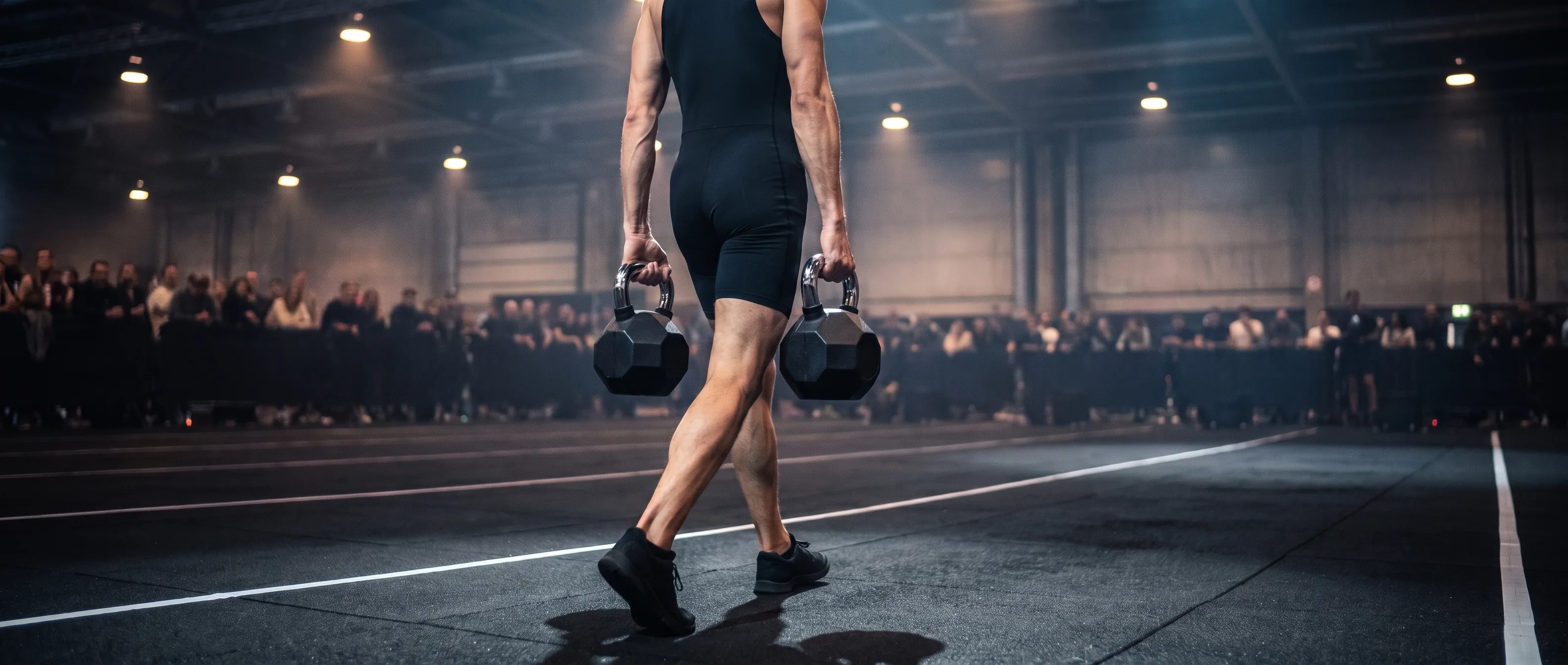
The farmers carry is one kettlebell per hand over 200 m. Open Women carry 2 x 35 lb (16 kg) and Open Men carry 2 x 53 lb (24 kg), with Pro raising both to 2 x 53 lb (24 kg) and 2 x 71 lb (32 kg). Grip is the limiter far more often than the legs, and the bells are octagonal rather than round, which changes how they sit against your forearm. Sizes and grip strategy are covered on the farmers carry weight page and the HYROX kettlebell weight page.
The sandbag lunges come next, 100 m of walking lunges with the bag across both shoulders. Open Women lunge 22 lb (10 kg) and Open Men lunge 44 lb (20 kg); Pro moves those to 44 lb (20 kg) and 66 lb (30 kg). On paper it is the lightest of the four carried loads. In practice it arrives second to last, on tired legs with only one of the 8 runs still to come, and every rep needs a knee to touch the floor. See the sandbag lunge weight page for the full rules on bag position and no-rep triggers.
Do the weights change for women?
Yes, and only by division rather than by anything else. Women's Open loads are set lower than Men's Open across all five weighted stations, and Women's Pro lands exactly on Men's Open. What does not change is the rep count, the running distance, the station order, or the number of shuttles on the sleds. A woman racing Open covers exactly the same race a man does, with different objects on it.
The one genuine gender-linked variable in the whole rulebook is the wall ball target height, covered in the callout above. Everything else follows division. The full women's table, station by station in both units, is on the HYROX women's weights page, and the men's equivalent is on the HYROX weights for men page.
Doubles and Relay: nothing gets lighter
HYROX runs in these formats: Singles, Doubles, Team Relay (4 athletes), and Adaptive. Neither Doubles nor Relay drops the loads below singles. Adaptive is the one format that does: its own division tables set lighter loads for several divisions, and our HYROX Adaptive guide covers that format.
In Doubles the weights are identical to singles for the equivalent division, so neither format is lighter. What the second athlete changes is the work split: only one partner works a station at a time while the other rests, which turns a steady grind into an interval. The full picture is on the HYROX doubles weights page.
Team Relay uses 4 athletes and runs in Women, Men, and Mixed. The format is straightforward: a 4-person team splits the standard 8 runs and 8 stations, each member covering 2 x 1 km and 2 workout stations. The women's and men's relay divisions carry the matching singles loads, so a relay leg is a shorter race at full weight, not a lighter one. Mixed relay assigns loads per athlete rather than by a single team column, so check the current rulebook for your own stations.
Do weights change with age?
No. Age groups in HYROX are ranking buckets, not load categories. They run Under 24 [16-24], then five-year bands from 25-29 up to 85-89, from a minimum age of 16, and they are set by your age on race day. A 58-year-old in the Open division pushes the same sled as a 24-year-old in the Open division.
There is one real interaction between age and division, and it sits at championship level. Athletes aged 60+ may race Pro at regular HYROX events but qualify for the World Championship through the Open division only, using Open weights at Worlds. Put another way: athletes aged 60 and above qualify for the World Championships through the Open division only, and race Open weights, reps and distances at Worlds. Below that, athletes may race the Pro divisions up to and including the 80+ age groups (the 80-84 and 85-89 bands) at regular HYROX races, with age-group rankings, podiums and flags applying as normal. The whole taxonomy of divisions, formats and age bands is laid out on the HYROX divisions page.
Do HYROX weights change each season?
The standards are stable, but they are pinned to a season. The figures on this page are Season 26/27, and they were re-checked against the official rulebooks rather than copied from another site. Loads carried over from the previous season without a change, but that only became clear after somebody went and looked.
The practical rule: any weights table without a season stamped on it should be treated as stale until proven otherwise. Several of the pages ranking for this query still show a two-season-old pin. Before your own race, open the rulebook linked in the sources at the bottom of this page and confirm your division, because the rulebook is the only thing that counts on the day.
How to train for the loads
Training for HYROX weights is mostly not a strength problem. The heaviest thing in the race, a Pro Men sled at 445 lb (202 kg), is well inside what a trained athlete can move fresh. The difficulty is that you never meet it fresh. Every load arrives after a 1000 m run.
So the useful adjustment is small: rehearse the loads in a fatigued state rather than a rested one. Run, then push. Row, then lunge. If your only exposure to race weight is a fresh session with full rest between sets, you have trained a different event. Race distances are broken down on the HYROX distances page, and station-specific technique on the stations guide.
The video below runs through every station's load and distance if you would rather hear it than read it.
Only want your own numbers? Pick your division and see just your loads, switchable between kilograms and pounds, without scrolling past three other divisions to find them.
Check my HYROX weightsFrequently asked questions
What are the weights for HYROX?
Five of the 8 HYROX stations carry an external load: sled push, sled pull, farmers carry, sandbag lunges and wall balls. The exact figure depends on your division. An Open man pushes 335 lb (152 kg) while an Open woman pushes 225 lb (102 kg), and Pro raises both.
What weight is the HYROX sled push?
The sled push is 225 lb (102 kg) for Open Women, 335 lb (152 kg) for Open Men, 335 lb (152 kg) for Pro Women and 445 lb (202 kg) for Pro Men. Those figures include the sled itself, and it is covered as 4 x 12.5 m rather than one straight push.
Are HYROX weights the same everywhere?
Yes. HYROX is standardised, so the loads in your division are identical at every event worldwide. What changes is the season pin: the current standards are Season 26/27. Always check the official rulebook for your own event before race day.
What is the difference between HYROX Open and Pro weights?
PRO divisions use heavier loads than Open, but only on five stations. SkiErg, Rowing and Burpee Broad Jump are identical. The cleanest way to picture it: a Pro woman pushes 335 lb (152 kg), exactly what an Open man pushes.
Is the HYROX wall ball count the same for women?
100 reps in every Open and Pro division, though in Doubles and Relay that count is shared across the team rather than thrown by each athlete. The "75 reps for women's Open" figure that still circulates is an old standard, retired when women's Open moved up for the 24/25 season. What changes between those divisions is the ball weight and, by gender, the target height.
What height is the HYROX wall ball target?
2.70 m for women and 3.00 m for men. Height follows gender, not tier, so a Pro woman throwing 13 lb (6 kg) aims at the same target as an Open woman throwing 9 lb (4 kg).
What kettlebells does the HYROX farmers carry use?
One kettlebell per hand over 200 m. Open Women carry 2 x 35 lb (16 kg) and Open Men carry 2 x 53 lb (24 kg). Pro raises both, to 2 x 53 lb (24 kg) and 2 x 71 lb (32 kg).
How heavy is the HYROX sandbag?
The sandbag lunge load is 22 lb (10 kg) for Open Women and 44 lb (20 kg) for Open Men, carried across the shoulders for 100 m of walking lunges. Pro raises it to 44 lb (20 kg) and 66 lb (30 kg).
Are HYROX doubles weights lighter?
No. Doubles uses the same loads as singles for the equivalent division. What the second athlete changes is the work split, because only one partner works a station at a time while the other rests. Neither format is lighter, they just feel different.
Do HYROX weights change by age group?
No. Age groups are ranking buckets only, running Under 24 [16-24], then five-year bands from 25-29 up to 85-89 from a minimum age of 16. The loads are identical in every band. The one real interaction is at championship level: athletes aged 60 and above qualify for the World Championships through the Open division only, and race Open weights, reps and distances at Worlds.
Which HYROX stations have no weight?
Three of them. SkiErg over 1000 m, Rowing over 1000 m and the Burpee Broad Jump over 80 m all use bodyweight only. That is why HYROX rewards engine as much as strength.
What are the HYROX weights in pounds?
Every standard on this page renders in both units, pounds first with kilograms alongside, because the rulebook is written in kilograms while most US athletes think in pounds. The sled push, for example, is 335 lb (152 kg) for Open Men.
Sources
Every figure on this page is drawn from the official HYROX competition rulebooks and the official race-format page. Standards are pinned to a season, currently Season 26/27, so confirm against the rulebook for your own event before race day. RoxTribe is an independent community resource and is not affiliated with HYROX.
- HYROX Official Competition Rulebook, Singles, the primary source for every station load, distance, rep count and target height.
- HYROX Official Competition Rulebook, Doubles, the primary source for doubles loads and format.
- HYROX Official Competition Rulebook, Team Relay, the primary source for relay loads and the four-athlete split.
- HYROX, The Fitness Race, the official race-format overview. Where it differs from the rulebooks, the rulebooks are the authority used here.