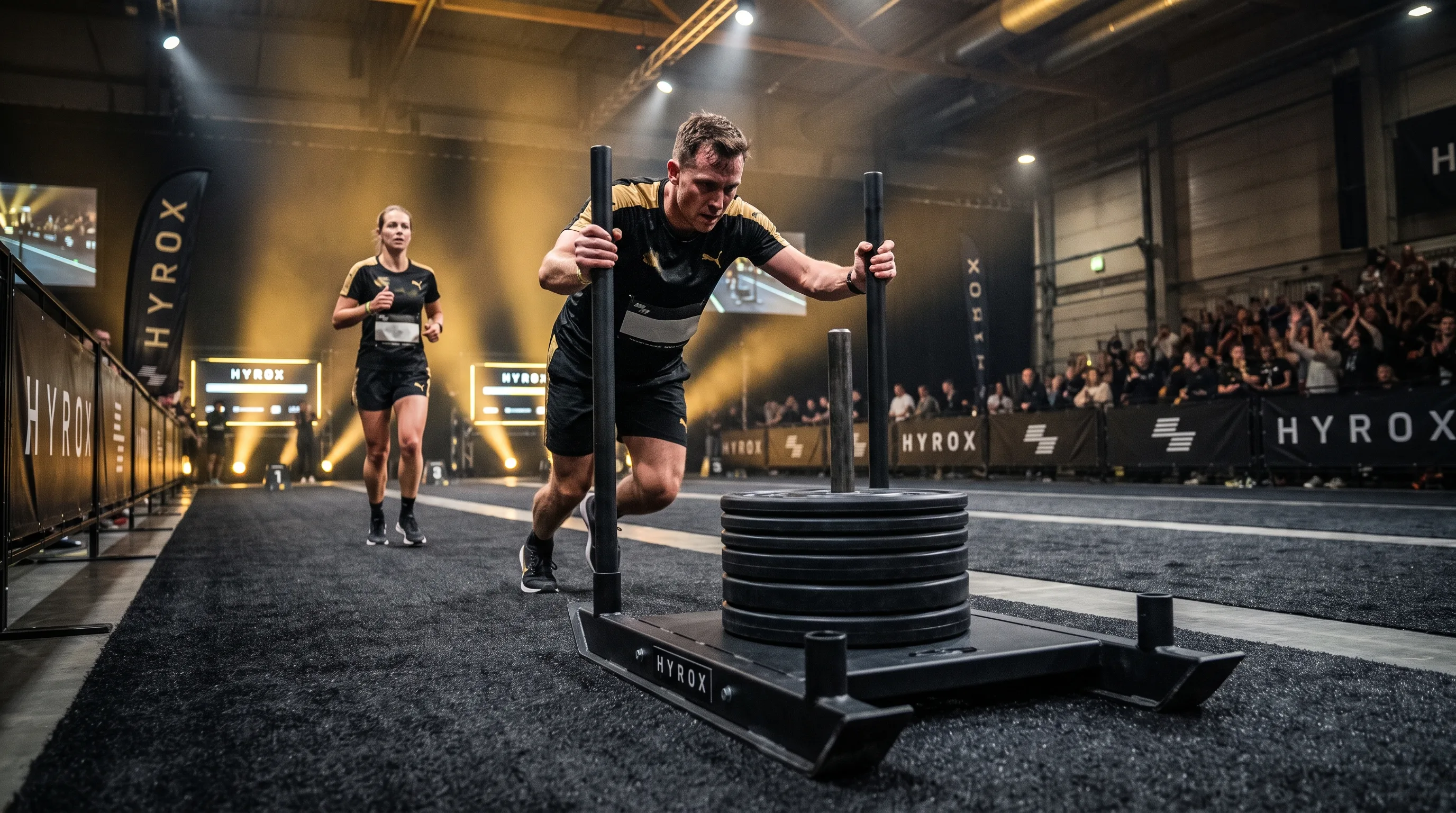
- A HYROX Doubles team races 8 runs of 1000 m and 8 functional stations as a pair, the same course a singles athlete covers alone.
- Doubles Men and Mixed push a 335 lb (152 kg) sled over 50 m, and Doubles Women push 225 lb (102 kg), according to the official Season 26/27 rulebook.
- Pro Doubles Men push 445 lb (202 kg) and Pro Doubles Women push 335 lb (152 kg), heavier than the Open doubles loads, since PRO divisions use heavier loads than Open.
- A doubles team completes 100 wall balls in total, the same rep count as a singles athlete, split between the two partners however they choose.
- Doubles runs as five divisions, Men's and Women's in both Open and Pro plus an Open-only Mixed, according to the official Season 26/27 rulebook.
HYROX Doubles is a two-person team format. You and your partner race the full HYROX course together: 8 runs of 1000 m and 8 functional stations. You run every run side by side, and at each station only one of you works while the other rests. You can trade places as often as you like, and the team still finishes the full station requirement, for example 100 wall balls between the two of you. The loads are the same as singles Open, so a shared station is never a lighter station.
What is HYROX Doubles?
A HYROX Doubles entry is a pair who tackle the whole race as one team. The format is the same as every other HYROX event: eight rounds, each a 1 km run followed by one functional workout station. The difference is the sharing. Instead of one athlete carrying the entire workload, two athletes split it, with one strict condition on the runs and one on the stations.
On the runs, you move together. On the stations, you take turns. That pattern, run as a pair and work one at a time, is the whole idea behind doubles, and it shapes everything from the pace you hold to the way you carve up the heavy stations.
Doubles vs singles
Singles and doubles cover the same 8-station course and the same 8 km of running. In singles you do all of it yourself. In doubles the station work is shared between two people, so each person handles less total volume at each station. The catch is that you are tied to your partner on every run, so you can only move as fast as the slower runner can sustain. The weights do not drop either. A doubles team lifts the same singles Open loads, just with two sets of hands to share them.
Doubles vs relay
Doubles and relay are often confused, but they split the work in different ways. Doubles is a pair who run every run together and share each station between them. A relay is a four-person team, part of the wider Singles, Doubles, Team Relay (4 athletes), and Adaptive lineup, that divides the race into legs so each athlete runs and works a portion before tagging the next. Put simply: doubles shares the load inside every station, while relay hands the whole race from one athlete to the next.
How HYROX Doubles works: runs, stations and the ROXZONE
The rules for doubles are short and worth learning before your first race. Both partners run all 8 runs together. Every movement between a run and a station happens through the ROXZONE, the central transition zone athletes run through between every run and station. Station work is always one athlete at a time. The official technical briefing below walks through the format, the waiting area and the penalties.
The running rule
Both partners must complete every 1000 m run together, side by side. You cannot take turns on the runs or let one partner bank a lap while the other rests. If a pair drifts too far apart, they risk a time penalty, so treat the run as a shared effort and keep each other close. In practice this means the faster runner reins it in and the pair settles on a pace both can hold for all 8 legs.

Station work and switching
At every station only one partner works while the other waits in the designated waiting area. The two of you never work the same station at the same time. Within that rule you have full freedom: split the reps or the distance any way you want, and switch as often as you like. Many teams call it a "you go, I go" rhythm, trading in short turns so neither athlete builds up too much fatigue. The team still has to complete the full station requirement before moving on, for example the whole 100 wall balls, no matter how you divide them.
The 8 stations in order
The stations always run in the same sequence, with a 1000 m run before each one: SkiErg, Sled Push, Sled Pull, Burpee Broad Jump, Rowing, Farmers Carry, Sandbag Lunges, Wall Balls, per the official Season 26/27 rulebook. That sequence puts the three non-loaded distance stations, the SkiErg over 1000 m, the burpee broad jump over 80 m, and the rower over 1000 m, on either side of the heavy sled work rather than grouped together. The order matters for your work split, because the heavy strength stations are spread through the race rather than clustered at one end. For a full breakdown of each station, its distance and its standards, see the HYROX stations guide.
HYROX Doubles divisions: Men's, Women's, Mixed, Open and Pro
Doubles runs as three team types, Men's, Women's and Mixed. Men's and Women's are each offered in Open and Pro, and Mixed has no Pro tier in the rulebook, which gives you five doubles divisions to choose from. A few events list a Pro Mixed race anyway; the rulebook publishes no loads for it, so your event page is the place to check. Doubles sits alongside the other formats HYROX runs: Singles, Doubles, Team Relay (4 athletes), and Adaptive. The loads a team lifts depend only on which of these categories it enters, and the core rule is simple: PRO divisions use heavier loads than Open.
Same-sex doubles
A Men's Doubles team uses the men's Open load class, so the sled push is 335 lb (152 kg), according to the official Season 26/27 rulebook. A Women's Doubles team uses the women's Open load class, with the sled push set at 225 lb (102 kg). Every other weighted station follows the same pattern: same-sex pairs lift their own gender's Open loads, and the reps and distances are identical to singles.
Mixed doubles
Mixed Doubles is where the load choice gets interesting. According to the official Season 26/27 rulebook, Mixed teams compete on the men's Open load class, so a mixed pair pushes the same 335 lb (152 kg) sled as a men's team, carries the same 2 x 53 lb (24 kg) kettlebells and lunges the same 44 lb (20 kg) sandbag. That is the single biggest strategic wrinkle in mixed racing: the female partner is working with the men's weights, which usually means the male partner absorbs more of the heavy sled and carry work. For every mixed station load, including ball weights, check the full doubles weights table and confirm against the current rulebook.
Open vs Pro doubles
PRO divisions use heavier loads than Open. In practice that means the sleds and carries jump up a level. According to the official Season 26/27 rulebook, a Pro Doubles Men team pushes 445 lb (202 kg), and a Pro Doubles Women team pushes 335 lb (152 kg). The reps and distances stay the same as Open; only the loads climb. One age nuance is worth knowing before you enter Pro: Athletes aged 60+ may race Pro at regular HYROX events but qualify for the World Championship through the Open division only, using Open weights at Worlds.
HYROX Doubles weights at a glance
Doubles uses the same reps and distances as singles. Only the sharing changes. According to the official Season 26/27 rulebook, the sled push, sled pull, farmers carry, sandbag lunges and wall balls all carry the singles Open load for the matching division. The table below shows the weighted stations for the Open categories, with a note on where Pro goes heavier. This is a quick reference, not the full grid, so use it to get oriented and then open the complete table for every division.
| Station | Doubles Women | Doubles Men, Mixed and Women Pro | Men Pro (heaviest) |
|---|---|---|---|
| Sled Push | 225 lb (102 kg) | 335 lb (152 kg) | 445 lb (202 kg) |
| Sled Pull | 172 lb (78 kg) | 227 lb (103 kg) | See full table |
| Farmers Carry (per hand) | 2 x 35 lb (16 kg) | 2 x 53 lb (24 kg) | See full table |
| Sandbag Lunges | 22 lb (10 kg) | 44 lb (20 kg) | See full table |
| Wall Balls | 100 reps at 9 lb (4 kg) | 100 reps at 13 lb (6 kg) | Heavier ball |
The reps and distances are the same as singles across the board; only the load and the way you share it change by category. For the complete per-division breakdown, see the HYROX doubles weights table.
Want to check any division against any station in kilos or pounds?
Open the weight standards toolWork-split strategy: who does which station
The rules give you total freedom on how to divide the stations, and that freedom is where doubles races are won. The guiding principle is simple: work hard, but never so long in one turn that you blow up. Switch before you fail, not after. A pair who trade in smart turns will beat a stronger pair who take giant sets and then stand around recovering.
Match partners to their strengths
Play to what each of you does best. The stronger lifter should take the bulk of the heavy stations: more of the sled push at 335 lb (152 kg) over 50 m, more of the sled pull over 50 m, and more of the farmers carry at 2 x 53 lb (24 kg) over 200 m. The faster or lighter partner should lead the burpee broad jump over 80 m and set the pace on the runs. In a mixed team the men's-weight sleds usually push more of that heavy work onto the male partner.
Switch early, switch often
On the erg stations and the wall balls, small frequent turns keep both heart rates under control. Trade the SkiErg over 1000 m and the rower over 1000 m in short blocks rather than grinding out a long pull. On the wall balls, break the 100 into small sets with fast swaps so neither of you ever goes to failure.

Pace to the slower runner
Both partners are tied together on every run, so the pair can only move at the slower runner's sustainable pace. Overcooking the runs is the classic doubles mistake. If the faster runner drags the pair along too hard early, the slower runner falls apart in the back half and the whole team pays for it. Lock in a run pace you can both repeat for all 8 legs, and spend the saved energy on the stations instead.
Picking a partner and building your race strategy around the pair you have
Partner selection is a work-split decision made before you ever line up. The pair you choose, or the pair you already have, sets the ceiling on how much a smart split can actually buy you. The table below keys off five common pairings and what each one should build its overall race strategy around, not which exact reps go to which partner on any one station. For the per-station load each partner is sharing, see the HYROX doubles weights table, which breaks down how to divide reps and handovers station by station.
| If your pair is... | Build your race strategy around... | Why |
|---|---|---|
| Mismatched in strength, one partner clearly stronger on the sled and carry stations | Letting the stronger partner anchor the heavy stations for the whole race, not just individual sets, and giving the weaker partner more of the technique work | The team only finishes a station once the full load is moved, so the pair's time is set by whichever combination clears each station fastest, not by an even split |
| Mismatched in running ability | Locking your race pace, not your station split, to what the slower runner can sustain for all 8 legs, then spending the gap you save as fresher legs at the stations | Both partners run every leg together, so the pace decision comes before any station decision and caps what a clever split can recover |
| One partner is new to the format or racing doubles for the first time | Rehearsing the changeover itself before race day, and giving the newer partner the more straightforward reps early while the experienced partner anchors the heaviest stations | A hesitant handoff on a first race costs more time than a slightly uneven load split, and only one partner works a station at a time so a clean switch matters every time you trade |
| Similar in strength and pace, no obvious mismatch either way | Rotating on a fixed count or a clock instead of working to failure, since the split itself will not decide the race | With no strength or pace gap to exploit, changeover speed and consistency become the actual differentiator between two evenly matched pairs |
| Training together regularly versus mostly training apart | A pair with little shared training time should spend it rehearsing changeover mechanics, who enters, who exits, who is already moving, rather than optimizing which partner takes which station | An unpracticed handoff loses more time on race day than a theoretically better split, and changeover timing is the one skill you cannot build training solo |
None of this changes what is on the sled or in the wall ball, only who is doing the work and when. For the per-station effort logic once your pair's strategy is set, our HYROX pacing guide breaks down where to push and where to hold back across the race.
Common HYROX Doubles mistakes
Most doubles time is lost in a handful of avoidable errors. Splitting everything fifty-fifty by default is the first one: matching stations to strengths beats an even split almost every time. Taking big fatiguing sets instead of frequent switches is the second, because a long turn that ends in a collapse is slower than two short clean ones. Drifting apart on the runs is the third, and it can cost a penalty on top of the lost rhythm. The last is a sloppy changeover in the ROXZONE: fumbled handoffs and unclear turns leak seconds every single station, and they add up fast over a full race.
How to train for HYROX Doubles as a pair
Doubles is a skill you rehearse together, not just fitness you build alone. Practice your changeovers until they are quick and quiet, so no station starts with a "your turn, no yours" scramble. Run at race pace as a pair so you both know the slower runner's honest speed before the day. Rehearse your station splits with the real loads, including the sled push at 335 lb (152 kg), so the turns feel automatic under fatigue. A structured plan keeps this on track: our HYROX training plan lays out the weekly work, and the pacing guide helps you set the run targets you will hold together.
HYROX Doubles FAQ
What is HYROX Doubles?
HYROX Doubles is a two-person team format where a pair races the full HYROX course together: 8 runs of 1000 m and 8 functional stations. Both partners run every run side by side, then share the work at each station, so neither one sits out.
How does HYROX Doubles work?
You and your partner complete eight rounds, each a 1 km run followed by one functional workout station. Both of you run every run together. At each station only one partner works at a time while the other waits, and you can switch as often as you like until the team has finished the full station requirement, for example 100 wall balls.
How much weight is used in HYROX Doubles?
Doubles uses the same loads as singles Open for that category. Men's Doubles sled push is 335 lb (152 kg) and Women's Doubles is 225 lb (102 kg). Pro Doubles goes heavier, at 445 lb (202 kg) for men. See the full doubles weights table for every station.
What weights do mixed doubles use?
Mixed Doubles teams compete on the men's Open load class, so the sled push is 335 lb (152 kg) and the sandbag lunge is 44 lb (20 kg). That is why many mixed pairs give the stronger partner more of the heavy sled and carry work.
Do both partners run in HYROX Doubles?
Yes. Both partners run all 8 runs of 1000 m together, side by side. You cannot split or take turns on the runs, so pace to your slower runner and save the sharing for the stations. Staying together also avoids a running penalty.
Can both partners work a station at the same time?
No. At every station only one partner works while the other rests in the designated waiting area. You can switch as often as you want, but the two of you never work the same station at once. On the runs, by contrast, both partners move together.
What is the difference between HYROX Doubles and Relay?
Doubles is a pair who run every run together and split each station between them. A relay is a four-person team, part of the Singles, Doubles, Team Relay (4 athletes), and Adaptive lineup, that divides the race into legs, so each athlete does a portion and then tags the next. Doubles shares within each station; relay divides across the race.
What HYROX Doubles divisions are there?
Doubles runs as Men's, Women's and Mixed pairs. Men's and Women's each come in Open and Pro, and Mixed is Open only in the rulebook. PRO divisions use heavier loads than Open. Mixed uses the men's Open load class, while same-sex divisions use their own gender's Open loads. Age-group rules also apply: Athletes aged 60+ may race Pro at regular HYROX events but qualify for the World Championship through the Open division only, using Open weights at Worlds.
Is HYROX Doubles easier than singles?
Not really, it just trades one kind of hard for another. Each partner does less total station volume, but you are pace-bound to each other on every run and lose time on changeovers. The weights are the same as singles Open, so a second pair of hands never buys you a lighter load.
How many wall balls are there in HYROX Doubles?
The team completes 100 wall balls in total, the same count as singles, split however the pair chooses. Most teams trade in small sets to stay fresh. The ball is 9 lb (4 kg) for women's and 13 lb (6 kg) for men's and mixed.
How do you split HYROX Doubles stations?
Match stations to strengths and switch before you fatigue. Put the stronger lifter on more of the sled push at 335 lb (152 kg) and the farmers carry, let the faster partner lead the burpee broad jump and the runs, and trade in small sets on the SkiErg, the rower and the wall balls.
How many burpees are in the HYROX Doubles burpee broad jump?
The burpee broad jump is measured by distance, not a fixed rep count: the team covers 80 m together. How many burpees that takes depends on each athlete's jump length, and the pair can split the distance however they like, usually leading with the faster jumper.
References
- Official HYROX Doubles Rulebook, Season 26/27: the primary source for the doubles format, the run-together rule, the one-at-a-time station rule, and every doubles load.
- HYROX, The Fitness Race: the official race format overview, covering the run-and-station structure, the ROXZONE, and the division lineup including Doubles.
- Red Bull, HYROX Singles vs Doubles: an outside look at the doubles categories and how the pacing and difficulty compare with singles.