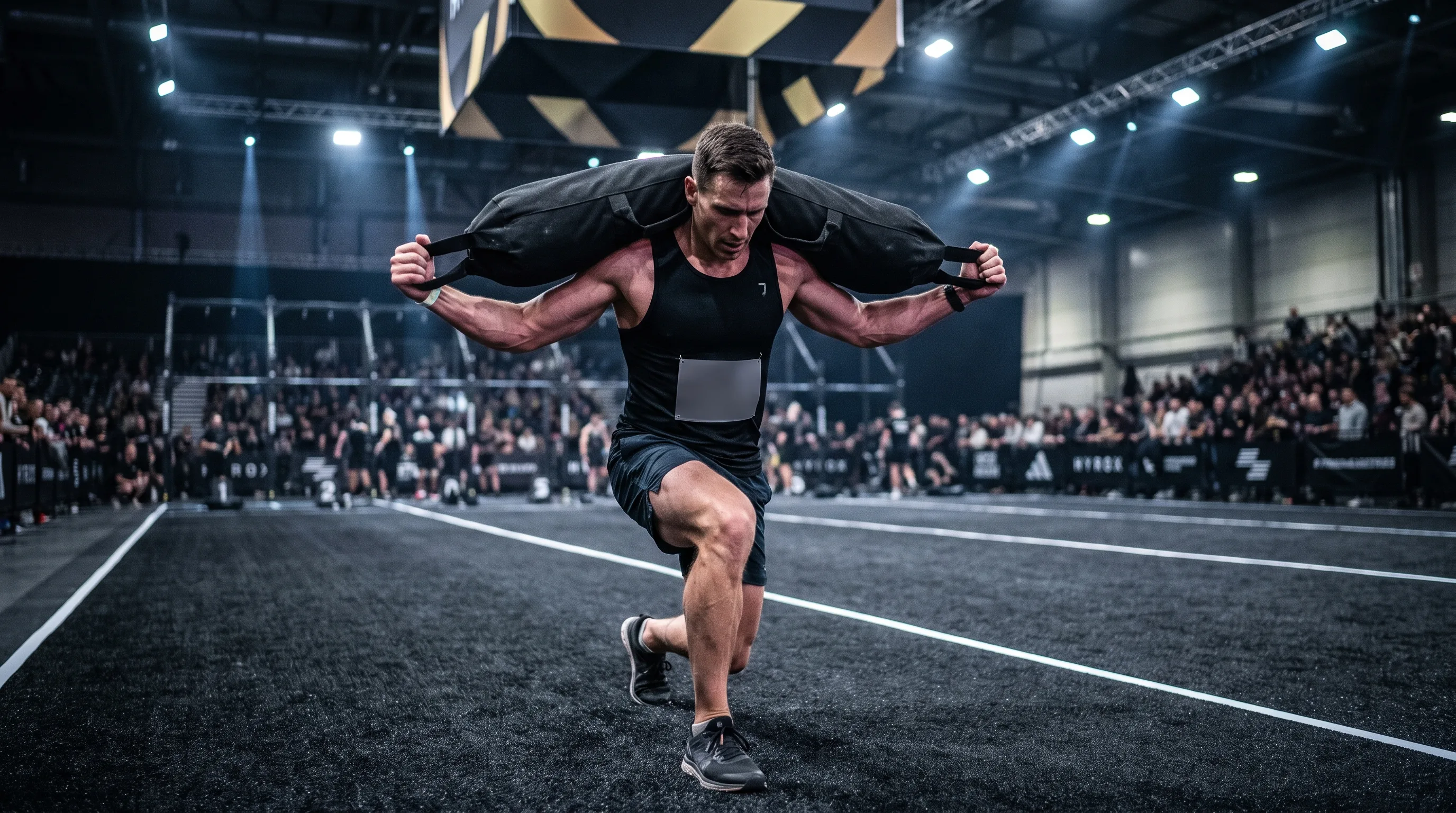
- Open Women lunge a sandbag load of 22 lb (10 kg), according to the official Season 26/27 rulebook.
- Open Men and Pro Women both lunge the same 44 lb (20 kg) sandbag.
- Pro Men lunge the heaviest bag on the station at 66 lb (30 kg).
- Every Open and Pro division covers the same 100 m sandbag lunge distance; only the load changes, never the length.
- The sandbag lunge is station 7 of 8, and most lost seconds here come from a bag sliding forward or a rushed trailing knee, not from the weight itself.
The HYROX lunge weight depends on your division. Open Women lunge with 22 lb (10 kg), Open Men and Pro Women both shoulder 44 lb (20 kg), and Pro Men carry 66 lb (30 kg). The distance is fixed at 100 m no matter which Open or Pro division you enter, and these are the loads listed for Season 26/27. Below you get the load by division, where the lunge falls in the race, and how to pace it without cooking your legs before wall balls.
HYROX lunge weight at a glance
Every Open and Pro division lunges the same 100 m carrying a sandbag, and the only variable is how heavy that bag is. The table below lists the official load and distance for each division.
| Division | Sandbag weight | Distance |
|---|---|---|
| Open Women | 22 lb (10 kg) | 100 m |
| Open Men | 44 lb (20 kg) | 100 m |
| Pro Women | 44 lb (20 kg) | 100 m |
| Pro Men | 66 lb (30 kg) | 100 m |
Notice that Pro Women and Open Men land on the exact same bag: 44 lb (20 kg). That overlap trips a lot of people up, so file it as a teaching point rather than a typo. If you want to check the load for any other station alongside the lunge, the weight standards tool lists every official figure by division.
Where the sandbag lunge sits in the race
The lunge is station 7 of 8, near the back end of the race. By the time you pick up the bag you have already run most of the 8 km of race running, so this is not a fresh-legs movement. Your quads are already loaded, your heart rate is high, and the lunge asks you to brace a bag overhead-of-shoulder while keeping balance. That context matters more than the raw number on the bag, because the same 44 lb (20 kg) that feels light in a warm-up feels very different at station 7.

Open vs Pro: why the HYROX lunge weight jumps
Put simply, PRO divisions use heavier loads than Open. The load climbs in a clean ladder: 22 lb (10 kg) for Open Women, up to 44 lb (20 kg) for both Open Men and Pro Women, then 66 lb (30 kg) for Pro Men. The jump from Open to Pro is purely about the weight on the bag. The 100 m you lunge does not change, and the movement standard does not change either. Pro athletes just move a heavier bag the same distance under the same fatigue.
Doubles and relay
In Doubles and relay formats each athlete lunges with the load that matches their own division, so a pair does not average their weights into one bag. For Mixed Doubles the sandbag is set to the men's column, 44 lb (20 kg), and both partners share the full 100 m between them. The bag is not allowed to touch the floor during a partner handover, which is the detail most new teams get wrong on their first attempt.
How the sandbag sits and moves
The bag rests across both shoulders behind your neck, and it has to stay there the whole way. You cradle the front of it with both hands, keep your chest tall, and brace your core so the load does not roll forward and pull you off balance. Then you alternate legs and lunge, with the trailing knee touching the floor on every single rep. Each lunge starts from a tall position with the hips and knees fully extended, so a rep only counts once you stand all the way up and then drop the back knee to the ground.

If you want to see the bag placement and knee-touch cue in motion, this breakdown walks through the whole movement and the most common faults.
Why the HYROX sandbag lunge burns your quads
The lunge is a station lots of athletes under-train because it looks simple on the equipment list, and the time it costs rarely shows up until race day. Here is what each symptom usually means and how to fix it before you get to station 7.
Your bag keeps sliding forward off your shoulders
If the load creeps down toward your neck or rolls off one side mid-lunge, the cause is almost always grip placement rather than the 44 lb (20 kg) bag being too heavy to hold. Reaching low on the bag lets it ride on soft tissue instead of bone, so it has nowhere stable to sit. Cradle the front corners high, pull your elbows up and in, and brace your core before you take the first step. A bag that stays put costs you nothing extra; a bag you have to re-seat every few steps costs you the whole lap.
Your trailing knee stalls before it reaches the floor
This shows up when fatigue shortens your stride: the step gets smaller, the drop gets shallower, and you end up bouncing on a half-lunge instead of completing the rep. The fix is tempo, not effort. Take a slightly longer step than feels necessary and let the back knee travel all the way down under control rather than rushing it. A controlled full-depth rep is faster over the whole 100 m than a string of shallow ones you have to repeat.
You stand up fully between every rep and it's bleeding time
Standing tall and resetting before each step feels safer, but it turns a continuous lap into a series of stops and starts. If your legs can handle it, switch to a true walking lunge: step straight through from one rep into the next without pausing at the top. Save the step-together, fully-reset style for the last third of the 100 m, once your legs are genuinely cooked, rather than defaulting to it from the first step.
Your quads lock up mid-lunge
By station 7 you have already covered most of the 8 km of race running, so quads that lock up mid-length are usually paying for pace spent earlier in the race, not for the sandbag load itself. Bank a little effort on the sled and farmers-carry stations before the lunge, and break the 100 m into shorter segments with brief resets rather than trying to grind it unbroken on legs that are already spent.
You picked the wrong bag position for your torso
A shorter torso often needs the bag sitting slightly higher, closer to the base of the neck, while a longer torso usually rides better with it a touch lower across the upper back. If the bag constantly wants to tip one direction, test both positions in warm-up rather than discovering the wrong one mid-lap. Retracting your shoulder blades to create a shelf for the bag matters more than raw strength here.
Pacing the lunge on tired legs
You have two ways to move down the lap: a true walking lunge where you step straight through into the next rep, or a step-together style where you stand fully between lunges. The walking version is faster but burns more, and the step-together version is slower but lets your heart rate settle. Most age-group athletes are better served breaking the 100 m into segments and using short rests at marked points rather than trying to go unbroken and blowing up halfway.
The reason to hold back here is what comes next. Wall balls are the final station, and they punish legs that are already shot from the lunge. Bank a little energy on the bag so you can keep your wall ball sets unbroken. For a full station-by-station plan, including where to spend and where to save across the whole race, see the HYROX pacing guide.
FAQ
How heavy is the HYROX lunge?
Open Women lunge 22 lb (10 kg), Open Men and Pro Women both carry 44 lb (20 kg), and Pro Men carry 66 lb (30 kg). The bag sits across both shoulders, and these loads are the standards for Season 26/27.
How far is the sandbag lunge?
It is 100 m, the same for every Open and Pro division. It is station 7 of 8, between the farmers carry and wall balls.
What is the HYROX lunge weight in pounds?
Open Women lunge 22 lb (10 kg), Open Men and Pro Women carry 44 lb (20 kg), and Pro Men carry 66 lb (30 kg). Each figure shows the pound value alongside the kilogram value.
What weight is the lunge in Mixed Doubles?
Mixed Doubles uses the men's column, 44 lb (20 kg). Both partners share the full 100 m between them, and the bag must not touch the floor on a handover.
Is the lunge weight different for women?
Yes. Open Women lunge 22 lb (10 kg), while Pro Women carry 44 lb (20 kg), the same load as Open Men. The distance stays 100 m for both.
What is the difference between Open and Pro?
In short, PRO divisions use heavier loads than Open. Pro Women step up to 44 lb (20 kg) and Pro Men step up to 66 lb (30 kg), while the 100 m stays the same.
What are the lunge rules?
The bag stays across both shoulders behind your neck for the whole 100 m, you alternate legs, the trailing knee touches the floor on every rep, and each lunge starts from a tall position. Dropping the bag is a penalty.
Which sandbag should I grab?
The competition sandbags are marked, so pick the one that matches your division (22 lb (10 kg), 44 lb (20 kg), or 66 lb (30 kg)) before you load up.
How many lunge steps is it?
There is no fixed rep count. You lunge the full 100 m, which works out to roughly 50 to 80 steps depending on your stride. Short controlled steps beat long unstable ones once your legs are tired.
Where does the lunge fall in the race?
It is station 7 of 8, after the farmers carry and before wall balls. It comes after most of the 8 km of race running, so you reach it on fatigued legs.
References
- HYROX 25/26 Singles Rulebook for weight, distance, and movement standards.
- HYROX 25/26 Doubles Rulebook for the Doubles and Mixed division mapping.
- HYROX official site for race format, divisions, and the ROXZONE.