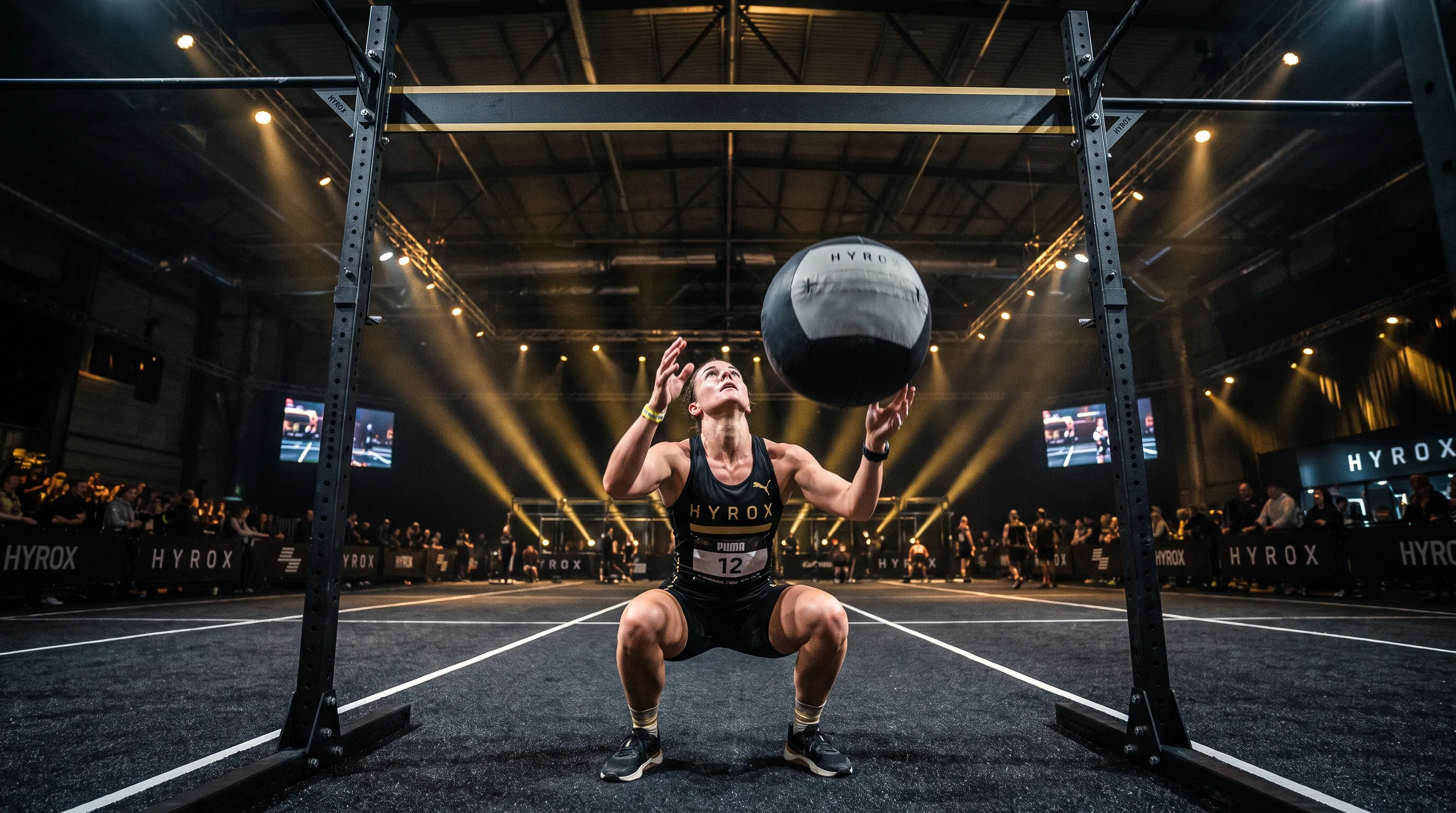
- Open Women throw a 4 kg (9 lb) wall ball to a 2.70 m target for 100 reps.
- Open Men throw a 6 kg (13 lb) wall ball to a 3.00 m target for 100 reps.
- Pro Women throw a 6 kg (13 lb) wall ball to a 2.70 m target for 100 reps.
- Pro Men throw a 9 kg (20 lb) wall ball to a 3.00 m target for 100 reps.
- Wall balls are the eighth and final station of 8, reached only after eight 1 km runs and seven other stations, which is why the set is where races fall apart.
- The rulebook sets 100 reps for every Open and Pro division; the 75-rep figure some guides still quote was retired for the 24/25 season and no longer applies.
The HYROX wall ball weight depends on your division. Open Women throw a 4 kg (9 lb) ball, Open Men throw 6 kg (13 lb), Pro Women throw 6 kg (13 lb), and Pro Men throw 9 kg (20 lb). All four complete the same 100 reps, and the target height is fixed by gender: 2.70 m for women and 3.00 m for men. These figures come from the official HYROX rulebook and are current for Season 26/27.
HYROX Wall Ball Weight, Reps and Target Height at a Glance
Here is the complete HYROX wall ball weight breakdown in one block: rep count, ball weight in kilograms and pounds, and target height for each of the four singles divisions. Read the row that matches your division and you have everything the station asks of you.
| Division | Reps | Ball Weight (kg) | Ball Weight (lb) | Target Height (m) |
|---|---|---|---|---|
| Open Women | 100 | 4 | 9 | 2.70 |
| Open Men | 100 | 6 | 13 | 3.00 |
| Pro Women | 100 | 6 | 13 | 2.70 |
| Pro Men | 100 | 9 | 20 | 3.00 |
Mixed Doubles uses the men's Open load class for wall balls, so a Mixed team throws the 6 kg (13 lb) ball regardless of who picks it up. To line every division up side by side, open the RoxTribe weight standards tool and switch brackets.

How Heavy Is the Wall Ball in Each Division?
The four divisions stack in a clean order. Open Women throw the lightest ball at 4 kg (9 lb), according to the official Season 26/27 rulebook. Open Men and Pro Women share the middle load of 6 kg, and that catches people out: a woman racing Pro throws the same wall ball as a man racing Open. Pro Men throw the heaviest ball at 9 kg (20 lb), per the same official Season 26/27 rulebook. Only the ball weight moves between brackets.
Open vs Pro: what actually changes
Going from Open to Pro changes one thing on this station, the ball. PRO divisions use heavier loads than Open. Open Men throw 6 kg and Pro Men throw 9 kg, a real jump that you feel most in the last twenty reps. The rep count stays at 100 and the target height stays the same within your gender, so Pro is not a different movement, it is a heavier one. If you only want the figures for a single bracket, the Open Men weight standards and the Open Women weight standards pages give you the wall ball plus every other station for that division.
Mixed Doubles and Relay wall ball weight
Doubles and Relay use the same per-division logic as Singles, with one rule worth memorising. Mixed Doubles sets the wall ball to the men's Open load class, so a Mixed team throws 6 kg (13 lb) no matter which partner takes the reps. Same-gender Doubles and Relay teams use the ball that matches their division and gender. Confirm your exact format against the current doubles rulebook before race day.
75 or 100 Wall Balls? The Rep Standard, Settled
The current HYROX wall ball rep count is 100 for every Open and Pro division: Open Women, Open Men, Pro Women and Pro Men all throw the same number. If you have seen a figure of 75 floating around, that is an old standard. Women's Open and the doubles formats moved up from 75 to 100 for the 24/25 season, first raced in Cape Town in September 2024, and the count has held at 100 ever since, including for Season 26/27. Any guide still quoting 75 reps is simply out of date.
This matters for pacing as much as for trivia. Planning your sets around the wrong number wrecks your final station, so build your race around 100 reps and treat 75 as history.
Wall Ball Target Height: Set by Gender, Not by Open or Pro
Target height tracks gender, not tier. Women and Women Pro throw to a 2.70 m target (roughly 9 ft), while Men and Men Pro throw to 3.00 m (roughly 10 ft). Racing Pro raises the ball weight, it does not raise the target. A Pro Woman throws a heavier ball than an Open Woman, but both aim at the same 2.70 m line. The metre figure is the authoritative one, and the feet conversion is an approximation for athletes who train against an imperial wall mark.

Why Your Wall Balls Start Missing the Target
Wall balls do not fall apart because the ball is too heavy. They fall apart because the set arrives last, on legs and lungs that eight runs and seven other stations have already spent. A rep only counts if the squat clears full depth and the ball strikes the target zone at your gender's height, 2.70 m for women and 3.00 m for men, under control. Most no-reps trace back to one of five fatigue-driven failures, not a lack of strength.
| Symptom | Cause | Fix |
|---|---|---|
| The ball lands short of the target line | Tired legs cut the drive out of the throw, so the arms try to make up the distance alone | Reset your stance and finish the extension through your hips on every rep, even if that means a shorter, more frequent break |
| Reps start getting no-repped for shallow squats | As the legs fatigue, squat depth creeps up until the hip crease no longer clears the top of the knee, the checkpoint a judge is watching for | Slow your tempo and consciously sit the hips back to full depth on every rep instead of chasing pace |
| The ball drifts away from the wall on the catch | Catching the ball out in front of the body instead of tight against it pushes the next throw off line | Catch and reset close to the wall so every rep starts from the same spot |
| Grip and shoulders give out late in the set | Wall balls are the eighth and final station of 8, arriving after eight 1 km runs and seven other stations have already taxed the same muscles | Break the set into planned short blocks with brief rests taken before failure, not one long unbroken attempt that collapses |
| The set falls apart around the same rep count every time | Training never rehearsed the full 100-rep count under fatigue, so race day is the first time the body meets that number tired | Rehearse the complete rep count at race pace on already-fatigued legs, not fresh, so the breakdown point moves later |
The Progrm's wall ball tutorial on YouTube is a useful technique watch for seeing correct squat depth and target contact in motion, though the rep and weight figures on this page are the ones that count on race day.
Where Wall Balls Sit in the Race, and Why That Matters
Wall balls are the eighth and final station. The full order runs SkiErg, Sled Push, Sled Pull, Burpee Broad Jump, Rowing, Farmers Carry, Sandbag Lunges, Wall Balls, so by the time you pick up the ball you have already run eight kilometres and cleared seven other stations across all 8 of them. Your legs are cooked, your grip is tired, and you still owe 100 reps to the target. So pacing the back half of the race decides this station: bank a little leg drive on the earlier stations and the wall balls feel survivable, empty the tank on the sleds and they feel impossible. For a station-by-station plan that protects your finish, see the HYROX pacing guide. As a culture note, the 100-unbroken patch popularised by Red Bull coverage has become a badge for athletes who clear the whole set without dropping the ball.
Practice With the Right Wall Ball Weight
Train with the ball your division actually uses. That means 6 kg for Open Men, 4 kg for Open Women, and the heavier Pro balls if you race Pro. Practising with a lighter ball flatters your numbers and leaves you short on race day. Throw to your gender's target height, 2.70 m for women and 3.00 m for men, and rehearse the full 100 reps under fatigue rather than fresh, because you never reach this station fresh. Small unbroken sets with short, planned rests beat hero sets that end in a long stand-around. To check the exact load for your bracket before a session, the RoxTribe weight standards tool has every division.
Frequently Asked Questions
How heavy is the HYROX wall ball?
It depends on your division. Open Women throw 4 kg (9 lb), Open Men throw 6 kg (13 lb), Pro Women throw 6 kg (13 lb), and Pro Men throw 9 kg (20 lb). The rep count and target height stay the same within your gender.
Is it 75 or 100 wall balls in HYROX?
It is 100 for every Open and Pro division in Season 26/27. The old 75 figure was retired when women's Open and the doubles formats moved up for the 24/25 season, first raced in Cape Town in September 2024. Any source still saying 75 is outdated.
How many wall balls are in HYROX?
Every Open and Pro division throws 100, and they are the eighth and final station of the 8. You reach them after eight one-kilometre runs and seven other stations, so the rep count is fixed but the fatigue is brutal.
What is the HYROX wall ball target height?
Target height is set by gender. Women and Women Pro throw to 2.70 m, and Men and Men Pro throw to 3.00 m. Racing Pro raises the ball weight, not the target.
What is the HYROX wall ball weight for women?
Open Women throw 4 kg (9 lb) to a 2.70 m target. Pro Women throw a heavier 6 kg ball to the same 2.70 m height, still for 100 reps, according to the official Season 26/27 rulebook. See your bracket on the Open Women weight standards page.
What is the HYROX wall ball weight for men?
Open Men throw 6 kg (13 lb) to a 3.00 m target. Pro Men throw a heavier 9 kg (20 lb) ball to the same height for 100 reps.
What is the difference between open and pro wall ball weight?
Only the ball weight changes. PRO divisions use heavier loads than Open. Pro Men throw 9 kg against Open Men at 6 kg, while the rep count holds at 100 and the target height is unchanged within your gender.
What is the Mixed Doubles wall ball weight?
Mixed Doubles uses the men's Open load class, so the team throws 6 kg (13 lb) wall balls regardless of which partner takes the reps. Confirm against the current doubles rulebook for your event.
When did HYROX change to 100 wall balls?
For the 24/25 season, first raced in Cape Town in September 2024. Women's Open and the doubles formats moved up from 75 to 100, and every Open and Pro division has thrown 100 since, including Season 26/27.
Why do my wall balls get no-repped?
A rep counts only if you squat below parallel, with your hip crease under your knee, and the ball hits the target centre at your gender's height, 2.70 m for women and 3.00 m for men. Shallow depth, a low or off-centre throw, or an uncontrolled catch all draw a no-rep.
What weight should I train wall balls with?
Match your division's ball: for example 6 kg for Open Men and 4 kg for Open Women. Rehearse the full 100 reps under fatigue and throw to your gender's target height, so nothing about the load is new on race day.
Is the HYROX wall ball the same as the CrossFit wall ball?
The movement is similar but the loads differ. HYROX Open throws 6 kg for men and 4 kg for women, to 3.00 m and 2.70 m respectively, for 100 reps as the final station of a long race rather than a standalone workout.
References
- Official HYROX Singles Rulebook, Season 26/27 (PDF). Primary authority for wall ball reps, ball weight, and target height.
- Official HYROX site. Primary source for race format, the eight stations, divisions, and the ROXZONE.
- Red Bull HYROX weights overview (2026). A reputable general overview of the station weights.