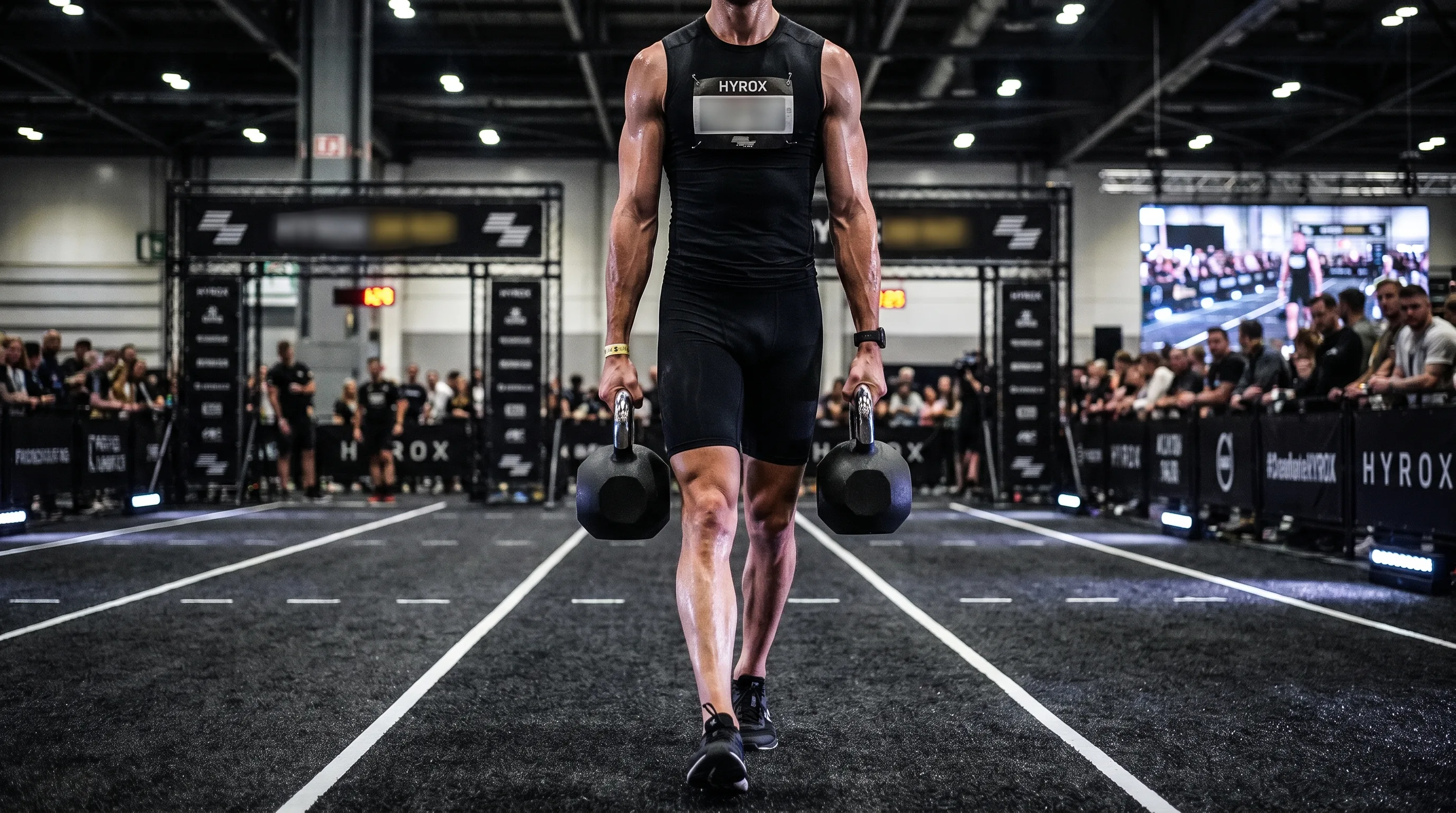
- Open Women carry 2 x 35 lb (16 kg) per hand in the HYROX Farmers Carry, according to the official Season 26/27 rulebook.
- Open Men carry 2 x 53 lb (24 kg) per hand, the same bell Pro Women carry, because PRO divisions use heavier loads than Open.
- Pro Women carry 2 x 53 lb (24 kg) per hand over the 200 m Farmers Carry lane.
- Pro Men carry the heaviest Farmers Carry load, 2 x 71 lb (32 kg) per hand, over the same 200 m every Open and Pro division walks.
- The Farmers Carry is station 6 of 8, and grip usually gives out before the legs do, because the Sled Pull at station 3 has already drained the forearms by the time you get there.
The HYROX farmers carry weight depends on your division, carried per hand over 200 m. It runs from 2 x 35 lb (16 kg) for Open Women up to 2 x 71 lb (32 kg) for Pro Men. The farmers carry sits 6th of 8 functional stations, with a 1000 m run on either side of it.
What is the HYROX farmers carry weight?
You pick up two kettlebells, one in each hand, and carry them the full 200 m lane. The load is set by division, according to the official Season 26/27 rulebook: Open Women take 2 x 35 lb (16 kg), Open Men 2 x 53 lb (24 kg), Pro Women 2 x 53 lb (24 kg), and Pro Men 2 x 71 lb (32 kg). The distance never changes between these divisions, only the kettlebell weight does. Because it lands after the row and before the sandbag lunges, you reach it already deep into the race. For the equipment itself and how to read the per-division loads, the HYROX kettlebell weight breakdown covers the bells; this page covers the carry.
Per hand, not combined
Every figure on this page is the weight of a single kettlebell, the one in each hand. HYROX never publishes a combined total, so do not double it. An Open Men carry is one 24 kg bell per hand, not a 24 kg total split across two. Reading the number as a pair is the most common mistake people make when they size up the station for the first time.

HYROX farmers carry weight by division (kg and lb)
Here is the full per-hand breakdown for Season 26/27. Each weight is the bell in one hand; the distance is the same 200 m in all four divisions.
| Division | Weight per hand | Distance |
|---|---|---|
| Open Women | 2 x 35 lb (16 kg) | 200 m |
| Open Men | 2 x 53 lb (24 kg) | 200 m |
| Pro Women | 2 x 53 lb (24 kg) | 200 m |
| Pro Men | 2 x 71 lb (32 kg) | 200 m |
For the rest of the field, the full per-station loads live on the RoxTribe weight standards reference. You can also jump straight to your division on the Open Men standards page or the Open Women standards page to see every station side by side.
Doubles, mixed and relay weights
Doubles and relay use the same per-division Open loads. In a mixed doubles pairing, the team carries the men's load class, 2 x 53 lb (24 kg) per hand. A mixed team relay works differently: each member races their own gender's Open loads on the stations they take, so the women on the team use the women's column and the men use the men's, so the women on the team carry 2 x 35 lb (16 kg) per hand on their leg and the men carry 2 x 53 lb (24 kg). Across Singles, Doubles and Relay the 200 m distance holds, so the kettlebell weight is the only thing that can shift between them. Adaptive is the exception: several Adaptive divisions carry a shorter distance or a single kettlebell, and our HYROX Adaptive guide names them.
Open vs Pro: how much heavier and why the farmers carry weight matters
Pro divisions raise the load, according to the official Season 26/27 rulebook. Pro Men carry 2 x 71 lb (32 kg) against Open Men's 2 x 53 lb (24 kg), and Pro Women step up to 2 x 53 lb (24 kg) from the Open Women 2 x 35 lb (16 kg). Here is a handy quirk: Pro Women and Open Men land on the same kettlebell, so a strong Open Men carry is a useful yardstick for a Pro Women athlete eyeing the heavier division. PRO divisions use heavier loads than Open
The jump is not just a bigger number. A heavier bell shortens how far you can carry before your grip starts to slip, which is why Pro athletes tend to plan their set-downs rather than gambling on one unbroken effort.
The farmers carry rules you can be penalised for
The movement standard is simple but strict. You hold the kettlebells with arms straight at your sides. You cannot rest the bells on your shoulders, hips, or any part of your body to take the load off your grip. You may set the bells down inside the lane to rest, but you cannot slide or kick them forward to gain distance. You finish by placing both bells inside the marked finish area, handles up, before the rep counts.
What the HYROX farmers carry weight costs your run
The load itself is moderate, but holding 2 x 53 lb (24 kg) for 200 m torches your forearms, grip, and upper back. That fatigue does not reset when you drop the bells. It follows you straight into the next 1000 m run and through the central transition zone athletes run through between every run and station. Arms that are already pumped make your turnover feel heavy and your shoulders tense, which quietly slows the run more than the carry slowed you.

Is it your grip or your legs failing over the carry distance?
Most racers blame the carry itself when it goes badly, but the 200 m lane rarely fails you on its own. It is station 6 of 8, arriving after the Sled Pull at station 3, the Burpee Broad Jump at station 4, and the Rowing at station 5, so whatever is left in your grip and legs when you pick up the bells is whatever every earlier station and run has left behind. Where in the lane you break down, and how often, tells you which one is actually the limiter, and the fix is different for each.
| What you notice over the distance | Likely cause | Fix |
|---|---|---|
| You set the bells down in the first half of the 200 m lane, every attempt | Raw grip and forearm capacity, not race fatigue, is the ceiling | Build unbroken carries at race weight well past 200 m while fresh, before worrying about fatigue sequencing |
| You are fine for the first half of the lane but your hands open up in the second half | Cumulative fatigue from the Sled Pull, Burpee Broad Jump and Rowing is catching up mid-carry, not the carry itself | Train the carry as the last leg of a station block instead of on fresh hands, so grip endurance under load is what improves |
| You keep re-gripping and setting down more than once per lane, and it is getting worse each attempt | Repeated set-downs compound: each re-pickup taxes the same fatigued grip again | Plan one deliberate set-down instead of drifting into several unplanned ones; a single brief reset beats three short ones |
| The bells swing and pull you off balance mid-carry even though your hands are not slipping | Hand position, not grip strength, is the problem: a loose or shifting hold lets the bell rotate | Set a full, closed grip and a tight torso before you lift, and keep the bells close to your legs so they cannot swing |
| Your hands slip late in the lane even though your grip strength feels fine | chalk may be used only at the sled pull and the farmers carry, and using it anywhere else is a 2-minute penalty, and skipping it is a common cause of a late slip | Chalk up before you pick the bells up, using only event-provided chalk, so a technique problem does not masquerade as a strength one |
| Your legs and hips feel heavy while your hands could still hold on all day | Leg fatigue stacked from the earlier running and stations, not grip, is the real limiter here | Treat the carry as a conditioning problem and train it after a leg-heavy block, not as an isolated grip session |
To tell which one is yours, run the carry in two states. First, carry 200 m at race weight completely fresh, with nothing done beforehand. If you break down before the halfway mark even fresh, the limiter is raw grip strength. Then repeat the same carry immediately after a Sled Pull, Burpee Broad Jump and Rowing block at race effort. If the fresh carry was unbroken but the fatigued one falls apart, the limiter is cumulative forearm fatigue from earlier in the race, not raw strength, and training the carry in isolation will not fix it. For the bell-load side of this same question, the HYROX kettlebell weight guide covers whether your race-weight bell itself is the bottleneck.
Strategy comes down to set-downs. Going fully unbroken looks fast but can leave your grip wrecked for the run. Planned brief set-downs, one or two inside the lane, cost a couple of seconds but keep your forearms alive for what comes next. Engaging your lats and bracing your core also takes load off the grip, so the bells feel lighter without you slowing down. If you want to see how this fits the wider race, the station-by-station pacing guide maps where to push and where to hold back.
How to train grip for the carry
Train the exact demand. Heavy carries at or above 24 kg per hand, held for time and distance, build the grip endurance the station asks for. Dead hangs grow raw holding capacity, and rehearsing clean pick-ups and put-downs makes your set-downs fast and controlled instead of clumsy. Adding upper-back and core endurance work keeps your posture intact when the bells start to drag you forward.
Frequently asked questions
How heavy is the HYROX farmers carry?
Per hand, by division: Open Women 2 x 35 lb (16 kg), Open Men 2 x 53 lb (24 kg), Pro Women 2 x 53 lb (24 kg), and Pro Men 2 x 71 lb (32 kg), all carried over 200 m.
How far is the farmers carry?
It is 200 m, the same for every Open and Pro division. It is the 6th of 8 stations and sits between two 1000 m runs.
Is the weight per hand or total?
Per hand. An Open Men carry is one 24 kg bell in each hand, written as 2 x 53 lb (24 kg). HYROX never lists a combined total, so do not double the figure.
What is the farmers carry weight for women?
Open Women carry 2 x 35 lb (16 kg) per hand and Pro Women carry 2 x 53 lb (24 kg), both over 200 m. The Pro Women load matches the Open Men kettlebell.
What is the farmers carry weight for men?
Open Men carry 2 x 53 lb (24 kg) per hand and Pro Men carry 2 x 71 lb (32 kg), both over 200 m. Pro Men is the heaviest load for Season 26/27.
What is the weight for mixed doubles?
A mixed doubles team carries the men's load class, 2 x 53 lb (24 kg) per hand. A mixed relay is the other way round: each member races their own gender's Open loads on the stations they take, so the women on the team use the women's column and the men use the men's, so the women on a mixed relay carry 2 x 35 lb (16 kg) per hand on their leg. That comes from the hyrox.com race-format listing (the Relay rulebook load table does not print a Mixed column). The distance stays at 200 m.
Can you put the kettlebells down?
Yes. You can set the bells down inside the marked lane to rest your grip over 200 m, as long as you do not slide them forward. Many athletes plan one or two brief set-downs on purpose.
Why is it so hard if the weight is light?
Because it is grip-limited, not strength-limited. Holding 2 x 53 lb (24 kg) for 200 m cooks your forearms and upper back, and that fatigue carries straight into the next 1000 m run.
How do I know if grip or legs are the real limiter on my farmers carry?
Test it in two states over the 200 m lane. Carry race weight completely fresh; if you break down before halfway, raw grip strength is the limiter. Then repeat it right after a Sled Pull, Burpee Broad Jump and Rowing block; if the fresh carry was unbroken but the fatigued one is not, cumulative forearm fatigue from earlier stations is the real problem, not grip strength itself, and the two need different training fixes.
How do you train for the farmers carry?
Heavy carries at or above race weight, held for time and distance, plus dead hangs, clean pick-up and put-down practice, and upper-back and core endurance. The goal is grip that lasts the full lane and recovers fast for the run.
Is the farmers carry weight the same for every division?
No. Across Open and Pro it ranges from 2 x 35 lb (16 kg) for Open Women up to 2 x 71 lb (32 kg) for Pro Men, per hand. Only the 200 m distance is constant across them. PRO divisions use heavier loads than Open.
References
- Official HYROX Singles Rulebook (2025/26): establishes the farmers carry station, the 200 m distance, the per-hand loads, and the kettlebell handling rules.
- HYROX: The Fitness Race: the official race-format page covering all 8 functional stations, including the farmers carry.
- Red Bull HYROX weights overview: a reputable third-party summary of division loads across the race.