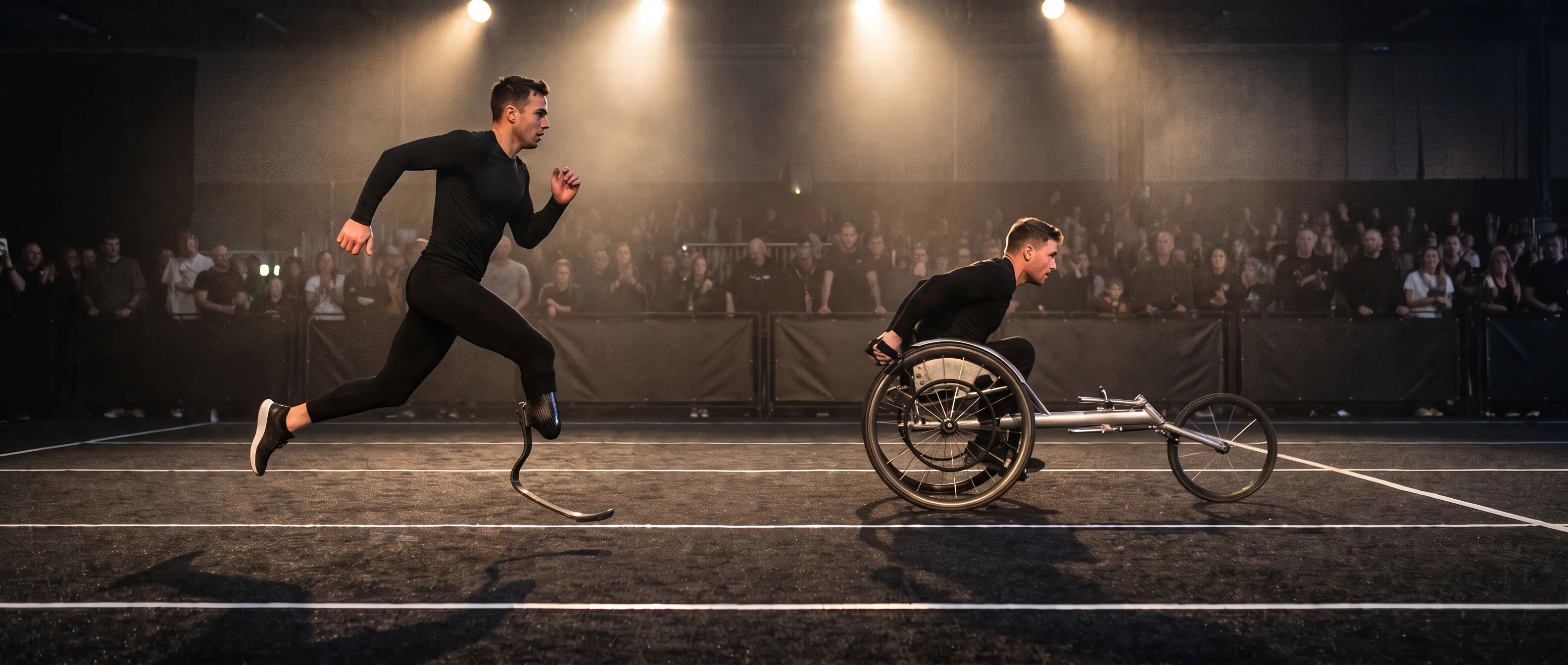
- HYROX publishes a separate Adaptive Rulebook for Season 26/27, and the copy on maintain.hyrox.com was re-issued in September 2026.
- Every one of the 8 HYROX stations has its own per-division table in the Adaptive Rulebook, so prescriptions change by division at every station.
- Seated HYROX Adaptive racers change how they move at every station; the Adaptive Rulebook also changes or offers alternatives to particular movements for Upper Limb, Lower Limb, Vision Impairment and Neurological Major racers, and for crutch, limited-jumping, single-arm and limited-knee-bending profiles.
- HYROX Adaptive racers must declare specialised equipment during registration on hyrox.com, and the Adaptive Rulebook gives no time allowance for setting it up or handling it in the race.
- Any HYROX Adaptive racer may race with a guide runner, handler or support person for orientation and navigation, but that person may not assist with the actual execution of the workout stations.
This guide is for an Adaptive athlete deciding how to race HYROX, or someone helping one enter. It maps each classification in the Season 26/27 Adaptive Rulebook, the edition re-issued on maintain.hyrox.com in September 2026, to the stations where the movement itself changes and what you do instead. It also says plainly what the rulebook leaves unpublished.
What HYROX Adaptive is, in the rulebook's own terms
HYROX lists its formats as Singles, Doubles, Team Relay (4 athletes), and Adaptive. The last of those runs on a rulebook of its own; our HYROX divisions guide covers the others. Section 5.1 of the Adaptive Rulebook names the divisions: Lower Limb Major and Minor, Upper Limb Major and Minor, Short Stature, Vision Impairment, D/deaf or Hard of Hearing, Neurological Major, Moderate and Minor, and the seated divisions, Seated With Hip Function (SWHF), Seated Without Hip Function (SWOHF) and Seated Without Core Function (SWOC).
Section 5.2 says racers must be officially classified, that the divisions are reserved for permanent impairments, and that temporary injuries do not qualify, giving knee or hip surgery as its example. If your impairment is not listed, the rulebook asks you to contact HYROX directly. Racers must be at least 16 years old on race day (Adaptive Rulebook, section 2.2).
The rulebook does not say how classification is assessed or by whom, or which events offer which divisions. Ask HYROX about both before you plan a season.
On language, section 4 sets an athlete-first principle, recognising every racer as an athlete first and their diagnosis second, and uses the term Adaptive athlete, as this guide does.
Find your classification: what changes in how you move
The first table is keyed to your classification and the second to how you move. Neither gives distances, loads or reps: those sit in section 8.3 for the run or push and in section 9 for the stations.
| Your classification | Where your movement or run changes | What you do instead (Adaptive Rulebook section) | Movement-profile rows that can also apply |
|---|---|---|---|
| Seated With Hip Function (SWHF), Seated Without Hip Function (SWOHF), Seated Without Core Function (SWOC) | Every station, and the run | Push the run segments (8.3). SkiErg and a separated rower from the chair, feet on the footplate (9.1, 9.5). Sled strapped to the chair and dragged until its front crosses the line (9.2). Sled pulled from the chair inside the racer's box (9.3). Front-chair dips (SWHF) or in-chair dips (SWOHF, SWOC), alternating with grid-length pushes (9.4). A single kettlebell on the lap, one hand on it, the other pushing (9.6). Sandbag lowered to the floor and back to the lap, then grid-length pushes, alternating sides (9.7). Each wall ball starts from the lap (9.8). | None (seated versions apply) |
| Upper Limb Major or Upper Limb Minor | Farmers carry; wall balls | A single kettlebell (9.6). Squat holding the ball without throwing it, or throw by choice (9.8). Major and Minor differ on grip aids (see the FAQ). | Burpee row for your tier; knee-bending row |
| Lower Limb Major or Lower Limb Minor | Sled pull and wall balls, both optional | Sled pull performed seated (9.3). A plyo box for stability in the squat (9.8). | Burpee row for your tier; carry and knee-bending rows |
| Vision Impairment | Wall balls (optional); the run | Squat-only wall-ball option (9.8). A mandatory non-elastic tether on the course, and a guide runner permitted (8.2, 8.4). | Carry and knee-bending rows; burpee rows not specified (see below) |
| D/deaf or Hard of Hearing | None | Standard movements; the division exists to remove communication barriers (5.2). | Carry and knee-bending rows; burpee rows not specified (see below) |
| Short Stature | The run (reduced lap count) | Standard station movements on shorter or lighter prescriptions, with a lower wall-ball target (section 9); a reduced run lap count (8.3). | Carry and knee-bending rows |
| Neurological Minor or Neurological Moderate | The run (reduced lap count) | Standard station movements; a reduced run lap count (8.3). | Burpee row for your tier; carry and knee-bending rows |
| Neurological Major | Wall balls (optional); the run (reduced lap count) | A plyo box for the wall-ball squat (9.8); a reduced run lap count (8.3). | Major burpee row; carry and knee-bending rows |
Profile rows can apply on top of your classification row. The rulebook splits the burpee rows by division tier and does not say which, if either, a crutch user or racer whose profile limits or prevents jumping in Vision Impairment or D/deaf or Hard of Hearing follows; ask HYROX.
| Your movement profile | Station where the movement changes | What you do instead (Adaptive Rulebook section) |
|---|---|---|
| Burpee row, Minor or Moderate division: crutch user, or a profile that limits or prevents jumping | Burpee broad jump | In-place burpees or walkouts, then crutch swings (swing-to or swing-through gait), or steps without crutches (9.4). |
| Burpee row, Major division: crutch user, or a profile that limits or prevents jumping | Burpee broad jump | In-place burpees or walkouts, then steps on the crutches in a point-gait pattern, or steps without crutches, over a shorter section (9.4). |
| Carry row: single-arm functional profile, or a crutch or other mobility aid | Farmers carry | A single kettlebell in one hand, the crutch in the other if you use one, or the standard pair by choice (9.6). |
| Knee-bending row: a profile that limits or prevents independent knee bending, particularly crutch users | Sandbag lunge | The sandbag on the shoulders while walking with crutches (9.7). |
Seated: SWHF, SWOHF and SWOC
Seated racers in SWHF, SWOHF and SWOC change how they move at every station under section 9 of the Adaptive Rulebook, and two may need arranging: bring your own sled straps, and if you need them placed, or need extra weights to steady the chair on the rower, tell staff upon registration and again before your start (9.2, 9.5).
At the sled pull, feet stay on the footplate and the chair may not sit on the solid lines of the racer's box while you hold the rope (9.3). The seated tables set shorter ergs, a shorter sandbag section, fewer sled-push lengths for women, and fewer wall-ball reps, falling from SWHF to SWOHF to SWOC, at a lower target with a lighter ball. SWOC is the one division whose women and men both race both sleds as a plain sled.
Upper Limb Major and Upper Limb Minor
Upper Limb Major and Upper Limb Minor racers both carry a single kettlebell and may squat holding the wall ball without throwing it (sections 9.6 and 9.8). Upper Limb Major also has shorter SkiErg and rowing distances and fewer sled-push lengths.
Lower Limb Major and Lower Limb Minor
Section 9.3 lets racers in "the Lower Limb division" perform the sled pull seated, without splitting Major and Minor, and section 9.8 gives the lower limb divisions a plyo box for stability in the wall-ball squat. Lower Limb Major also pushes the sled over fewer lengths and throws a lighter ball.
Vision Impairment, and D/deaf or Hard of Hearing
Vision Impairment racers may take the squat-only wall-ball option (section 9.8); their tether and guide-runner rules follow below. For D/deaf or Hard of Hearing, section 9 prints no movement substitution keyed to the classification itself.
Short Stature and the Neurological divisions
Short Stature and the Neurological divisions run a reduced lap count and keep the standard movements, apart from the Neurological Major plyo box and any profile row that applies. Short Stature, framed around limb length against standard equipment heights and wall-ball targets (section 5.2), gets shorter ergs, fewer sled-push lengths, a shorter burpee section, carry and lunge, and fewer wall-ball reps at a lower target with a lighter ball.
Neurological Moderate and Major get shorter ergs, a shorter carry and lunge, and a lower wall-ball target. Major also throws a lighter ball, its women push a plain sled, and women in both Moderate and Major pull one.
Crutch, jumping, single-arm and knee-bending profiles
At the burpee broad jump, the Adaptive Rulebook splits crutch users and racers whose profile limits or prevents jumping by division tier (section 9.4): Minor and Moderate divisions swing on the crutches, Major divisions step on them over a shorter section, and either may step without crutches instead. A single-arm profile or mobility aid allows the single-kettlebell carry (9.6), and limited knee bending allows walking on crutches with the sandbag on your shoulders (9.7).
The official briefing video, and where it differs from the PDF
HYROX's official technical briefing walks the stations in race order.
Run or push before each station, and the divisions on a reduced lap count
Every adaptive division races the stations in the standard order, with a run or push segment before each one (section 8). In the standard format those segments total 8 km, 8 of 1000 m each, and seated racers push them (section 8.3). Short Stature and Neurological Minor, Moderate and Major race a reduced lap count; every other division races the full distance. Our HYROX stations guide covers the order and each station.
Because the reduced count is set in laps, its distance depends on the venue's layout. Where a single lap covers a whole segment, the rulebook says HYROX will make every effort to accommodate the shorter distance, but that venue constraints may not always allow it.
Two rules apply to everyone: you count your own laps, with no time adjustment for extra ones (section 8), and racers at or quicker than the pace the rulebook sets must use the inside Fast Lane (section 8.3).
Adaptive equipment: declare it, and budget the clock for it
Section 8.2 of the Adaptive Rulebook defines adaptive equipment as any item used to compensate for an eligible permanent impairment, including prosthetics, wheelchairs, visual or hearing aids, and specialised grip aids. The limit is stated plainly: adaptive equipment must enable participation or protect the racer, and must not provide a mechanical advantage that exceeds the natural movement of a racer. Declaration is not optional: all specialised equipment must be declared at registration, and undeclared equipment that produces a significant performance jump can bring a time penalty or, in severe cases, disqualification.
The equipment regulations at the back of the rulebook word that consequence as the Head Judge adjusting the racer's rank. Under either wording, declare everything.
Section 8.2 also makes you liable for the structural integrity of your own equipment, permits daily-use chairs while encouraging sports wheelchairs, and gives a reasonable window to fix a failure. If the repair cannot be made safely or quickly, you must withdraw.
Compliance currently rests with the athlete, though the rulebook says HYROX is working toward formal safety and technical checks on the race floor. One thing does not widen: the adaptive clothing and accessories list is identical to the standard-format list, so the adaptive grip-aid permission comes from the adaptive-equipment rule and not from the clothing list. Our grip strength guide and HYROX gear rules cover that standard list.
Guide runners, handlers and support persons
Section 8.4 permits all racers to complete the race with a guide runner, handler or support person to help with orientation and navigation. You appoint them; HYROX does not provide one except where local legal requirements apply. They do not appear in the rankings and may not assist with the actual execution of any workout station.
For Vision Impairment racers, section 8.2 adds a tether rule: tethers are mandatory and must be non-elastic, and their length should be about arm's length.
Entering HYROX Adaptive, in the order that avoids a race-day problem
- Confirm your classification first. Ask HYROX how it is done, and contact them if your impairment is not listed.
- Register on hyrox.com, the only route the rulebook recognises (section 2.2): use "Register here" for your city, select your adaptive division and enter your details (section 3.1).
- Declare every piece of specialised equipment in that registration (section 8.2).
- Ask for any station setup you need upon registration and again before your start: sled straps placed (bring your own) or extra weights to steady your chair on the rower (sections 9.2 and 9.5). The Head Judge's team assigns station equipment and lanes, and approved adaptations are prepared in advance (section 9).
- Check your own weights on race day. Even with assigned equipment, choosing the correct kettlebells, sandbag and wall ball for your division is your responsibility (sections 9.6 to 9.8). The wrong weight at the carry or the lunge means repeating the whole station, or disqualification if you do not.
The World Championship route sits in our HYROX qualifying guide, not here. The weight standards tool shows the standard Open and Pro loads in kg and lb, not adaptive ones; do not set yours from it.
What the HYROX Adaptive rulebook says changes at mid-season
The appendix to the Adaptive Rulebook says Classification Codes will be formally introduced by mid-season, each identifying the primary area of impairment and its functional impact level. It also prints a Points System giving each sport class a functional value.
The appendix names Adaptive Doubles as the most notable new format the points support, and says a Doubles Points Cap will be implemented in the mid-season, so that a pair's combined functional points cannot exceed a set limit. The closing acknowledgements add a mid-season review of the codes and of upcoming formats.
The rulebook gives no calendar dates or events for Adaptive Doubles, no rules on how an adaptive pair shares the stations, and does not say outright whether a partner without an adaptive classification can join. Our guide to HYROX Doubles covers the standard format; do not assume its rules carry over. The functional point values are also a separate scale from the 2PT and 1PT labels on the upper-limb classifications.
Numbers to take from the rulebook itself
This page prints no adaptive weight, distance, rep count or lap count. That is deliberate. RoxTribe publishes a HYROX standard only after it has been checked against the official rulebook and signed off, and the adaptive tables have not been through that check yet. Read them in the PDF.
Some general lines in the PDF repeat standard-race wording that its own division tables contradict: section 1 and the opening of 8.3 on the run, 9.5 on the rowing distance and 9.8 on wall-ball reps. Section 5.1 points to 8.3 for the run exceptions, and the division tables carry each division's figures. Our HYROX penalties guide covers where the Adaptive penalty table differs.
Frequently asked questions about HYROX Adaptive
What does HYROX Adaptive Men or Adaptive Women mean?
It is the gender split inside each adaptive division. The rulebook differentiates divisions by gender as well as reps and weight, starts waves by gender, and prints separate women's and men's figures in most station tables. Classification picks the row; gender picks the column.
Has the HYROX Adaptive rulebook changed this season?
HYROX replaced the PDF at maintain.hyrox.com with a new edition in September 2026. Its appendix calls the rulebooks living documents and plans to bring in Classification Codes by mid-season, so a saved copy may already be out of date. Download the current one before each race.
Can you race HYROX Adaptive in a wheelchair?
Yes. Seated With Hip Function, Seated Without Hip Function and Seated Without Core Function are written for racing from the chair: you push the run segments, and every station has a seated version, from dragging the sled on straps fixed to your chair to wall balls that begin on your lap.
What is the difference between SWHF, SWOHF and SWOC in HYROX?
The seated divisions split by function. SWHF racers retain full or partial hip function, SWOHF racers lack hip function but may keep core function, and SWOC racers have neither. At the burpee broad jump, SWHF does front-chair dips and the others do in-chair dips.
What do 2PT and 1PT mean in HYROX Adaptive?
Section 5.2 attaches them to the upper-limb classifications. Under the rulebook, racers classified Upper Limb Major, designated 2PT, are permitted to use adaptive strapping or hooks for grip support. By contrast, racers classified Upper Limb Minor, designated 1PT, are not permitted adaptive strapping. Neither label is a score from the appendix's functional points system.
Which adaptive divisions can squat the wall ball without throwing it?
Upper Limb Major, Upper Limb Minor and Vision Impairment. Racers in those classifications can complete each rep as a squat while holding the ball, with no throw at the target, and anyone able to throw is still free to. Seated racers return the ball to the lap between reps.
Can you use a guide runner in HYROX Adaptive?
Yes, whatever your classification. Any racer may bring a guide runner, handler or support person for finding their way; you choose them, they are not ranked, and they may not assist in performing a station. Vision Impairment racers must also use a non-stretch tether, which the rulebook says should be about arm's length.
Do you get extra time to fit or adjust adaptive equipment?
No. Fitting, adjusting or removing adaptive kit counts against your race time, and the rulebook rules out both extra time and any deduction for it on fairness grounds. If a station needs setting up, such as sled straps, raise it when you register and repeat the request before you start.
Is there a HYROX Adaptive Doubles division?
The Adaptive Rulebook's appendix says it is being introduced, tied to the functional points system, with a cap on how many points a pair can combine. The PDF gives no calendar dates or events for it, sets no rules on how you split the stations, and does not say outright whether your partner needs a classification too. Ask HYROX first.
How do you enter HYROX Adaptive?
Online only, through hyrox.com: pick the event in your city, choose your adaptive division and declare all the specialised kit you will race with. You need an official classification before you enter. Station setup is a separate request to staff, upon registration and again before your start.
Before you enter, read your classification's rows in sections 8.3 and 9 of the Adaptive Rulebook, and have your equipment list ready for the registration form.
Open the Season 26/27 Adaptive Rulebook (PDF)References
- HYROX Adaptive Rulebook, Season 26/27, re-issued on maintain.hyrox.com in September 2026 (accessed October 2026). The source for every adaptive rule and section reference on this page.
- HYROX Singles Rulebook, Season 26/27, for the standard race format and the shared clothing list.
- HYROX Adaptive 2026-27 technical briefing, official HYROX YouTube channel, embedded above. Beyond describing the video, this page cites it only for the two points where it differs from the PDF.
- hyrox.com, the official HYROX site and the only registration route the Adaptive Rulebook recognises (section 2.2).
RoxTribe is an independent community resource and is not affiliated with HYROX.