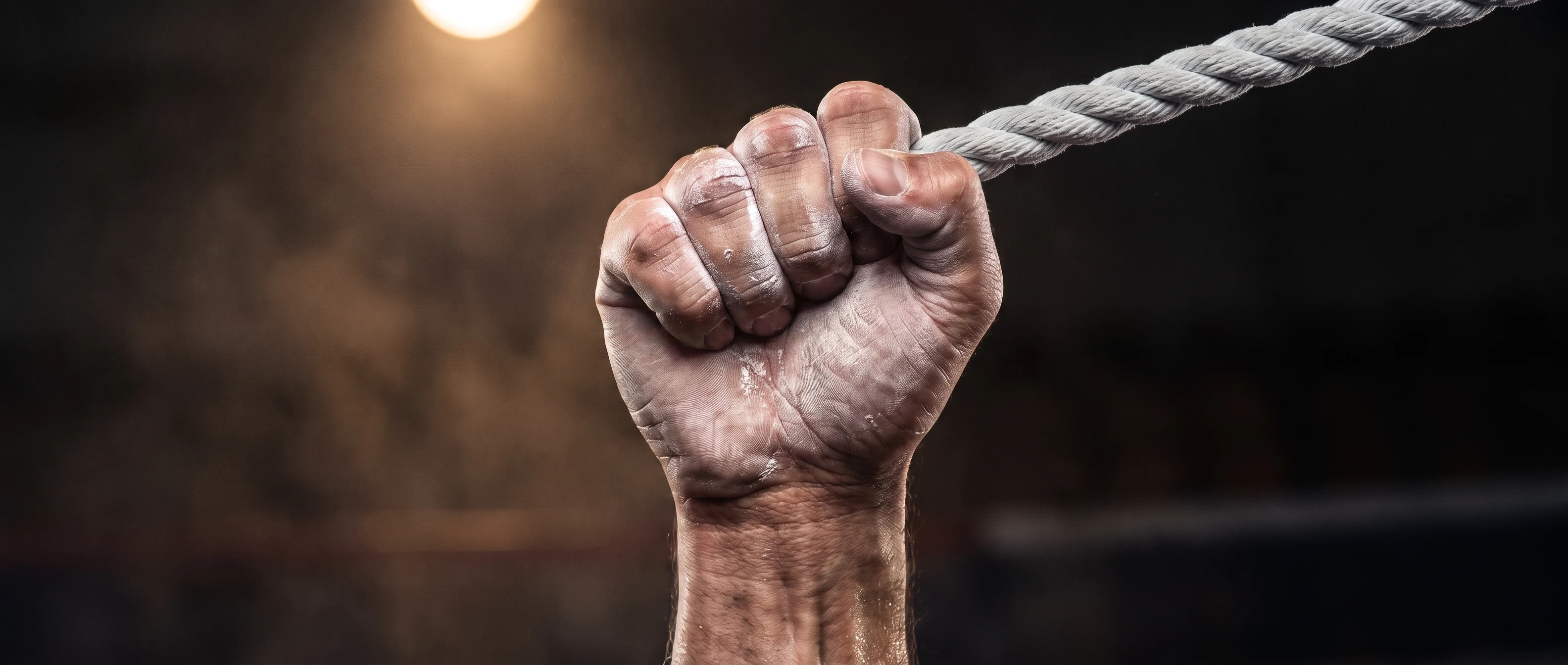
- Grip is rarely what you lack. It is what you spend. Across 8 stations it gets loaded again and again with no real recovery window in between.
- The sled pull and the farmers carry bill your hands directly, and they land in the middle third of the race.
- Support grip, the ability to keep holding on, fails long before crush grip, the ability to squeeze hard. Most people train the wrong one.
- Gloves are on the rulebook's permitted list. Grips are excluded on the same line. Straps are not listed at all, and the list is closed.
- Chalk is restricted: chalk may be used only at the sled pull and the farmers carry, and using it anywhere else is a 2-minute penalty. On top of that, only event-provided chalk is permitted, and using your own or carrying chalk away from a station is a 2-minute penalty per infringement.
Almost every HYROX grip guide treats this as a training-volume problem: do more hangs, do more carries, buy a gripper. The rulebook is the half nobody covers, and it is where the expensive mistakes live, because what you are allowed to put on your hands is a closed list and the chalk rule is narrower than the advice circulating about it. Both halves matter, so this page covers what actually fails, how to train it, and what the rulebook permits.
Why HYROX grip strength fails in a race and not in the gym
In the gym you grip once, fresh, for a short set, and then you put the thing down. HYROX runs as eight rounds, each a 1 km run followed by one functional workout station, so your hands get loaded repeatedly at a heart rate that is already near the top, with sweat on the palms and no true rest anywhere in the sequence. What fails first is not maximum strength. It is local endurance in the forearm flexors, and it fails on the second loaded station of the day rather than the first.
That reframes the problem. Grip in a race is a budget, not a max. You start with a fixed amount, every station draws on it, and the stations that draw hardest are not evenly spaced. Athletes who blow the budget early do not notice until the hand simply stops closing, which is usually somewhere in the back half of a carry.
Support, crush and pinch are three different things
Crush grip is closing your hand against resistance. It is what a hand gripper trains and what a firm handshake demonstrates. Support grip is holding a fixed position under load for time, which is what any heavy carry demands. Pinch grip is holding something between the thumb and the fingers with no hook to help you, which is what a smooth plate demands.
A HYROX race is almost entirely a support-grip event, with a small pinch component if you end up holding a sandbag by its edge. Buying a gripper and squeezing it at your desk trains the one quality the race asks for least. Strength in one does carry over a little to the others, but not enough to matter over 8 stations. Train the thing you are actually going to do.
What a compromised grip actually feels like
It arrives in a predictable order. First the forearm pumps and feels tight and hot. Then fine control goes, so the rope feels slippery and the kettlebell handle feels wider than it did. Then the hand opens. Not because you gave up, but because the muscle can no longer hold the position, and there is nothing you can say to yourself that changes that.
Writing for BOXROX, Jo Taylor describes exactly this pattern late in a race, with the hands failing while the legs still had something left. That is the useful part of the account: it is a local blood-flow and endurance problem, not a willpower problem. Treating it as a mental failure is why so many athletes never fix it.
The two stations that bill your grip
Two stations do most of the damage, and this article is not the place to learn either movement. For the sled pull technique itself, read our sled pull technique guide. For the carry, read the farmers carry technique guide. What follows is what each one costs your hands.
Sled pull
50 m of sled, run as 4 x 12.5 m, pulled hand over hand on a thick rope. The grip cost here is set by the rope diameter and the sheer number of reaches, not by the sled weight alone. A thick rope loads the fingers in a weaker position than a bar does, and you make that reach dozens of times.
One rules detail belongs here and nowhere else in this article. Singles Rulebook 26/27 section 8.3 item 6 requires the racer to stay standing and not to pull from a seated or kneeling position. That removes the option of bracing the rope against the body and hauling with your mass, so the hands carry more of the job than newcomers expect from watching the station from the side.
Farmers carry
200 m with a bell in each hand and the arms extended at your sides. This is the purest support-grip test in the race, and it is the one where the budget usually runs out.
The genuinely useful rule here, and one most coverage skips, is in Singles Rulebook 26/27 section 8.6. Item 4 permits putting the kettlebells down to rest, provided they do not move forward when placed on the ground. A planned set-down is therefore legal, and it costs you only the seconds it takes. Dropping the bells because your hand opened costs you those same seconds plus the reset, plus whatever the fumble does to your rhythm. Item 3 requires both arms extended by your sides, which rules out racking the bells against your chest to give the fingers a break.
| Load class | Sled pull | Farmers carry (per hand) |
|---|---|---|
| Open Women | 172 lb (78 kg) | 2 x 35 lb (16 kg) |
| Open Men | 227 lb (103 kg) | 2 x 53 lb (24 kg) |
| Pro Women | 227 lb (103 kg) | 2 x 53 lb (24 kg) |
| Pro Men | 337 lb (153 kg) | 2 x 71 lb (32 kg) |
Loads shown are Season 26/27. PRO divisions use heavier loads than Open, which on these two stations means the Pro Women column matches the Open Men column exactly. Check every load for your own division with the HYROX weight standards tool, and see the farmers carry weight reference for the full breakdown by division.
Where the bill comes due, which is not where it was run up
The order of the race matters here: SkiErg, Sled Push, Sled Pull, Burpee Broad Jump, Rowing, Farmers Carry, Sandbag Lunges, Wall Balls. The SkiErg at 1000 m and the row at 1000 m each add a low-grade tax on the forearms well before the carry, and almost nobody counts them. The sandbag at 44 lb (20 kg) for Open Men is held against the shoulders rather than gripped, but tired forearms still struggle to keep it seated where it belongs. And by the time you reach 100 reps with a 13 lb (6 kg) ball, catching and controlling that ball is a hand-endurance task as much as a leg task.
The only relief is the ROXZONE, the central transition zone athletes run through between every run and station, and it is measured in seconds rather than minutes. That is the whole argument for treating grip as something you budget across the race rather than something you find more of on the day.
What the HYROX rulebook allows on your hands
This is where most grip content goes wrong, so it is worth being precise. The permitted clothing and accessories list appears in every rulebook, at Singles section 10.1, Doubles section 10.1, Relay section 8.1 and Adaptive section 11.1, and it prints the same permitted items in the same order in every one of them. The table below is not that list: it pairs the entries that matter for grip with the items racers most often assume are permitted.
| Item | Status | Where it says so |
|---|---|---|
| Gloves [not grips] | Permitted, with grips excluded in the same entry | Singles 10.1, item 2 |
| Knee sleeves | Permitted | Singles 10.1, item 1 |
| Weightlifting belt | Permitted | Singles 10.1, item 3 |
| Wristbands | Permitted | Singles 10.1, item 4 |
| Lifting straps | Not on the list, and the list is closed | Absent from Singles 10.1, Doubles 10.1, Relay 8.1, Adaptive 11.1 |
| Wrist wraps | Not on the list, and the list is closed | Absent from every permitted list |
| Specialised grip aids | Adaptive equipment for eligible racers, declared at registration | Adaptive 8.2, item 1 |
The permitted list is closed, not illustrative
Each of those lists ends with the same sentence: "Any item not explicitly listed as permitted is, by default, prohibited." That single line is what does the work. Lifting straps are not banned by name anywhere in any rulebook. They are simply absent from a closed list, and absence is what makes them unusable. The same logic covers wrist wraps, tacky, grip pads and anything else you might be tempted to bring.
The list is not completely without an escape hatch. The rulebooks provide for written permission from the Race Director before the race starts, so the honest version of this is that anything unlisted is prohibited unless you have cleared it in advance, not that it can never happen.
Gloves yes, grips no, and the one exception
Item 2 on the permitted list reads "Gloves [not grips]". The bracketed exclusion is the rulebook's own text, not an editorial gloss, so the two are settled in a single line: gloves are in, gymnastics-style grips are out for Singles, Doubles and Relay.
Note also that the Adaptive rulebook still carries the same clothing list at section 11.1. The grip-aid permission comes from the adaptive-equipment rule, not from a relaxed clothing list, which is why it is tied to eligibility and declaration rather than being open to anyone who fancies it.
Chalk, and the mistake the training blogs are making
Chalk is permitted, but narrowly, and in two separate ways that both catch people. The first is about where: chalk may be used only at the sled pull and the farmers carry, and using it anywhere else is a 2-minute penalty. The second is about whose: only event-provided chalk is permitted, and using your own or carrying chalk away from a station is a 2-minute penalty per infringement.
That second rule is the one worth reading twice, because a great deal of HYROX training content recommends bringing your own liquid chalk in your kit. Under the current rulebooks that is precisely the penalised case. Use what the event puts out, at the two stations where it is allowed, and leave it there. Chalk does not travel with you either, so it is not available as a fix for hands that are struggling on the wall balls at the end of the race. Our HYROX gear guide and HYROX rules guide cover the wider kit and penalty picture.
How to train HYROX grip strength
Four things, in rough order of importance. The exercise prescriptions below follow Jo Taylor's BOXROX progressions, and the structure around them is coaching judgement rather than a tested protocol.

Train support grip for time, not crush grip for reps
Hangs from a bar are the backbone of this. Start at three sets of 30 seconds and build toward three sets of 60. Time under tension is the right currency, because time under tension is exactly what the race charges you. Counting reps of anything tells you very little about whether your hand will still be closed at the far end of a carry.
Carry heavier than race weight, for the race distance
Build toward 200 m unbroken with kettlebells above your division's race load. If you can only just complete the distance at race weight when fresh, you will not complete it on race day, because on race day you arrive at the station already deep into the budget. Going 10 to 20 percent over race load in training buys you the margin.
Make the handle harder, not just heavier
Towel-grip rows and towel-grip pull-ups replicate the thick, awkward, slightly-slipping feel of a sled-pull rope far better than a knurled bar does. Add thick-grip work where you have the equipment for it. For the pinch component, plate pinches at three sets of 30 seconds per hand are enough. A towel and a bar cover most of it.
Train it fatigued, because that is how you will meet it
This is the piece pure grip work misses. Put the carry after the row, or straight off a run, so that support grip is trained in the state it will be tested in. A carry done fresh at the start of a session tells you about your ceiling. A carry done with your heart rate at 170 tells you about your race. Our HYROX strength training guide and the wider HYROX training guide cover how to slot this into a week without wrecking your pulling sessions.
How often, and the tendon caution
Two or three short sessions a week is plenty, and the BOXROX article carries a warning worth repeating: do not take the hands to failure repeatedly in the early weeks. Tendons and ligaments adapt more slowly than muscle does, so the tissue that gets you injured is not the tissue giving you the feedback. Hands adapt slower than the enthusiasm that trains them.
Rich Ryan's breakdown of the sled pull covers the training and strategy side of the station where grip is most visible. It is a coaching video from a working HYROX coach rather than an independent review, and his own training app is linked in the description, but the technique and training chapters are a good demonstration of what this section describes:
Managing grip on race day
Spend it deliberately
Relax the hands on the reach phase of the sled pull instead of gripping continuously through the whole cycle, because the rope only needs holding on the pull. Chalk up at the two stations where it is legal, using what the event provides. And decide your set-down point on the carry before you start it, rather than discovering it at the moment your hand opens. A planned rest is a tactic. An unplanned one is a failure with the same time cost plus the panic.
The pre-race checklist
- If you wear gloves, wear them from the start of your race to the finish. Singles section 10.1 requires any permitted item to be carried from start to finish, and handing it to or taking it from anyone during the race counts as outside assistance.
- Do not pack your own chalk, in any form. Liquid chalk is the version people get caught with.
- Know that a set-down on the carry is legal so long as the bells do not travel forward, and pick roughly where you will take it.
- Check the current rulebook for your event and format before race day, because the formats are Singles, Doubles, Team Relay (4 athletes), and Adaptive, and the details do not always match across them.
HYROX grip strength: your questions answered
Is grip strength important for HYROX?
Yes, and it is more often the limiter than the goal. Grip is loaded across 8 stations with almost no recovery, and it is billed hardest at the sled pull and the farmers carry. Most athletes have plenty of grip strength and run out of grip endurance.
Are gloves allowed in HYROX?
Yes. The permitted clothing and accessories list in the Singles Rulebook 26/27 section 10.1 includes gloves. The same entry excludes grips in brackets. If you wear gloves you must keep them from the start of your race to the finish, and you cannot hand them to or take them from anyone during the race.
Are grips allowed in HYROX?
Not in the standard formats. The permitted list reads "Gloves [not grips]", and it closes by stating that anything not listed is prohibited by default. HYROX Adaptive is a separate rulebook: its section 8.2 recognises specialised grip aids as adaptive equipment for eligible racers, declared at registration.
Can you use lifting straps in HYROX?
Straps are not on the permitted list in any rulebook. Because that list closes with the statement that anything not explicitly listed is prohibited by default, straps are not usable. The only route around it is written permission from the Race Director before the race starts.
Can you use chalk in HYROX?
Only narrowly. The first rule is that chalk may be used only at the sled pull and the farmers carry, and using it anywhere else is a 2-minute penalty. There is a second constraint many athletes miss: only event-provided chalk is permitted, and using your own or carrying chalk away from a station is a 2-minute penalty per infringement. So the popular advice to pack your own liquid chalk describes the exact case the rulebook penalises.
Why do my forearms fail before my legs in HYROX?
Because grip is a local endurance system with a small muscle mass, loaded repeatedly at an elevated heart rate with sweaty hands. Your legs get partial recovery on the runs. Your hands get almost none, since the ROXZONE is measured in seconds rather than minutes.
Can you put the kettlebells down during the farmers carry?
Yes. The Singles Rulebook 26/27 section 8.6 permits putting the kettlebells down to rest, provided they do not move forward when placed on the ground. That makes a planned set-down a legal grip-management tool. The same section requires both arms extended at your sides, so racking the bells is not an option.
Which HYROX stations use grip the most?
The sled pull over 50 m, run as 4 x 12.5 m, and the farmers carry over 200 m. The SkiErg at 1000 m and the row at 1000 m add a smaller tax earlier, and the accumulated effect shows up late at the wall balls.
How do I train grip strength for HYROX?
Train support grip for time rather than crush grip for reps. Bar hangs from three sets of 30 seconds building to three sets of 60, heavy carries built toward 200 m unbroken, towel-grip rows and pull-ups for a harder handle, and plate pinches for the pinch component. Do some of it already fatigued.
How long should I be able to hang from a bar for HYROX?
A practical working target is three sets of 60 seconds, built up gradually from three sets of 30. The progression matters more than the number, because hand tendons and ligaments adapt more slowly than muscle. Taking the hands to failure repeatedly in early sessions is how people get hurt.
Does hook grip help on the HYROX kettlebells?
Not in the weightlifting sense. A true hook grip traps the thumb under the fingers against a barbell, and neither a kettlebell handle nor a rope allows it. What does help is letting the bells hang from relaxed, hooked fingers rather than crushing the handle, which spends far less forearm over 200 m.
Do heavier kettlebells make grip the problem, or is it the distance?
The distance, mostly. Load sets how hard the hand works per step, and it is fixed by your division, from 2 x 35 lb (16 kg) up to 2 x 71 lb (32 kg) per hand. But it is holding that load across 200 m while already fatigued that decides whether the hand opens.
References
- HYROX Singles Rulebook 26/27 (PDF), the authority for the chalk rules, the sled pull and farmers carry movement standards, and the permitted clothing and accessories list.
- HYROX Adaptive Rulebook 26/27 (PDF), the authority for specialised grip aids as declared adaptive equipment and for the classification profiles.
- BOXROX, "The Importance of Grip Strength for HYROX" by Jo Taylor, 2025, the source for the athlete account of grip failure and the exercise progressions.
- HYROX official site, race format and divisions.