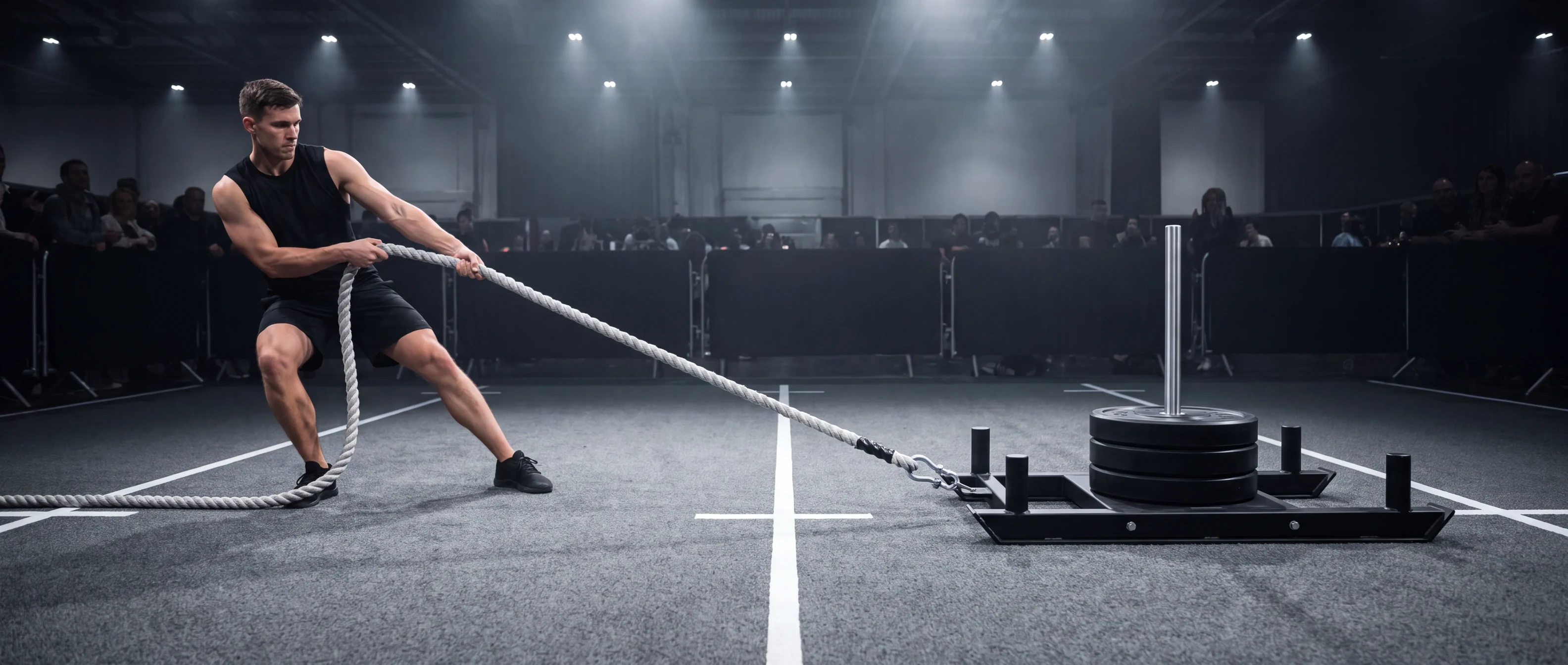
- The sled pull is station 3 of 8, covering 50 m inside your lane for every Open and Pro division.
- For Season 26/27 the loads are 172 lb (78 kg) for HYROX Women (Open), 227 lb (103 kg) for HYROX Men (Open), 227 lb (103 kg) for Pro Women and 337 lb (153 kg) for Pro Men.
- This is a hip and leg movement. Your arms are the connection to the rope, never the engine.
- Your feet stay behind the marked line inside your box for the whole station. Stepping over it is the single most common avoidable fault.
- Pull the slack out of the rope before you commit your bodyweight, or your first hard effort moves nothing at all.
What is the HYROX sled pull?
The sled pull is station 3 in the fixed HYROX sequence: SkiErg, Sled Push, Sled Pull, Burpee Broad Jump, Rowing, Farmers Carry, Sandbag Lunges, Wall Balls. Standing inside a marked box, you haul a loaded steel sled 50 m toward you with a rope, hand over hand, until the total distance is covered. Your feet stay behind the line the whole time. The load depends on your division.
Where it lands in the race is half the story. HYROX runs as eight rounds, each a 1 km run followed by one functional workout station, so you arrive at the rope with the sled push already sitting in your legs and another 1000 m leg waiting the moment you finish. Athletes describe it the same way every time: it looks like the easiest station on the floor, and then your forearms are gone two lengths in. Our guide to the HYROX stations in order maps where every station sits.
How far is the HYROX sled pull?
50 m in total, identical for every Open and Pro division. The Singles rulebook sets that out in section 8.3 as four lengths of 12.5 metres, run out and back inside your own lane, and the station is only complete once you have finished all four and the entire sled has crossed the line. The same four-by-12.5 layout applies to the sled push.
What you are actually pulling
| Division | Sled pull load | Distance |
|---|---|---|
| HYROX Women (Open) | 172 lb (78 kg) | 50 m |
| HYROX Men (Open) | 227 lb (103 kg) | 50 m |
| HYROX Pro Women | 227 lb (103 kg) | 50 m |
| HYROX Pro Men | 337 lb (153 kg) | 50 m |
Those figures are the total loaded sled you drag for Season 26/27, frame plus plates, not the plates on their own. PRO divisions use heavier loads than Open. For the complete breakdown, including doubles, relay and the kilogram and pound split, see the full sled pull weight by division, or pull your exact loads in the weight standards tool. Knowing the number is the easy part. Moving it is what the rest of this page is about.
HYROX sled pull technique, step by step
Five things, in order. Get the first two right and the rest mostly takes care of itself.
- Set up at the front of the box with your feet behind the line and your hips loaded back.
- Take the slack out of the rope with straight arms before you add any bodyweight.
- Break the sled loose with hip extension, not with a pull.
- Keep it moving with short, rhythmic pulls and a consistent backward lean.
- Manage the rope so it lands somewhere other than where you are about to step.
Set up: box, line and stance
Feet at the front of the box but clearly behind the line, roughly hip width. Hips pushed back, chest down, arms long. This is a deadlift setup, not a tug-of-war stance.
Setup is what makes the first pull cheap or expensive, and almost nobody treats it as worth the two seconds. Stand up too tall and you have no lever, so the only thing left to pull with is your arms. Crowd the line and you spend the whole station being told to step back.
The engine is your hips and legs, not your arms
This is the highest-value coaching point on the station, and the one every experienced racer keeps repeating to newer ones. Arms locked out and straight, working as hooks. Lats braced. The movement comes from hip extension and from your bodyweight shifting backward.
Arm-dominant pulling works for about half a length, then stops working. Your forearms fatigue far faster than your posterior chain does, and once grip goes you cannot get it back mid-station. At a Pro Men load of 337 lb (153 kg) the maths is even blunter: the sled will not break friction on grip strength, no matter how hard you squeeze. The rope is a connection between the sled and your hips. Treat it as anything else and the station wins.

Take the slack out first
Rope stretches, and a rope lying loose on the turf has plenty of give in it. Launch your bodyweight into a slack rope and you spend a maximal effort moving nothing, arrive at the end of your range with the sled still parked, and then have to start it from a dead stop with no leverage left. That is one of the most expensive mistakes available on this station and it happens in the first three seconds.
Pull to tension with straight arms. Feel the sled load up. Then commit.
Keep the sled moving
A sled already in motion is dramatically cheaper to move than a sled restarting. Static friction on the HYROX turf is significantly higher than the friction of a sled that is sliding, which means every full stop charges you the break-loose cost again. Short, rhythmic, continuous pulls beat big yanks separated by pauses, every time, even though the big yanks feel more productive while you are doing them.
Hand over hand or step back? Choosing your technique
There are two main families, and the argument about which is better misses the point. They solve different problems.
Hand over hand means bracing in position and drawing the rope in with alternating hands, staying more or less planted. Step back means gripping the rope, leaning away from the sled so your bodyweight does the work, walking backward within your box, then resetting your grip and repeating. Plenty of athletes run a hybrid: step back to break the sled loose, then switch to hand over hand once it is sliding.
| Method | Best when | What it costs | Main risk |
|---|---|---|---|
| Hand over hand | The load is light relative to your strength and your grip is still fresh | Grip and forearms | Forearms fail early and you have nothing left for the farmers carry |
| Step back | The load is heavy relative to your strength, or your grip is already fading | Legs, posterior chain and floor space inside the box | Wasted time resetting your grip, and drifting toward the line |
The decision rule is relative load, not preference. Heavy for you means step back. Light for you means hand over hand is faster because there is no reset between pulls. If you are unsure which side of that line you fall on, start with the step back to get the sled moving and see how it feels once it is sliding.
This coach-led walkthrough covers the setup, the technique variations and the penalties in under five minutes.
Rope management, the hidden time sink
Nobody trains this and it costs real seconds. As the sled comes toward you, the rope you have already pulled has to go somewhere, and left to itself it goes exactly where your feet want to be.
Feed the slack to one side, consistently, so a pile builds beside you rather than under you. Pick a side before you start and stick to it. On the direction change, most athletes are better off keeping light contact with the rope rather than dropping it entirely, because a dropped rope lands in a heap and you then spend the first pull of the next length untangling it instead of moving the sled. Keep everything inside your own lane too. A rope wandering into your neighbour's box is both a courtesy problem and a trip hazard for two people.
The rules a judge enforces on the HYROX sled pull
The standard here is simpler than most stations, which is exactly why judges catch so much of it.
- You and the sled start behind the line. Both, not just one.
- Your feet stay behind the marked line at all times. Not on it, not over it. This is the fault that gets called more than any other.
- You stay inside your box and your lane for the whole station.
- The sled fully passes the 12.5 m mark before it changes direction. Close enough is not across.
- You do not touch or reposition the sled by hand where the rules do not allow it. The rope is the tool.
Miss the standard and it is a no-rep: you redo the work, there is no invented fixed time deduction bolted on top. That is the same principle that runs through the whole race, and our guide to how HYROX judging and no-reps work covers it station by station. The official rulebook is the authority for the exact wording, and it is linked below.
The most common sled pull faults
- Stepping over or in front of the marked line.
- Starting the pull with slack still in the rope.
- Pulling with bent arms, turning the station into an upper-body exercise.
- Standing too upright, so there is no leverage available.
- Letting the sled stop dead between pulls.
- Letting the rope tangle across your own feet.
- Drifting outside the box or into the neighbouring lane.
HYROX sled pull vs sled push: why the pull often feels harder
Both stations cover the same ground: 50 m for the push and 50 m for the pull. The push is the heavier absolute load, at 335 lb (152 kg) for Open Men against 227 lb (103 kg) on the pull. Yet ask around after a race and plenty of athletes name the pull as the worse of the two.
Three reasons. First, the pull recruits grip and posterior chain in a way the push simply does not, and grip is the quality most amateur athletes have trained least. Second, sequencing: the pull is station 3 and it comes one run leg after the push at station 2, so you walk into it with legs that were emptied minutes earlier. Third, the technique window is narrower. On the push, bad technique is slow. On the pull, bad technique can stop the sled entirely, and a stopped sled is a fresh break-friction cost every single time.
If you want the other half of the comparison, our guide to the sled push loads covers that station's numbers in full.
What the sled pull costs you later in the race
This station bills you twice, and the second invoice arrives later.
Grip fatigue follows you to the farmers carry: 200 m at 2 x 53 lb (24 kg) per hand for Open Men, on forearms you have already emptied. Posterior-chain fatigue carries into whatever remains of the 8 km of running. And both show up first in ROXZONE, the central transition zone athletes run through between every run and station, where a redlined sled pull turns a jog into a walk without you consciously deciding anything.
So the argument is not about being tough. Pulling the sled at ninety percent and being able to run afterwards beats a hundred percent sled pull and a walked lap, every time, by a margin that is not close. The clock does not care which station you spent the effort on.
How to train the HYROX sled pull
The awkward truth first: most gyms do not have a sled rope, which is why this station is so under-practised and why the question keeps coming up in every HYROX community thread. There are two branches depending on what you can get access to.
If you have a sled and a rope. Pull at race weight over short lengths with fixed rest, and make repeatability the metric rather than a single fast effort. Six honest lengths at a consistent pace tells you more than one heroic one. Then start some sessions pre-fatigued, after a run or an interval block, because tired legs change the technique that works and you want to find that out in training.
If your gym has no rope. Build the same qualities separately. Heavy sled drags with a waist belt or shoulder strap cover the leg-drive pattern. Seated rope or cable pulls train the pulling position. Heavy rows, deadlifts and general hip-hinge strength build the engine. Then add dedicated grip work, because grip is the thing most likely to be your limiter on race day and it is the easiest quality to train without any specialist equipment at all.
Structured weeks that build this sit in our HYROX training guide, and individual sessions you can drop into a week are in our HYROX workouts library.
Training at the wrong load teaches you the wrong technique. Confirm your division before your next sled session.
Sled pull in Doubles and Relay
HYROX runs as Singles, Doubles, Team Relay (4 athletes), and Adaptive. In Doubles only one partner works the station at a time and the pair swaps as they choose, at 227 lb (103 kg) for mixed doubles and 172 lb (78 kg) for women's doubles. Relay teams share the same sled: 227 lb (103 kg) for men's relay and 172 lb (78 kg) for women's relay. In a mixed relay, each member races their own gender's Open loads on the stations they take, so the women on the team use the women's column and the men use the men's.
The practical decision is where to swap. Swap by length rather than by feel, agreed before the race, because the partner currently on the rope is always the worst available judge of how much they have left. Give the resting partner a job too: resetting the rope so the incoming partner starts on a clean line rather than a tangle is worth more than standing there breathing. Our guide to how Doubles pairs split the sleds covers the wider work-split strategy.
Frequently asked questions
How much weight is the sled pull at HYROX?
For Season 26/27 the load is 172 lb (78 kg) for HYROX Women (Open), 227 lb (103 kg) for HYROX Men (Open), 227 lb (103 kg) for Pro Women and 337 lb (153 kg) for Pro Men. That is the total loaded sled, frame included. Full per-division detail sits on our sled pull weight page.
How far is the HYROX sled pull?
Every Open and Pro division covers 50 m in total, regardless of load. The Singles rulebook splits that into four lengths of 12.5 metres, out and back inside your own lane, and the sled must pass the 12.5 m mark completely before it changes direction.
What are the sled pull rules in HYROX?
You and the sled both start behind the marked line. You stay inside your box and your lane for the whole station, with your feet behind the line at all times. The sled must fully pass the 12.5 m mark before you change direction. A judge watches the standard throughout, and a missed standard is a no-rep you redo.
Is the HYROX sled pull harder than the sled push?
Many athletes find it harder despite the lighter load, since the push is 335 lb (152 kg) for Open Men. The pull taxes grip and posterior chain, it lands at station 3, with only a run between it and the push at station 2, and its technique window is narrower, so a poor setup costs you more.
What is the proper form for the HYROX sled pull?
Set up at the front of the box with your feet behind the line, hips loaded back like a deadlift, chest down and arms long. Take the slack out of the rope with straight arms, then break the sled loose with hip extension. Keep short, rhythmic pulls going so the sled never fully stops.
Should you go hand over hand on the sled pull?
It depends on the load relative to your strength. Hand over hand works well when the sled moves easily and your grip is fresh. At heavier loads, such as the Pro Men figure of 337 lb (153 kg), a leg-driven step-back method usually moves the sled with far less grip cost. Many athletes mix both.
What muscles does the HYROX sled pull work?
Primarily the posterior chain: glutes, hamstrings, lats and lower back, driven by hip extension. Grip and forearms take a heavy load because you hold rope tension throughout, and your core braces against the sled the entire time. Quads contribute on the drive and on the walk back.
What are the most common HYROX sled pull mistakes?
Starting to pull with slack still in the rope, pulling with bent arms so it becomes an upper-body exercise, standing too upright and losing leverage, letting the sled stop between pulls so you pay break friction repeatedly, tangling the rope across your own feet, and stepping over the marked line.
How do you train the sled pull if your gym has no rope?
Build the same qualities without the exact movement. Heavy sled drags using a waist belt or shoulder strap, seated rope or cable pulls, heavy rows, and hip-hinge strength work cover the engine. Add dedicated grip work so your forearms are not the limiting factor. Recreate the fatigue by pre-loading sessions with running.
Does the sled pull weight include the sled itself?
Yes. The quoted figure is the total weight of the loaded sled you drag, frame plus plates, not the plates alone. That is why the number looks large compared with a gym sled loaded to the same plate count. Our sled pull weight page covers this across every division.
References
- Official HYROX Singles Competition Rulebook (PDF) – the primary authority for the sled pull movement standard, the box and line rules, and how a missed standard is handled.
- Official HYROX Doubles Rulebook (PDF) – the authority for how the sled pull is shared and swapped in a Doubles heat.
- HYROX: The Fitness Race – the official explanation of the race format and where the sled pull sits in the station sequence.
- Centr station guide to the HYROX sled pull – lane and direction-change detail from an official HYROX training partner.
- Hyrox Sled Pull Full Guide 2026 – the coach-led walkthrough embedded above, covering setup, technique variations and common penalties.
Standards on this page are current for Season 26/27. They change by season and can vary by event, so confirm against the official rulebook for your own race before you compete. RoxTribe is an independent community resource and is not affiliated with HYROX.