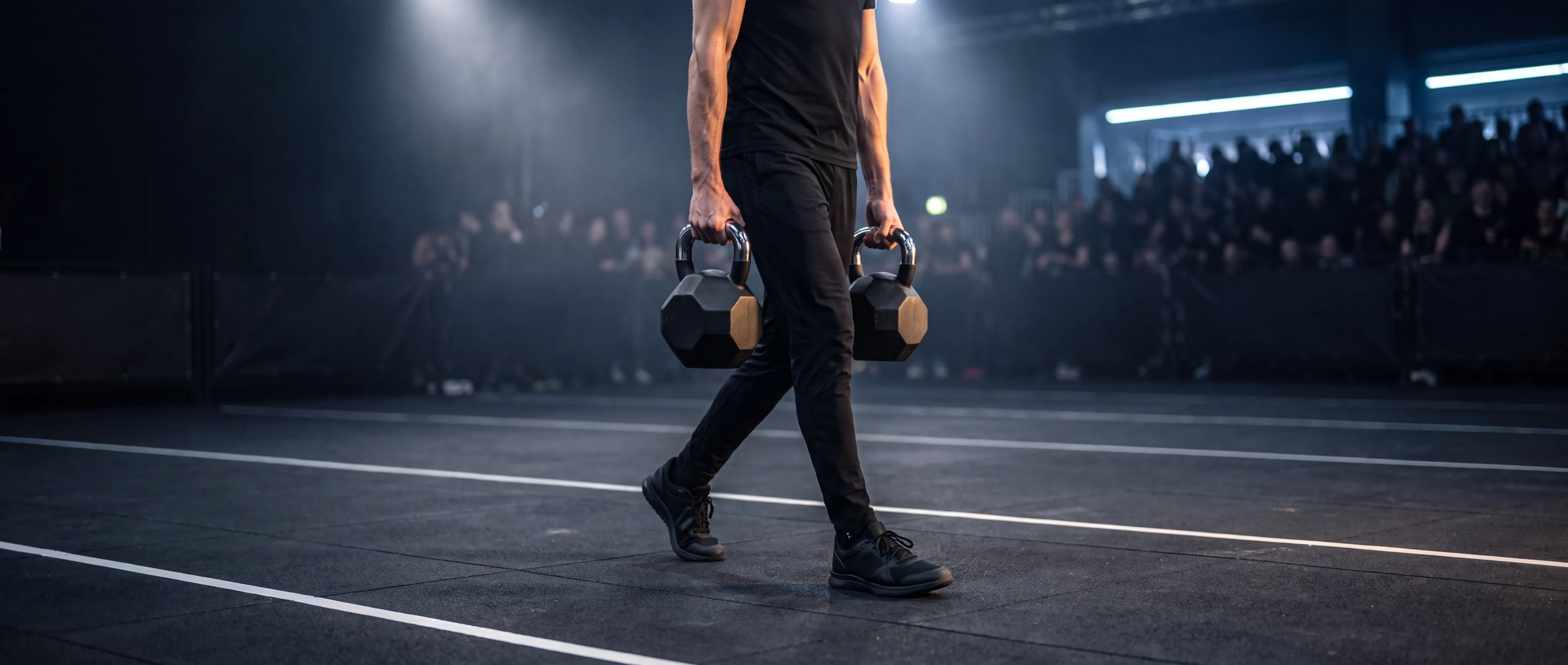
The farmers carry is station 6 of 8 at HYROX, a 200 m carry with one kettlebell in each hand. The listed weight is the load per hand, not a combined total. The station is not finished when you cross the line: it ends only once both bells are back in their marked box with the handles upright.
- Station 6 of 8, a 200 m carry sitting between two 1000 m runs.
- The listed weight is per hand, one bell in each hand. It is never a combined figure.
- The rulebook requires both bells carried at all times while you move, with both arms extended by your sides.
- Setting the bells down to rest is explicitly permitted, with one condition on how you place them.
- The station ends only when the bells are back in the correct box with the handles upright. Fix a mistake before you leave the ROXZONE and no penalty applies.
- Lane markings here are orientation only, so your turn line is a time decision rather than a compliance one.
- Loads on this page are pinned to Season 26/27.
What the HYROX farmers carry actually is
The station order at HYROX never changes: SkiErg, Sled Push, Sled Pull, Burpee Broad Jump, Rowing, Farmers Carry, Sandbag Lunges, Wall Balls. The farmers carry is number 6 in that list, which is the detail most people skip past. By the time you reach the kettlebells you have already been through the SkiErg, both sleds, the burpee broad jumps and the rower, with a 1000 m run in front of each one and another waiting the second you put the bells down.
That sequencing changes everything about how the station should be executed. Your grip has been mauled by the sled pull rope. Your upper back has been loaded by the sleds and the burpees. Your forearms are already pumped. So the carry you rehearse fresh in the gym on a Tuesday morning is not the carry you get on race day, and athletes who have only ever practised it fresh are consistently surprised by how early their hands start to slip.
It is also the station athletes write off in advance. Walking with weights sounds like a rest between two harder pieces. It is not. Handled badly it wrecks the run that follows, and it is the station before the sandbag lunges, which are the last thing you want to meet with a shredded upper back. Our guide to the HYROX stations in order maps how the whole sequence stacks up.
The loads, per hand
| Division | Weight per hand (one bell in each hand) | Distance |
|---|---|---|
| HYROX Women (Open) | 2 x 35 lb (16 kg) | 200 m |
| HYROX Men (Open) | 2 x 53 lb (24 kg) | 200 m |
| HYROX Pro Women | 2 x 53 lb (24 kg) | 200 m |
| HYROX Pro Men | 2 x 71 lb (32 kg) | 200 m |
Read those figures as one bell per hand: a HYROX Men (Open) carry means a single 24 kg bell in each hand, not that number doubled and not that number halved. Doubles, mixed and relay loads, plus the full kilogram to pound breakdown, are broken out in the farmers carry weight guide, and you can check your own division in the weight standards tool.
The movement standards the rulebook actually sets
Most technique pages for this station recycle generic gym cues. The rulebook is more specific than that, and section 8.6 sets four things out plainly.
- The station begins and ends at the marked box. You take the kettlebells out of the box next to the start and finish line, and you return them there. Everything in between is the station.
- You carry both kettlebells at all times while you are moving. One down and one up is not a carry.
- Both arms stay extended by your sides. This is the standard nobody quotes and the one that rules out every improvisation a fatigued athlete reaches for.
- Putting the bells down to rest is permitted, provided they do not move forward when you place them on the ground.
The arms-extended rule is worth sitting with. When your grip starts going, the instinct is to bail into something easier: racking a bell on a shoulder, hugging one to your chest, shrugging both up to shorten the hang, curling slightly to take the strain off your fingers. None of those meet the standard. The bells hang, at your sides, on straight arms, or you are not carrying them legally. Which means your grip plan has to be a real plan, because there is no fallback position to improvise into halfway down the lane.
The other one people miss is the bookend. The clock on this station is not the distance, it is box to box. Sprinting the carry and then fumbling the return costs you more than a slightly slower carry with a clean finish.
Yes, you can put the bells down
This is the most useful rule on the station and the most widely misunderstood. Setting the kettlebells down to rest is explicitly allowed. It is not a no-rep, it is not a fault, and it does not restart anything. The single condition the rulebook attaches is about placement: the bells must not move forward when you put them on the ground. Set them down where you are standing, not slid or dropped ahead of you.
Reframe that as a tactic rather than a confession. A planned set-down at a point you chose, taken while you can still control the bells, costs a few seconds and buys back a grip that can finish the distance. An unplanned set-down happens when your fingers open on their own, usually mid-lane, usually with the bells landing badly, and it costs the few seconds plus the fumbled restart plus the psychological hit of having failed rather than decided. Same rule, very different price.
How the station is judged, and where athletes lose time
The finish condition is precise. The station is complete once you carry the kettlebells across the finish line and return them to the correct box, with the handles left in the upright position. Both parts matter: correct box, handles up. A bell tipped on its side in the right box does not meet the standard, and a perfectly upright bell in the wrong box does not either.

Get that wrong and a time penalty applies. The rulebook attaches a correction window to it: if you go back and fix the infringement before you exit the ROXZONE, the penalty is not applied at all. So the reflex to build in training is to glance back at the box before you commit to the next run.
The second half of the protocol is heavier. Completing any part of the station with the wrong weight means repeating the entire station with the correct kettlebells, and refusing to do that is a disqualification. The bells at the station are colour coded by load to help you pick the right pair, but selecting correctly is the racer's responsibility, so check the athlete map and the rulebook for your event rather than guessing from the rack in a crowded lane.
One thing this station does not have: the escalating warning ladder some other stations use for repeated movement faults. The farmers carry protocol is the box-and-upright penalty and the wrong-weight rule, and that is it. Our guide to how HYROX judging and penalties work covers the wider picture, and penalty durations are set out in the official rulebook for your event.
Turns, laps and lane markings
This is the part most guides skip entirely. The rulebook does not prescribe a lap count or a turning technique for this station. It says that depending on the venue, covering 200 m may involve multiple laps, and that it is the racer's responsibility to familiarise themselves with the athlete map and complete the required number of laps.
It goes further in the general conduct section. On the lunges, the burpee broad jumps and the farmers carry, faster racers may overtake slower racers when it is safe to do so, and any grid lines or lane markings at these stations serve as orientation only. They are not mandatory to follow.
Draw the conclusion out, because it is genuinely useful: your turn is unregulated. Nobody is judging the shape of it, nobody is measuring whether you clipped inside a painted line, and there is no prescribed technique to get wrong. Turn strategy on this station is purely a time-saving question.
Which makes it a physics question instead. The real cost of a turn is not the arc, it is the deceleration and re-acceleration of a loaded body. Grinding to a halt, pivoting, and starting again is expensive and also the moment the bells swing most. A rounded turn that keeps some speed through the change of direction generally beats a square one, and it keeps the load stable in your hands rather than yanking at your fingers as it changes direction.
The lap count is the other half. Count your laps before you start, from the athlete map, and commit the number to memory in the corral. Counting while your grip is failing is exactly when counting stops working, and racers who lose track either run an extra lap they did not owe or get sent back for one they did.
Grip and posture for the HYROX farmers carry
Chest up and shoulders back is where most advice on this station stops. It is not wrong, it is just not enough to get you through 200 m on tired hands. Four things matter more.
Where the handle sits in your hand. A handle hooked deep across the base of the fingers, close to the palm, hangs off skeletal structure and connective tissue. A handle gripped in the fingers is held by muscle that is already fatigued and will keep fatiguing. Set the hook when you pick the bells up, because you cannot fix it once you are moving without setting the bells down.
Stopping the swing. A swinging bell steals energy twice: it loads your grip at the bottom of every arc and it torques your shoulder at the top. Braced lats hold the bells close to the line of your body and let them hang rather than pendulum. It is the difference between carrying a load and fighting one.
Staying tall. Folding at the chest under load is the natural response and it compresses your ribcage exactly when you need to breathe. That matters here more than on most stations, because the run that follows starts immediately and you cannot recover a breathing pattern while jogging with a wrecked upper back. Tall torso, ribs down, breathe through the carry rather than holding on and hoping.
Walk or shuffle. A brisk walk with a slightly bent knee absorbs bounce. A stiff-legged march or a jog sends every footfall straight up into the bells, which then oscillate, which then rips at your fingers. Soft knees, quick turnover, no vertical bounce. The bells should look almost still relative to your body while your feet move fast.
What to do when your grip starts to go
Grip failure gives you warning if you are listening. The first sign is not slipping, it is the handle creeping out toward your fingertips and a sudden urge to squeeze harder. That is the decision point, not the moment the bell hits the floor.
Pick a set-down point in advance, ideally at a turn where you are slowing anyway, and take it deliberately when you feel that first creep. Place the bells down without letting them travel forward, shake the hands out for a couple of breaths, reset the hook deep in the palm, and go again. A break you chose runs a few seconds. A drop you did not choose costs the same seconds plus a scramble, plus the risk of a bell landing somewhere it should not, plus starting the next stretch on hands that are now genuinely done rather than merely tired.
Doubles: the two extra rules
The Doubles rulebook adds two things to the same station, and both are about direction of travel.
First, kettlebells must never be passed forward during a transition between partners. Sideways or backwards is fine, forwards is not. Second, the resting partner must walk behind the working partner at all times, because walking alongside obstructs other racers and is treated as an infringement.
Practically, that shapes your handover: the incoming partner comes level from behind or beside, the outgoing partner sets the bells down or hands them across laterally, and the resting partner tucks back in behind rather than pacing next to their teammate for company. Agree the swap points before you race instead of negotiating them mid-lane. Our guide to HYROX Doubles covers the wider work-split strategy.
How to train the HYROX farmers carry
Rich Ryan is a multiple-time Elite 15 qualifier, and his take on this station is that athletes treat it as a throwaway and pay for it later in the race. Worth seven minutes.
The training principle matters more than any specific session. Train the carry pre-fatigued, not fresh. The race version arrives with the stations before it and every run that precedes them already behind it, so a carry practised at the start of a session tests a quality you will not have on the day. Put it after a run, after rowing, after anything that has already taxed your grip and your upper back.
Train grip as time under tension rather than as maximum load. The limiter here is how long you can hold a manageable weight, not how heavy a bell you can pick up once. Static holds at race load, held for the sort of duration your carry will actually take, build the exact quality the station charges you for. So do broken carries: the full race distance split into segments with short, fixed rests, so you rehearse the planned set-down instead of discovering it under pressure.
Two other things pay off cheaply. Carry with the bells you will race with if your gym has them, because handle thickness and the shape of the bell change how the hook sits. And finish carry sessions with a short run, so the transition from loaded upper back to running form is something your body has met before a judge is watching.
Training at the wrong load teaches the wrong technique. Confirm your division before your next carry session.
Frequently asked questions
What are the rules for the HYROX farmers carry?
You must carry both kettlebells at all times while moving, with both arms extended by your sides. The station starts and finishes at the marked box, and it is only complete once both bells are returned to the correct box with the handles upright. Full movement standards are in the official rulebook.
Can you put the kettlebells down during the HYROX farmers carry?
Yes. The rulebook explicitly permits setting the bells down to rest, with one condition on placement: they must not move forward as you put them on the ground. A planned set-down is a legitimate pacing tactic rather than a fault, and it usually costs less time than carrying to failure.
How far is the HYROX farmers carry?
The carry is 200 m, and depending on the venue that distance may be split across multiple laps of a shorter lane. It is the racer's responsibility to check the athlete map before the race and complete the required number of laps.
Which station is the farmers carry in HYROX?
It is station 6 of 8, arriving after a 1000 m run with another one immediately after. The full fixed order is SkiErg, Sled Push, Sled Pull, Burpee Broad Jump, Rowing, Farmers Carry, Sandbag Lunges, Wall Balls, and it never changes between events.
What penalty applies on the HYROX farmers carry?
A time penalty applies if the kettlebells are not returned to the correct box, or are not left with the handles upright. If you go back and correct it before leaving the ROXZONE, no penalty is applied. Completing the station on the wrong weight means repeating the whole station.
Do you have to stay inside the lane markings on the farmers carry?
No. The rulebook states that grid lines and lane markings at the farmers carry serve as orientation only and are not mandatory to follow, and that faster racers may overtake when it is safe. Your turn line is therefore a time decision, not a compliance one.
Is the HYROX farmers carry weight per hand or in total?
Per hand, always. The listed figure is the weight of one kettlebell, and you carry one in each hand. Doubling it to get a combined total misreads the standard, and so does halving it. The per-division breakdown sits on our farmers carry weight guide.
What are the doubles rules for the HYROX farmers carry?
Kettlebells must never be passed forward during a partner transition, though sideways or backwards is permitted. The resting partner must stay behind the working partner at all times, since walking alongside obstructs other racers and is treated as an infringement.
How do I know I picked up the right kettlebells?
Selecting the correct load for your division is the racer's responsibility, and the bells at the station are colour coded to help. Check the athlete map and the rulebook for your event before you race, because finishing on the wrong weight means repeating the entire station.
References
- Official HYROX Singles Competition Rulebook (PDF) – section 8.6 is the authority for the farmers carry movement standards, the set-down permission, the return-to-box finish condition and the penalty protocol.
- Official HYROX Doubles Rulebook (PDF) – the authority for the no-forward-pass transition rule and the requirement that the resting partner stays behind the working partner.
- HYROX official site – the authority for the race format, the division taxonomy and the ROXZONE.
Standards on this page are current for Season 26/27. They change by season and can vary by event, so confirm against the official rulebook for your own race before you compete. RoxTribe is an independent community resource and is not affiliated with HYROX.