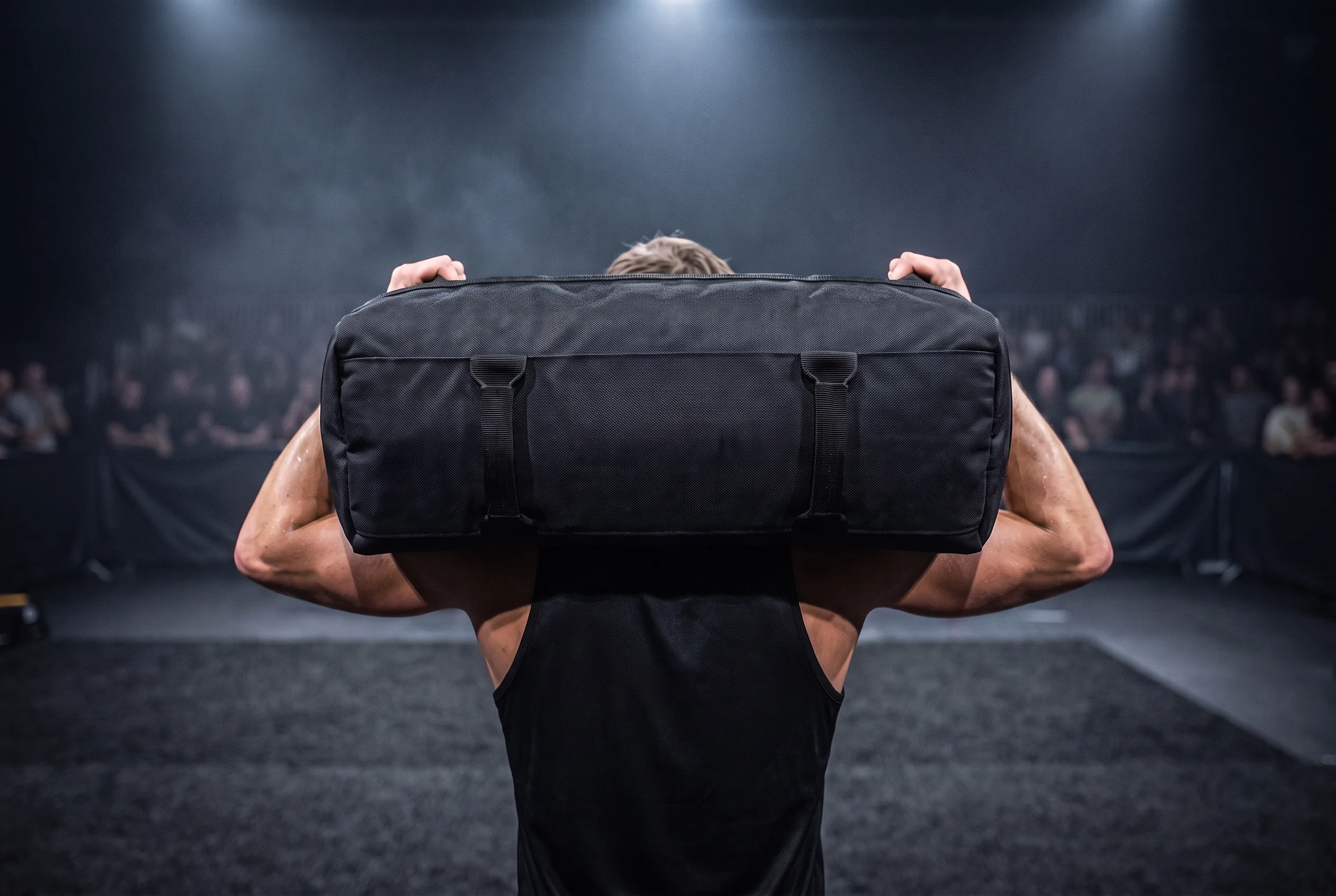
The sandbag lunge is station 7 of 8 at HYROX: 100 m of walking lunges with a flat sandbag across both shoulders. Two things are judged on every single repetition. The trailing knee has to clearly touch the ground, and the rep has to end standing tall with knees and hips fully extended. The load is modest. The station is not.
- The HYROX sandbag lunge is station 7 of 8, covering 100 m of walking lunges with the bag across both shoulders.
- Open division sandbag lunges load 22 lb (10 kg) for women and 44 lb (20 kg) for men over 100 m, according to the official Season 26/27 rulebook.
- Pro division sandbag lunges load 44 lb (20 kg) for women and 66 lb (30 kg) for men over the same 100 m, according to the official Season 26/27 rulebook.
- Every rep is judged twice: the trailing knee clearly touching the ground, and a fully tall finish with knees and hips extended.
- Lunges must alternate. You may lunge continuously or pause with both feet parallel, but steps and shuffles between reps are not permitted.
- The bag must stay fully supported by you throughout. Setting it on the floor, a barricade or your feet to shed the load carries a 15 second penalty each time under the rulebook.
- The station is decided by the running and everything else that came before it. Arrive with legs, then pick a stride you can hold.
- Standards on this page are pinned to Season 26/27.
What the HYROX sandbag lunge station actually is
HYROX is eight rounds, each a 1 km run followed by one functional workout station. The sandbag lunge is station 7 of 8 in that sequence, the last one before wall balls. You cover 100 m as walking lunges, up and back along a marked lane, with the bag on your shoulders the whole way.
The bag is nothing like a barbell. It is long, flat and rectangular, with webbing grab handles stitched along its length and sand that shifts every time you move. Bags are colour coded by load so you can find yours on the rack. That shifting fill is why the bag feels heavier than a barbell of the same weight: the mass arrives half a beat behind you on every descent, and your torso absorbs the lag.
The loads, in one table
HYROX singles runs Women, Women Pro, Men, and Men Pro, and PRO divisions use heavier loads than Open.
| Division | Sandbag load | Distance |
|---|---|---|
| HYROX Women (Open) | 22 lb (10 kg) | 100 m |
| HYROX Men (Open) | 44 lb (20 kg) | 100 m |
| HYROX Pro Women | 44 lb (20 kg) | 100 m |
| HYROX Pro Men | 66 lb (30 kg) | 100 m |
That is the only place loads appear here. The full per-division breakdown, the doubles and relay bags and the kilogram to pound conversion live in the HYROX sandbag lunge weight guide, and you can check your division in the weight standards tool. One rulebook line is worth carrying into the corral: selecting the correct bag is the racer's own responsibility, not the judge's.
Where the lunges sit in the race, and why that changes everything
The station order never moves: SkiErg, Sled Push, Sled Pull, Burpee Broad Jump, Rowing, Farmers Carry, Sandbag Lunges, Wall Balls. Read that list and the difficulty stops being about the bag. By the time you shoulder it you have run a 1000 m leg in front of every station before this one, pushed and pulled the sleds, rowed, and finished the farmers carry that has just emptied your grip and upper back. Our guide to the HYROX stations in order sets out what arrives before the bag.
So this is a quad and glute station handed to you on legs that have already done everything. Athletes hit the second lane and find their front leg will not control the descent any more. That is a fatigue problem wearing a strength problem's clothes, and it is why training the lunge fresh tells you almost nothing about race day. What follows makes it worse: the lunges leave you with hips and quads that still owe you a run and then wall balls.
How to carry the bag, the position that decides the station
The bag sits across the upper back and both shoulders, in the yoke position: on the meat of the traps, clearly below the base of the neck, ends extending a hand span past each shoulder. Both hands grip the webbing handles and pull the bag down into the traps rather than resting on it. That downward pull is the whole trick. A bag held down becomes part of your torso. A bag balanced on top of your shoulders is a separate object that goes where physics sends it.
Ask first timers what went wrong and you get the same answer: the bag crept, sliding down the back or riding forward onto the neck. Two causes, both fixable. The bag was set badly before the first rep, and the torso folded forward once the legs started burning.
Fix the first at the marked area, while you are still standing tall and fresh, because a crooked bag never straightens itself out. Fix the second with posture: chest up, eyes down the lane, ribs stacked over hips. The moment your chest drops, gravity walks the bag up your spine. Hook the handles rather than crushing them, since your forearms have already been through the farmers carry.
Common carrying mistakes that cost you the station
Front racking or hugging the bag to the chest feels more secure and loads exactly the muscles that ruin the run afterwards. Letting it drift onto one shoulder turns a symmetrical movement into a slow limp. And re-setting every few metres bleeds more time than people realise, because each reset is a full stop, a hoist and a restart of your rhythm.
A note on chalk
The judged movement standards, rep by rep
This is where the station is won and lost, and it is the part almost every guide skips. The Season 26/27 HYROX Singles rulebook sets the standards out in section 8.7. In plain English:
- The station begins and ends with taking the bag out of, and returning it to, the marked area beside the start and finish line.
- You start standing tall with both feet behind the line, then lunge across it.
- On every lunge the trailing knee must clearly touch the ground. Hovering short is an infringement, and it is the most penalised thing at this station.
- Every repetition ends standing tall, knees and hips fully extended. A half-risen shuffle into the next rep is not a finished rep.
- Lunges must alternate, so alternating knees touch the ground.
- You may lunge continuously, or stop between lunges with both feet parallel on the ground. Both rhythms are legal and the choice is yours.
- You may not take any steps or shuffles between repetitions.
- Your front foot must completely cross the white line at the end of each lane, and at the finish.
- You do not have to lunge around the turning points. You do have to restart each working section with two feet behind the white line and by lunging across it.
- The station is complete once your leading foot completely crosses the finish line. The bag then goes back to the correct marked area.
The rule almost everyone gets wrong: no steps or shuffles
Read items 6 and 7 together and the rulebook is stricter than most athletes assume. You get two legal rhythms. Lunge continuously, or lunge, bring the back foot up so both feet are parallel, breathe, lunge again. That is the entire menu.
What is not on the menu is the thing tired people do naturally: a correcting step to square up, a half shuffle to fix a wandering line, a hop to reset balance. A legal reset is standing still with both feet level, for as long as you like. An illegal one is any travel between reps.
The turning points, where free time hides
Item 9 is the most useful rule in the section and hardly anyone uses it. You are not required to lunge around the turnaround. You can stand up and walk the turn on two feet, provided you restart the next section with two feet behind the white line and a lunge across it.
So the turn is a penalty free micro-break every lane: walk it, take two proper breaths, re-seat the bag if it has crept, shake out a hand, set up behind the line and go. Athletes who lunge the turn out of caution are paying for a rest the rulebook is handing them for free.
The sandbag penalty protocol, and how it differs from every other station
Section 8.7 carries its own penalty protocol and the shape of it is unusual. A first infringement is a formal warning rather than a penalty. A second is a 15 second penalty. The general penalty table backs that with dedicated rows for a trailing knee that does not touch and for a failure to stand tall, both at 15 seconds per infringement.
Failing to return the bag to the correct marked area is a 30 second penalty, and it comes with a reprieve: correct it before you exit the ROXZONE and the penalty is not applied. Completing all or any part of the station with the wrong weight means repeating the whole station with the correct bag, and failing to do that is a disqualification rather than a time cost.
Compare that with the farmers carry, where setting the load down to rest is explicitly permitted. Here it is not. There is no legal rest that involves the bag leaving your shoulders, which is why the setup and the turn breaks matter so much. Our guide to how HYROX judging and penalties work covers the race wide framework.
Bad rules going around
A claim circulating widely, including in Google's own AI answer for this station, describes a distance or time penalty for dropping the bag, escalating to disqualification on a second drop. It is not in the Season 26/27 Singles rulebook. Nothing resembling it appears in section 8.7 or the general penalty table.
The real rule is above: shedding the load costs 15 seconds each time, and disqualification is reserved for racing the wrong weight and not repeating the station. That difference is practical. Under the invented version a second lapse ends your race, so the rational move is to grind on with a slipping bag.
Pacing the HYROX sandbag lunges on tired legs
Stride length is the main dial and almost nobody sets it before race day. A shorter stride means more repetitions, but each is cheaper, your centre of mass stays lower under the bag, and the knee touch is far more reliable because there is less descent to control. A longer stride covers the lane in fewer reps, but each costs more from the quad, and a long stride under fatigue is where shallow knee touches come from.
Most athletes land somewhere in the region of 50 to 80 individual lunges, though that is an estimate that swings a long way with height and stride rather than a fixed number. Know roughly what yours is before you race: a rehearsed rep count is a countdown, a discovered one is a guess.
Plan lane by lane instead of as one block, since a lane ends at a turn you are allowed to walk. Breathe on the ascent, not the descent, so the brace holds through the loaded part. The classic error is going out hard on lane one, where fresh legs on a light bag make the opening reps feel free.
A block-by-block plan through 100 m
Split the distance into quarters before you touch the bag and decide, in advance, where you are willing to break stride. A plan you build on tired legs is not a plan.
- Block 1, first quarter. Set the stride you rehearsed in training and hold it. This is the one block where legs are still fresh regardless of what came before, so treat it as your baseline pace, not a warm-up. Every rep is still judged from the first one.
- Block 2, second quarter. Hold the same stride and use the turn as your first scheduled break: walk it on two feet, pull the bag back down into the traps with both handles rather than letting it ride up your back, and take two full breaths before you lunge back across the line. That reset costs no distance you were not already covering to turn around.
- Block 3, third quarter. This is where the quads usually start to go. Shorten the stride a half step rather than holding the same length slower, since a shorter stride under fatigue keeps the knee touch clean and a long stride under fatigue is where reps get missed. If the bag has crept during this block, fix it at the next turn rather than mid-lane.
- Block 4, final quarter. If the quads are already gone by here, that is a loading problem showing up as a pacing one; see the sandbag lunge weight guide for the symptom, cause and fix. On the day, shorten the stride again if you have to, walk the last turn rather than rushing it, and spend whatever you have left getting the leading foot cleanly across the finish line instead of hurrying the closing reps.
The transition in and out
Getting the bag up is a skill, and the rulebook expects you to do it unassisted. Practise it: hinge, hands under the bag, bring it to the chest, roll it onto the shoulders in one movement rather than fighting it up in stages.
The finish has a fixed order people get backwards. Leading foot completely across the line first, then the bag back to the correct marked area, then run. The 30 second penalty is avoidable by not sprinting off the second the line is behind you, and if you do get it wrong you have a window: fix it before you leave the ROXZONE, which is the central transition zone athletes run through between every run and station, and no penalty applies.
Doubles in one paragraph
HYROX runs Singles, Doubles, Team Relay (4 athletes), and Adaptive. In doubles only one partner works the station at a time, so partners split the distance and swap as often as they like. The bag must not touch the floor during a handoff, which makes the swap a skill worth rehearsing rather than improvising in the lane. Our guide to HYROX Doubles covers the wider work-split strategy.
How to train for HYROX sandbag lunges
The Progrm's coach-led breakdown runs through bag position, stride and station strategy, and it is one of the few videos dedicated entirely to this station.
The base is unglamorous: split squats, Bulgarian split squats and loaded walking lunges, built until one leg can control a slow descent under load without wobbling. That control is what produces a clean knee touch when you are tired.
The part that matters more is lunging on pre-fatigued legs. The race never hands you fresh quads here, so lunges done first in a session train a quality you cannot access on the day. Put them after a hard run, after rowing, after a sled session. Then train some sessions with a bag slightly heavier than race load, and cover the full station distance unbroken at least once beforehand so the lane count is familiar rather than discovered under a judge.
Training at the wrong load teaches the wrong stride. Confirm your division before your next lunge session.
Frequently asked questions
What are the rules for sandbag lunges in HYROX?
The Season 26/27 Singles rulebook requires the trailing knee to clearly touch the ground on every lunge, each repetition to end standing tall with knees and hips fully extended, and the lunges to alternate. You may lunge continuously or stop with both feet parallel, but steps and shuffles between repetitions are not permitted.
Can your knee touch the ground in HYROX lunges?
It must. The rulebook says the trailing knee has to clearly touch the ground on every single repetition, so a knee that hovers short is an infringement rather than a clean rep. The general penalty table lists a trailing knee not touching the ground at 15 seconds per infringement after the initial warning.
How far are the HYROX sandbag lunges?
The station covers 100 m of walking lunges with the bag across your shoulders. It is station 7 of 8, the last before wall balls. Your front foot must completely cross the white line at the end of each lane and at the finish line.
How heavy is the HYROX sandbag lunge?
Load is set by your division, and selecting the correct bag is the racer's own responsibility under the rulebook. The per-division figures, plus doubles, relay and the kilogram to pound conversion, are set out in the HYROX sandbag lunge weight guide.
What is the penalty for sandbag lunges in HYROX?
A first infringement is a formal warning and a second is a 15 second penalty. Failing to return the bag to the correct marked area is 30 seconds, waived if you correct it before leaving the ROXZONE. Racing the wrong weight means repeating the station, and failing to do so is a disqualification.
Can you put the sandbag down during HYROX lunges?
No. The rulebook states the bag must remain fully supported by the working athlete and must not be placed on the ground, a barricade, your feet or any other surface to remove the load. Each time is another 15 second penalty. Re-seating it on your shoulders while it stays supported is fine.
Do you have to lunge around the turns in HYROX?
No. The rulebook explicitly says you do not need to lunge around the turning points at the end of each lane. You must restart each working section with two feet behind the white line and begin by lunging across it, which makes the turn a legal place to reset your grip and your breathing.
Why are HYROX sandbag lunges so hard?
Because of where they sit. By this point you have covered all but the last of the 8 runs and everything preceding the bag, including the farmers carry that has just drained your grip. The load is modest. The station is hard because your quads and glutes are already spent.
References
- Official HYROX Singles Competition Rulebook (PDF) – section 8.7 is the authority for every movement standard on this page, the no-steps rule, the turning point exception and the sandbag lunge penalty protocol. The general penalty table is the authority for the chalk restriction.
- Official HYROX Doubles Rulebook (PDF) – the authority for the one-partner-works-at-a-time format and the handoff conditions.
- HYROX official site – the authority for the race format, the division taxonomy and the ROXZONE.
Standards on this page are current for Season 26/27. They change by season and can vary by event, so confirm against the official rulebook for your own race before you compete. RoxTribe is an independent community resource and is not affiliated with HYROX.