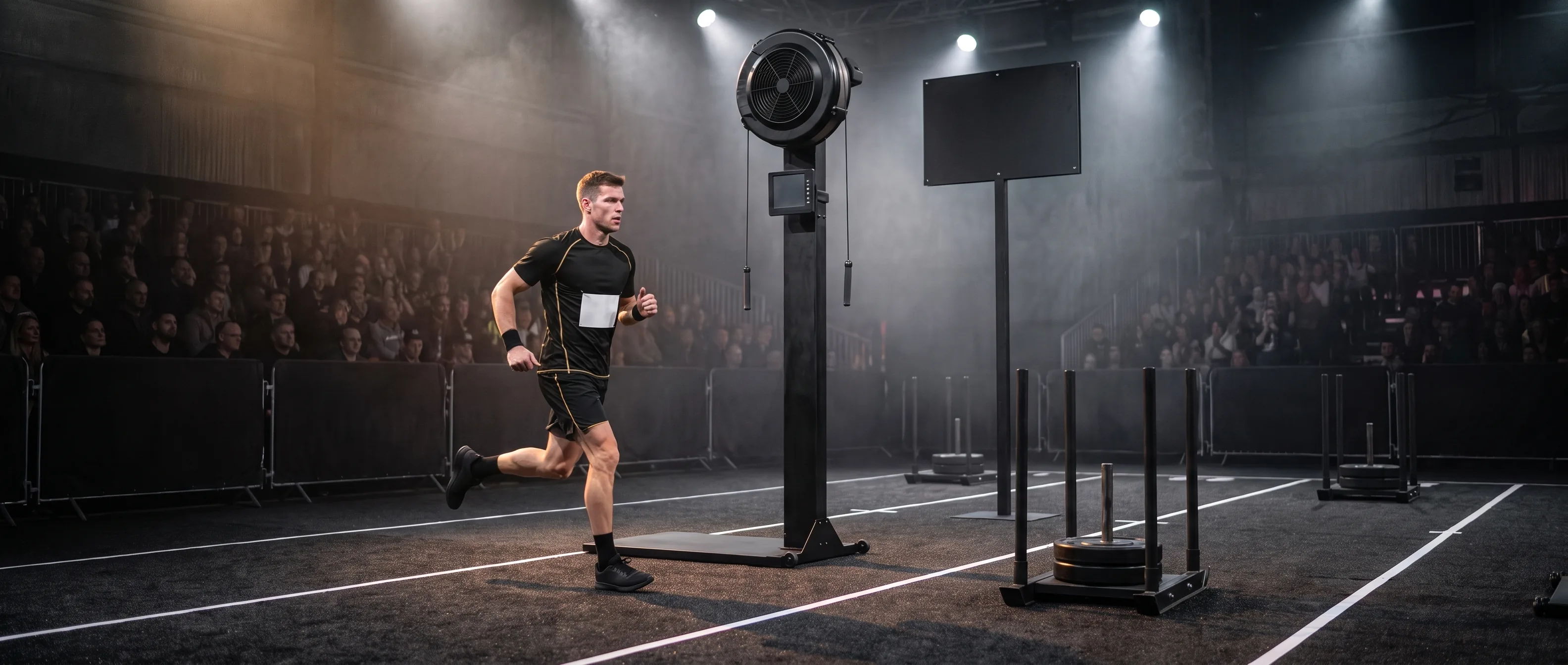
- A HYROX race is 8 stations, each reached by a 1000 m run, so you run 8 times for 8 km on foot.
- Station working distances are 1000 m SkiErg, 50 m sled push, 50 m sled pull, 80 m burpee broad jump, 1000 m row, 200 m farmers carry and 100 m sandbag lunges.
- Neither sled is a straight push. The 50 m total is laid out as 4 x 12.5 m lanes, in every Singles, Doubles and Relay division.
- Wall balls is the one station measured in reps and target height rather than distance: 100 reps for every Singles, Doubles and Relay division.
- Target height tracks gender, not Open or Pro: 2.70 m for women including Pro, 3.00 m for men including Pro.
What are the HYROX distances?
A HYROX race is eight rounds, each a 1 km run followed by one functional workout station. You cover 1000 m before each of the 8 stations, 8 legs in total, for 8 km of running. Every station then carries its own fixed working distance, published in the rulebook and identical at every event worldwide in Season 26/27.
The order is SkiErg, Sled Push, Sled Pull, Burpee Broad Jump, Rowing, Farmers Carry, Sandbag Lunges, Wall Balls. That sequence, and what each station actually asks of you, is covered in full on the HYROX stations pillar. This page stays on the numbers: what each distance is, and what it looks like once a venue paints it onto the floor. If you are completely new to the format, start with what HYROX is and come back.
Every HYROX distance at a glance
One table, every measurement in the race. The last column is the part most reference pages leave out: the published number and the shape you actually race are not the same thing.
| Order | Station | Working distance | How it is laid out |
|---|---|---|---|
| 1 | SkiErg | 1000 m | Machine reading, not ground covered |
| 2 | Sled Push | 50 m | 4 x 12.5 m shuttle lanes |
| 3 | Sled Pull | 50 m | 4 x 12.5 m shuttle lanes |
| 4 | Burpee Broad Jump | 80 m | Marked lane, turn at the far line |
| 5 | Rowing | 1000 m | Machine reading, not ground covered |
| 6 | Farmers Carry | 200 m | Lane, lap count varies by venue |
| 7 | Sandbag Lunges | 100 m | Lane with turning points |
| 8 | Wall Balls | 100 reps | Measured in reps and target height |
Add the running to that: 1000 m before every station, 8 times. Nothing in the table changes between Open and Pro, or between women and men. The only measurement with a gender split is the wall ball target, which has its own section below.
How far do you actually run?
The run leg is 1000 m, repeated 8 times, for 8 km. That figure holds for every Singles and Doubles division, every age group and every load class at the individual level. There are two exceptions. A relay member runs only their own share of it, as the relay section below explains, and some adaptive divisions race a reduced lap count, set out in our HYROX Adaptive guide.
What changes is how those kilometres feel. You never run two of them back to back, and apart from the first, each one begins with a station still in your legs. Race-day splits therefore sit well off anyone's standalone pace. The running total on its own tells you almost nothing about how hard the race is. The HYROX pacing guide covers what to target on each leg.
Why your watch reads more than 8 km
The official running figure counts the run legs and nothing else. Your GPS watch has no idea where a run leg ends. It also records your movement through the ROXZONE, the central transition zone athletes run through between every run and station, plus the ground you cover inside the stations themselves: the sled lanes, the lunge lane, the carry lane, the walk back to the rig.
Course layout adds the rest. Venues differ in floor size, so the distance between a station and the run lane is not the same at every event. No single official all-in total exists that covers the transitions and station work as well. That explains both halves of the argument you see after every race: the totals people post vary wildly, and none of them contradict the rulebook. Treat the official running figure as the running figure and your watch total as a record of your day.
The station distances, and how they are actually laid out
Every station distance below is published in the rulebook, but a rulebook gives you a total, not a shape. The venue turns that total into lanes, laps and turning lines. Group the stations by how they are measured rather than by the order you meet them, and the gap between the two becomes obvious.
The two machine stations measured in metres
SkiErg is 1000 m and the row is 1000 m, but neither is a distance you travel. Both are a monitor reading: the erg counts flywheel revolutions and converts them into a simulated distance, so you finish the station standing exactly where you started. Two athletes covering the same figure can have moved the handle a very different number of times, because stroke power decides how much each pull is worth.
The sleds: 4 x 12.5 m, not a straight push
This is the measurement that surprises people most. The sled push is 50 m and the sled pull is 50 m, and both totals are laid out as 4 x 12.5 m and 4 x 12.5 m lanes respectively, with a direction change at each end. You are never pushing or pulling in one continuous line.
That structure changes the physical task. A sled sitting still on turf takes far more force to get moving than to keep moving, and a shuttle format means you break that static friction at the start of every lane rather than once. The turns are where races come apart: athletes who trained one long straight push arrive at the second turn with a heart rate they cannot recover from and start losing whole seconds resetting their feet. The sled push technique guide covers how to attack the restart rather than absorb it.
One point gets misread constantly, so here it is flat: the shuttle layout is not a variation used by one format. It is the same in Singles, Doubles and Relay, and the same in Open and Pro. The total distance is constant across all of them too. What changes between their divisions is only the load on the sled.
The lane stations: turns, laps and the athlete map
Burpee broad jump is 80 m, farmers carry is 200 m and sandbag lunges are 100 m. All three are covered on marked lanes, and all three come with layout details the published figure hides.
The rulebook notes that at some venues the carry distance is achieved over multiple laps of a shorter lane rather than one long stretch, and that reading the athlete map and completing the required number of laps is the racer's own responsibility. Nobody counts for you. The lunge lane has turning points as well, and the working section restarts from behind the line after each turn, so a sloppy turn is a repeated rep rather than a saved one. Both points are worth checking against the HYROX rules for your event before you rack up a no-rep.
Wall balls: the station with no distance
Wall balls is the exception in the whole race. There is no lane and no metres to cover, only 100 reps against a fixed target, and that target is where the only gender-based measurement in Singles, Doubles and Relay lives.
Wall ball target height, the measurement that tracks gender
Every Singles, Doubles and Relay division throws 100 reps. The target height splits by gender, and then stays put whether you enter Open or Pro.
| Division | Target height |
|---|---|
| Open Women | 2.70 m |
| Pro Women | 2.70 m |
| Open Men | 3.00 m |
| Pro Men | 3.00 m |
Do the HYROX distances change by division?
Not in Singles, Doubles or Relay. Adaptive is different: several of its divisions race shorter distances, as our HYROX Adaptive guide shows. Women, Women Pro, Men, and Men Pro all cover identical run legs, identical station working distances and an identical rep count. PRO divisions use heavier loads than Open, and that is the only axis that moves. Weights sit outside the scope of this page on purpose, since mixing loads into a distance reference is how people end up quoting the wrong number for their division. Check yours in the weight standards tool instead.
How the HYROX distances work in Doubles and Relay
The published measurements are constant. What the team formats change is who covers which piece of them. The full taxonomy is Singles, Doubles, Team Relay (4 athletes), and Adaptive.
Doubles
The running is not divided. Both partners cover all 8 km together, side by side, so each athlete personally runs the full distance. Only the station work is shared, split inside each station with one partner working at a time while the other rests. The working distances and the rep count are unchanged from singles, which means a Doubles team faces the same measurement sheet, just with someone to hand the sandbag to. The HYROX Doubles guide covers the handover rules in detail.
Team Relay
Relay is the format where the distances are genuinely divided: a 4-person team splits the standard 8 runs and 8 stations, each member covering 2 x 1 km and 2 workout stations. With 4 athletes on the team, that works out at 2 x 1000 m of running per member and 2 stations each, and each member completes 2 of the 8 stations, and the team chooses which.
Handover is flexible: a member may run and work back to back, or hand over in the Transition Zone after each leg, and that swap happens in the Transition Zone [TZ]. Teams race in the Women, Men, and Mixed divisions. The team still covers the full race between them, so no distance is removed from the event. Only the ownership of each piece changes. That alone makes relay pacing a different problem from singles pacing, because you are racing short and hard rather than rationing yourself across the whole floor.
HYROX distances FAQ
What are the distances in HYROX?
A HYROX race is 8 stations, each preceded by a 1000 m run, so you cover 8 km on foot. The station working distances are 1000 m SkiErg, 50 m sled push, 50 m sled pull, 80 m burpee broad jump, 1000 m row, 200 m carry and 100 m lunges, with wall balls measured in reps instead.
How far do you run in a HYROX?
You run 1000 m before every station, 8 times, for 8 km in total. That is identical for every Singles and Doubles division, every gender and every load class. In a relay each member runs only their own legs, and some Adaptive divisions race a reduced lap count.
How many miles do they run at HYROX?
The official running total is 8 km, split into 8 legs of 1000 m each. Converted, that is a little under five miles, all of it broken up by station work rather than run continuously.
Why does my watch show more distance than the official total?
The official figure counts the run legs only. A GPS watch also picks up your movement through the ROXZONE, the central transition zone athletes run through between every run and station, plus the ground you cover inside stations. Course layout varies by venue, so there is no single official all-in total to compare against.
How long is the HYROX sled push?
50 m in total, and the sled pull is the same at 50 m. Neither is one continuous lane. Both are laid out as 4 x 12.5 m lanes with a direction change at each end, so you restart the sled from a dead stop several times inside a single station.
Is the HYROX sled push a straight line?
No. The rulebook gives the total and specifies it as 4 x 12.5 m lanes. That holds in Singles, Doubles and Relay, in Open and Pro alike. Training the sled as one long straight push under-prepares you for the restarts at each turn. The turns are where the station takes its time from you.
Are the HYROX distances the same for women and men?
Yes, in every format except Adaptive. Every run leg and every station working distance is identical across Women, Women Pro, Men, and Men Pro, and the only measurement there that tracks gender is the wall ball target height, 2.70 m for women and 3.00 m for men. Loads differ between those divisions; distances do not.
Are the distances different in Pro?
No. Pro races the same distances and the same rep count as Open, because PRO divisions use heavier loads than Open and nothing else moves. Pro wall balls even use the same target height as Open of the same gender. Only the ball weight goes up.
What are the distances in HYROX Doubles?
The same as singles. Both partners run all 8 km together rather than splitting the running, and the station work is shared inside each station with one partner working at a time. The published working distances are unchanged.
Is the farmers carry always one straight lane?
The distance is 200 m, but the rulebook notes that at some venues that total is achieved over multiple laps of a shorter lane. Checking the athlete map before your wave and knowing your lap count is the racer's own responsibility, and getting it wrong is expensive.
Do HYROX distances change between events or seasons?
The distances have been stable and are the same at every event worldwide in Season 26/27. What varies is how a venue lays the course out: lane lengths, lap counts and ROXZONE geometry differ, so confirm against the current rulebook and your event's athlete map.
References
Every figure on this page is drawn from the official Season 26/27 rulebooks. Confirm against the rulebook for your own event before race day.
- HYROX Singles Rulebook : the authoritative source for the run legs, every station working distance, the sled shuttle layout and the venue-lap note on the farmers carry.
- HYROX Relay Rulebook : how a four-athlete team splits the same runs and stations, and the handover rules.
- HYROX: The Fitness Race : the official overview of the run-then-station structure and the transition zone.
- Red Bull: HYROX exercise stations guide : third-party context on what each station involves.