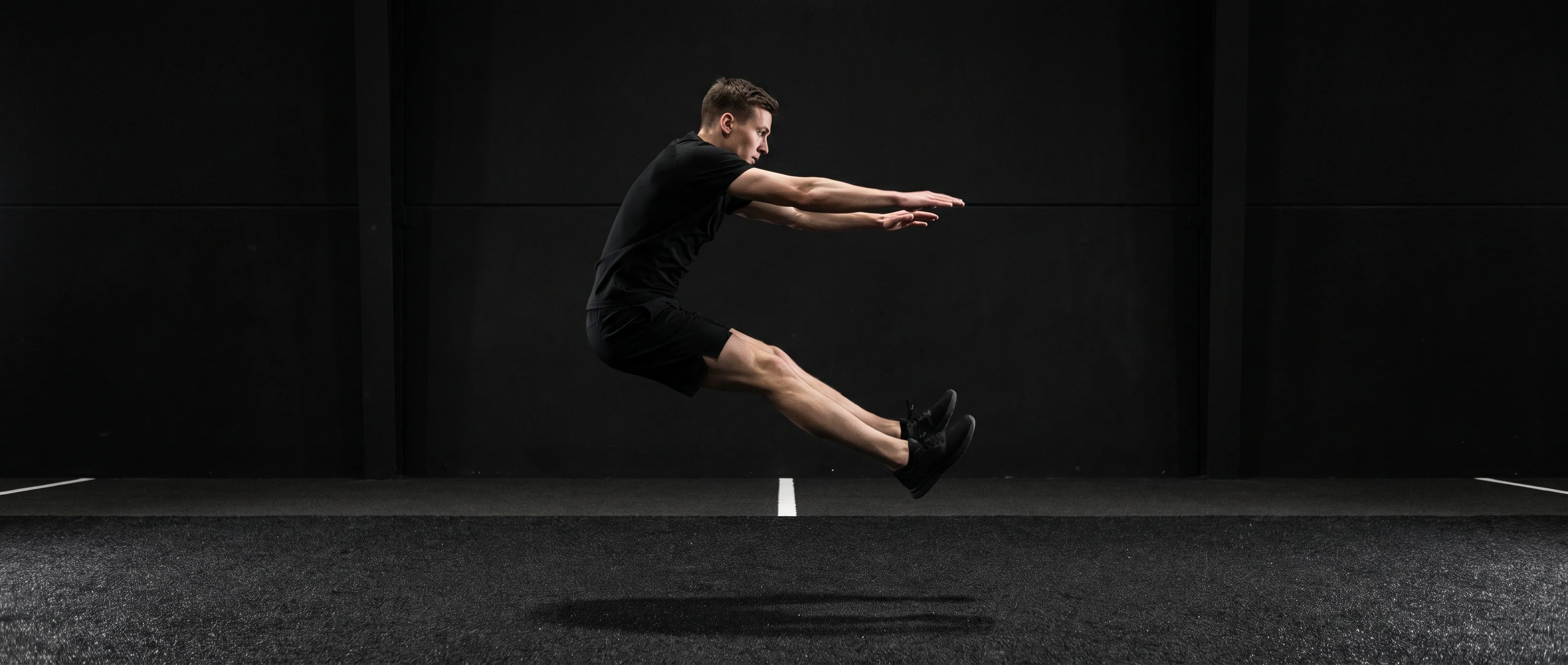
The burpee broad jump is station 4 of 8 in a HYROX race and covers 80 m. It carries no external load. One rep is a burpee with your chest on the ground, followed immediately by a two-footed forward jump, repeated down the lane until you cross the finish line.
- The station covers 80 m with no weight, and you arrive there straight off the fourth 1000 m run.
- Chest contact is judged at the nipple line. There is no push-up in a HYROX burpee.
- Hands go no more than 30 cm ahead of the toes of your front foot, and once planted they cannot creep forward.
- Take-off and landing are two-footed, with a maximum of 5 cm of stagger permitted in Season 26/27.
- The first infringement is a formal warning. The second costs 15 seconds, and so does every one after it.
- Staying low between reps instead of standing tall is the single biggest time saver here.
Where the burpee broad jump sits in a HYROX race
A HYROX race is eight rounds, each a 1 km run followed by one functional workout station. The sequence never moves: SkiErg, Sled Push, Sled Pull, Burpee Broad Jump, Rowing, Farmers Carry, Sandbag Lunges, Wall Balls. That puts the burpee broad jump squarely at the halfway mark, reached through the ROXZONE, which is the central transition zone athletes run through between every run and station. For the full station-by-station picture, the complete race guide maps every one of them in order.
The sequencing is what makes this station bite. You walk in with your grip already cooked from the sled pull, which for Open Men is 227 lb (103 kg). Your forearms have just spent minutes hauling a loaded sled hand over hand, and now you're asking those same hands to catch your bodyweight dozens of times over, depending on how long you jump. Then you leave and face rowing over 1000 m.
So the real damage is rarely the station itself. It's the row you row badly afterwards, and the run you jog instead of running, because you spent four minutes at 95 percent of max heart rate on the floor.
Why this station breaks races
Athletes see no weight next to this station and file it mentally as recovery. Then they get there. Dropping your whole body to the floor and standing back up, over and over, drives heart rate higher than anything else in the race, including the sleds, and it does it without the warning signal of a heavy load in your hands. Nothing to blame but yourself, which is why so many races come apart here.
The Season 26/27 movement standards, rule by rule
| Rule | What the rulebook requires | What counts as an infringement |
|---|---|---|
| Station distance | 80 m, no external load | Stopping short of the final line |
| Chest contact | The nipple line makes clear contact with the ground; no push-up required | Chest hovering, or only the hips touching down |
| Hand placement | No more than 30 cm forward of the toes of the front foot, measured at the base of the palms where the hands meet the wrists | Reaching or crawling the hands out ahead of that limit |
| Hand movement | Once the hands are placed on the ground, they cannot be moved forward | Walking the hands forward mid-rep to steal distance |
| Overstepping | When jumping or stepping out of the burpee, the feet cannot go beyond your fingertips | Feet landing ahead of the hands on the way up |
| Take-off and landing | Both feet leave and land together, with a maximum of 5 cm variance between the front of one foot and the front of the other | A staggered jump or a single-leg take-off or landing |
| Extra movement | No additional steps or shuffles at any time | A shuffle step to reset before jumping |
| Standing up | A racer may use a knee when coming out of the bottom of the burpee | None; listed so athletes stop worrying about it |
| Jump length | The length of each broad jump is entirely up to the racer | None; listed to kill a persistent myth |
| Lanes | Grid lanes are guidance only, and faster racers may cross lanes to overtake | None |
| Turning points | Where turning points are used, no rep is performed around the turn, but every white start and finish line must be jumped across | Stepping over a white line instead of jumping it |
What changed for Season 26/27
The headline change is the 5 cm stagger tolerance on take-off and landing. Your feet no longer have to be perfectly square, which removes a source of judging friction that frustrated a lot of athletes at the back half of a race, when fatigue makes precise foot placement a coin flip.
Read the tolerance for what it is. Five centimetres is about two finger widths, not a licence to bound off one leg. Plan to stagger and you'll exceed it under fatigue without feeling it, because your sense of where your feet are degrades long before your legs do. Train square, race square, and let the tolerance absorb the drift instead of building a technique around it.
Two standards get forgotten far more often than the stagger rule: the 30 cm hand limit and the overstepping rule. Both punish the same instinct, which is buying free distance with your upper body. Reaching the hands forward before you drop feels efficient, and it reads as a clear infringement from a judge standing over you.
Penalties and how they escalate
The rulebook sets out a ladder rather than a flat charge. Your first infringement is a formal warning from the judge, with no time cost. A second infringement carries a 15-second penalty. Every further infringement after that adds another 15 seconds, and no additional warnings are given. The ladder is per athlete, so a sloppy patch of five reps early on is genuinely expensive by the time you reach the line.
Separately, failing to complete a station in its entirety is treated as an Incomplete Station and results in disqualification, a rule that applies across all 8 stations rather than just this one. The wider penalty framework, including no-reps at other stations, is covered in our guide to HYROX rules and penalties.
How to perform the HYROX burpee broad jump efficiently
Break the rep into four beats and treat each one as a separate technical decision: the descent, the floor contact, the recovery to your feet, and the jump. Most athletes only think about the fourth.
Beat one: the descent
Drop, do not lower. Controlled eccentric lowering looks disciplined and quietly cooks your triceps over dozens of reps, which you then need for wall balls at the end of the race. Place your hands inside the 30 cm limit, take your weight briefly, and let your body go to the floor rather than easing it there.
Beat two: the floor contact
Hips and thighs land first, then the chest arrives last in one wave. That order matters, because a flat slam from a height is jarring and a chest-first landing forces you to press yourself back up from a dead stop. Your chest needs to make clear contact at the nipple line and nothing more. No press-up, no pause, no lockout.

Beat three: the recovery
Bring your feet in close to your hands so the distance you have to stand up through is short. Athletes who leave their feet wide behind them pay for it every single rep with a longer, heavier hip extension. A knee on the floor coming out of the bottom is explicitly permitted, so use one if it keeps your rhythm intact. Keep your chin tucked so your spine stays stacked as you come up.
Beat four: the jump
Do not stand fully upright between the burpee and the jump. Loading from a crouch and springing forward saves a full extension and re-flexion of the hips on every rep, which across the whole station adds up to minutes, not seconds. Let your arms stay in the rhythm: the swing forward is free momentum you have already paid for, and athletes who leave their arms hanging are throwing it away.
Jacob Price walks through the standards and four technique variations in this five-minute breakdown, which is worth watching before you next practise the station.
The four common technique styles
Jump back, jump in. Fastest per rep, most expensive metabolically. Both feet leave together on the way down and again on the way in. It suits strong, light athletes early in the station and almost nobody in the last quarter of it.
Jump back, step in. The common compromise. You keep the speed of the drop but walk your feet in one at a time, which shaves heart rate without adding much time. Most athletes drift into this one around halfway whether they planned to or not.
Step back, step in. Slowest per rep, cheapest on your heart rate. Stepping the feet back is fully legal, and this is the version to hold in reserve for the moment your breathing goes ragged. It isn't a failure to use it. It's a gear.
The low continuous style. Never coming above a crouch, flowing from the floor into the jump with almost no vertical travel. Hardest of the four to own, most efficient once you do, and it needs specific practice because the pull to stand up under fatigue is strong.
Pick your gear off your heart rate, not your ego. An athlete who steps the whole station at a controlled effort beats the one who jumped the first third and then knelt on the turf gasping.
Jump length is a strategy choice, not a rule
The rulebook leaves the length of each broad jump to the racer, so your rep count is a lever you control rather than a number handed to you. Longer jumps cover the ground in fewer reps but load your quads and calves heavily, and you carry that into the row. Shorter, rhythmic jumps mean more reps but a flatter heart rate and a cleaner transition out.
Anyone quoting you a fixed rep count is guessing. The honest answer is a range that depends on your jump length, your height and what's left in your legs by the time you get there. Work out your own number in training over the real distance instead of trusting an average from someone else's race.
Pacing the burpee broad jump without blowing up the row
Going unbroken is a trap. It feels like the aggressive choice and it usually ends in a stall in the last quarter that costs more than the planned pauses would have. Chunk the distance before you start, say five blocks with a two-breath reset between each, and treat those resets as scheduled rather than earned. A three-second pause you chose is cheap. A thirty-second collapse you didn't is not.
Breathing is the hidden variable, and almost everyone gets it wrong. Most athletes hold their breath through the floor contact and only start again once they're upright, so they spend a third of every rep in a breath hold at the moment demand is highest. Tie the breath to the beats: exhale on the way down, inhale as your feet come in, exhale through the jump. It feels wrong for a dozen reps, then it becomes the thing holding the whole station together.
Judge the station by the state you leave it in. Arriving at the rower over 1000 m with a controlled heart rate is worth more than 20 seconds saved on the turf, because you can pull those 20 seconds back over the row and the run that follows. You cannot pull back a heart rate that never comes down.
Doubles and relay considerations
In doubles only one partner works at a time and the pair alternate through the station, so the swap point is a decision rather than an accident. Set your swaps by rep count before the race starts, not by feel. Feel is the first thing to go under fatigue, and the partner on the floor is always the worst judge of how much they have left.
Practise the handover itself, not just the reps. A clean swap with the incoming partner already crouched and ready costs almost nothing. A swap where both of you stand around orienting yourselves costs a few seconds every time. The official Doubles rulebook carries the format specifics, and our guide to how doubles teams split the work covers the wider strategy.
How to train for it
Three separate qualities need work, and most athletes only train the first one.
Burpee volume under fatigue. Never practise this station fresh. Run first, then burpee. A simple session: 4 rounds of a 400 m run followed by 20 burpee broad jumps, resting only as long as the run took. You're training technique that survives ragged breathing, which is the only condition you'll meet it in on race day.
Broad jump mechanics on their own. Train the jump fresh and low-volume, 3 to 4 sets of 5 maximal broad jumps with full rest, focused on a two-footed take-off, a square landing and absorbing the impact through the hips. That's a power session, not a conditioning one, and it's what stops your jump distance collapsing in the second half of the station.
Race-specific pairing. Every couple of weeks, run the full distance for time on pre-fatigued legs, ideally straight off a sled session. Log the rep count and the time. That's your baseline, and it beats any average you'll read online.
Structured sessions that build this kind of work into a week sit in our burpee-specific training sessions.
The mistake most athletes make in training
Practising the station fresh. It is never fresh in a race. It arrives after four runs and both sleds, with your grip already compromised, and a technique that holds together in a rested gym session can fall apart entirely under those conditions. If your training reps all happen at the start of a workout, you have practised a movement you will never actually perform.
Frequently asked questions
How far is the burpee broad jump in HYROX?
The burpee broad jump covers 80 m. It is station 4 of 8, and you reach it after the fourth 1000 m run. The distance is identical for every Open and Pro division, since this station carries no external load and no weight-based scaling.
What are the HYROX rules for the burpee broad jump?
Your chest must make clear contact with the ground at the nipple line, with no push-up required. Hands go no more than 30 cm ahead of your front foot's toes and cannot move forward once planted. Both feet leave and land together, within 5 cm of each other, with no extra steps or shuffles.
How many burpee broad jumps are in the station?
There is no fixed rep count. The rulebook leaves jump length entirely to the racer, so you complete however many reps it takes to cover 80 m. Longer jumps mean fewer reps and heavier legs. Shorter jumps mean more reps and a steadier heart rate. Both are legal.
Is there a weight for the HYROX burpee broad jump?
No. This is the only fully bodyweight station in the race, so there is no sandbag, sled or kettlebell involved and nothing changes between Open and Pro. Weight scaling applies elsewhere: PRO divisions use heavier loads than Open. The burpee broad jump load is identical for every athlete on the floor.
What is the penalty for a bad burpee broad jump?
Your first infringement earns a formal warning from the judge. A second infringement costs a 15-second penalty, and each further infringement adds another 15 seconds with no additional warning. Failing to complete the station in full is treated as an Incomplete Station and results in disqualification.
Do I have to do a push-up in the HYROX burpee?
No. The rulebook requires only that your chest makes clear contact with the ground at the nipple line. There is no press-up requirement, so you can drop, make contact and peel straight off the floor. Adding a strict push-up wastes triceps endurance you need for later stations.
Can I step my feet back instead of jumping them back?
Yes. The rulebook permits stepping the feet back and stepping them in, and you may use a knee coming out of the bottom position. Many athletes step deliberately to keep their heart rate under control. What is not permitted is any additional step or shuffle between the burpee and the broad jump.
What changed in the burpee broad jump rules this season?
For Season 26/27, feet no longer need to be perfectly parallel on take-off and landing. A maximum stagger of 5 cm between the front of each foot is now permitted. Five centimetres is a narrow margin though, so keep your feet as square as fatigue allows.
Which station comes before and after the burpee broad jump?
The race order is SkiErg, Sled Push, Sled Pull, Burpee Broad Jump, Rowing, Farmers Carry, Sandbag Lunges, Wall Balls. You arrive from the sled pull with a run leg in between, and another run leg separates the burpee broad jump from rowing over 1000 m. That sequencing matters, because the sled pull taxes your grip and posterior chain before you ever touch the floor.
Why is the burpee broad jump considered the hardest HYROX station?
It carries no weight, so athletes underestimate it, then discover it produces the highest heart rate in the race. It arrives at the halfway point across all 8 stations, with four runs already in the legs, and it punishes anyone who stands fully upright between reps. The 100 wall balls waiting at the end are what you pay for overcooking it.
Should I take long jumps or short jumps?
Jump length is your choice under the rules, so treat it as a pacing lever. Long jumps cut your total rep count but load your quads and calves heavily for the row that follows. Short, rhythmic jumps keep your heart rate lower at the cost of more reps.
References
- Official HYROX Singles Competition Rulebook (PDF) – section 8.4 is the primary authority for the burpee broad jump distance, movement standards and penalty protocol quoted throughout this page.
- HYROX rulebook hub – where athletes find the current-season rulebook for every race format.
- Official HYROX Doubles Rulebook (PDF) – the authority for the doubles work-split rule referenced in the doubles section.
- Centr station guide to HYROX burpee broad jumps – general station and training context from HYROX's official equipment partner.