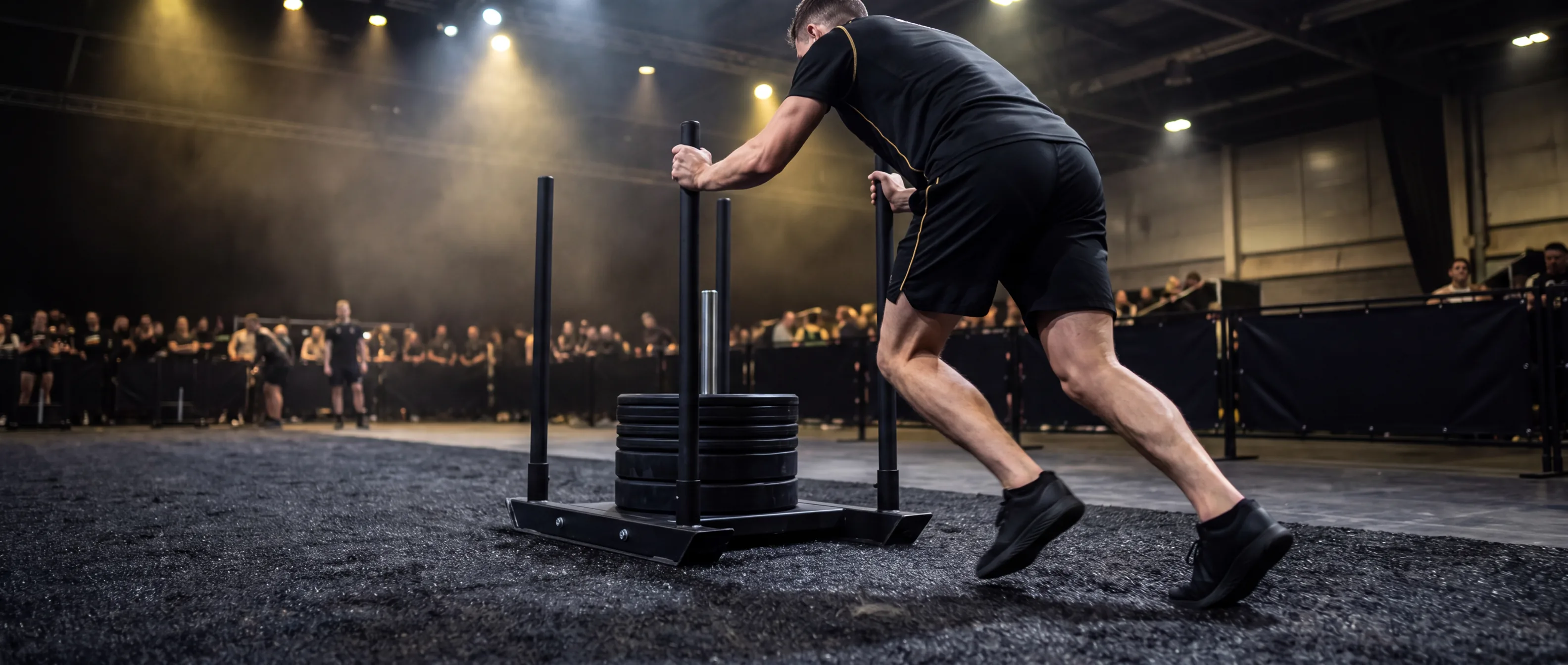
- A HYROX shoe has to run 8 km across 8 legs and survive all 8 stations in the same pair, because nothing in the official Season 26/27 rulebook provides for a mid-race change of footwear.
- Open Men push a 335 lb (152 kg) sled and Open Women push a 225 lb (102 kg) sled over 50 m, according to the official Season 26/27 rulebook, and outsole grip decides that station before leg strength gets a say.
- The official HYROX rulebook requires closed-toe shoes throughout the race, with one named exception at the wall-ball station, where racers may remove them.
- PUMA states it is the official HYROX apparel and footwear partner for all races from 2024 to 2027 and builds the Deviate NITRO Elite HYROX as a purpose-made race shoe, but no rule requires any brand.
- Nobody at RoxTribe has raced in any of the shoes named on this page; every spec, score and price below is attributed to the source that published it.
HYROX asks one pair of shoes to do four jobs that fight each other, inside a single continuous race, with no provision anywhere in the rules for swapping them: the cushioning of a road shoe for the running legs, the outsole of a cross-trainer for the sled, the wide firm platform of a lifting shoe for the carries and lunges, and enough abrasion resistance to survive turf and steel. No shoe is excellent at all four; picking well means deciding which compromise costs you least. This page works through the demand profile first, then which property matters most for your case, then the models.
What the best shoes for HYROX actually have to survive
The format is fixed worldwide: eight rounds, each a 1 km run followed by one functional workout station. That structure creates four separate demands on a single pair of shoes.
- Run 8 km, split into 8 legs of 1000 m, with only the opening leg run on fresh legs. This rewards cushioning, energy return and low weight.
- Grip short-pile turf under a loaded sled. This rewards full rubber coverage and a lug pattern that bites.
- Stay stable under load through carries and lunges. This rewards a wide, firm, low platform, which is close to the opposite of what the running legs reward.
- Survive abrasion from turf, sled uprights and repeated hard forefoot loading.
Jobs one and three pull against each other directly. A tall, soft, narrow racing stack is fast over 1000 m and unhelpful with a sandbag on your shoulders. A wide, firm, grippy platform is superb at the sled and heavy underfoot for the running total. Every shoe on this page is somebody's answer to that trade-off, and none of them dissolves it.
Why one pair has to do everything
Every HYROX racer must wear closed-toe shoes at all times during the race, according to the official Season 26/27 rulebook's clothing and accessories section, with a single named exception at the wall-ball station, where racers may remove them. Nothing in the rulebook provides for a mid-race change of footwear. The same section also states that permitted items must stay with the athlete from start to finish, and that handing anything to, or receiving anything from, another person during the race counts as outside assistance and can lead to disqualification.
Practically, there is also nowhere to do it: every transition passes through the ROXZONE, the central transition zone athletes run through between every run and station, and the clock never stops. Plan on one pair carrying the whole race. The full rules are covered in our HYROX rules guide.
Which stations actually stress the shoe
The station order is identical at every event: SkiErg, Sled Push, Sled Pull, Burpee Broad Jump, Rowing, Farmers Carry, Sandbag Lunges, Wall Balls. A handful of those decide footwear, and the rest are broadly indifferent to what is on your feet.
- The running legs. The single largest block of time in the race for most athletes, and the reason a pure cross-trainer is usually the wrong call.
- Sled push and sled pull. Pure traction. Nothing else on the course punishes a slick outsole this hard.
- Sandbag lunges and farmers carry. Lateral stability with load high on the body and a fatigued midfoot.
- Rowing. The one station where heel shape matters more than heel stack, because the shoe has to seat in a Concept2 foot cradle.
Our station-by-station breakdown covers what each one involves in full.
The six things that make a good HYROX shoe
RunRepeat publishes the only instrumented, HYROX-specific shoe testing in this space that we could verify. It states that it buys every shoe itself with no sponsorship, and runs, rows, lunges and sled-pushes in each tested pair alongside lab work producing more than thirty data points per shoe. The thresholds below are RunRepeat's stated criteria, from its guide by Jens Jakob Andersen, published July 2026, not ours.
| What to look for | Why HYROX demands it | What RunRepeat recommends |
|---|---|---|
| Outsole grip | Sled push and pull on turf, plus polished concrete and wet rubber flooring in transit | Full rubber coverage, described as critical rather than optional |
| Platform stability | Carries and lunges load the shoe sideways with weight held high | Heel stack 30 to 38 mm, midsole firmness at or above 35 AC, base width 80 mm or more |
| Energy return | The running legs are the biggest single time block in the race | 60 percent or better |
| Forefoot flexibility | Lunges and the sled drive both need the forefoot to bend under load | Around 13 N to bend 30 degrees is average |
| Heel shape | The rowing foot cradle expects a heel it can hold | Rounded, so it seats properly in a Concept2 cradle |
| Drop | Newer runners tend to load the heel more on tired legs | 6 mm or more suggested for beginners |
Grip, the criterion with no workaround
According to the official Season 26/27 rulebook, Open Men push 335 lb (152 kg) and Open Women push 225 lb (102 kg) over 50 m, then pull 227 lb (103 kg) for Open Men and 172 lb (78 kg) for Open Women back over the same ground. Not one of those numbers moves if the foot behind them is sliding. This is the part of the race where footwear choice shows up as raw seconds, because a slipping foot dumps the leg drive into the floor instead of the sled, and the recovery costs more than any midsole ever gave back.
Full rubber coverage matters more than lug depth here. HYROX turf is short-pile and dense, not deep, so a shoe needs contact area and a pattern that resists shearing sideways, not trail-style teeth. Our sled push technique guide covers the body positions that convert grip into movement; the exact load for your division is in the weight standards tool.
Rich Ryan, a three-time HYROX Elite 15 World Championship qualifier and co-holder of a HYROX Doubles world record according to his own channel, walks through the same trade-off above, and says on camera that he has not raced in every shoe he names.
Stability under load, where running shoes struggle
Sandbag lunges put 44 lb (20 kg) on the shoulders for Open Men and 22 lb (10 kg) for Open Women over 100 m, and the farmers carry adds 2 x 53 lb (24 kg) for Open Men and 2 x 35 lb (16 kg) for Open Women over 200 m, according to the official Season 26/27 rulebook. Both stations arrive with the calves already loaded from running and the sled.
This is where a tall, soft, narrow racing stack turns into a liability: the taller the foam, the further your ankle sits from the floor and the more the platform can roll under sideways load. RunningXpert makes a related point about the plated PUMA Deviate NITRO Elite HYROX, describing it as light and narrow with a stiff carbon plate that asks for more stability management as fatigue builds. A shoe that feels planted fresh can feel unruly by the far end of a 100 m lunge.
The heel shape nobody thinks about
RunRepeat flags a detail almost no shoe review mentions: the heel needs to be rounded enough to seat in a Concept2 foot cradle. Modern road racers increasingly taper the heel to shave weight, fine on tarmac and awkward on the erg, where a heel that will not sit down leaves you rowing off an unstable base for the whole 1000 m. Our rowing technique guide covers the setup.
Wall balls, the one place shoes come off
According to the official Season 26/27 rulebook, racers may remove their shoes once they reach their designated wall-ball target. It requires the shoes to be placed under the rig, and requires the athlete to take them along to the Finisher Stage afterwards, because returning to the wall-ball area after finishing is not allowed. Some athletes use that to do their 100 reps, the same count in every division, barefoot for a flatter and more direct squat position. The rules allow it. That is all they do, and it is the only footwear exception anywhere in the race.
What to prioritise for your specific feet and your specific race
The six criteria above are generic. What decides a shoe for you depends on your feet, your division and how you plan to use the pair. The table below maps common situations to the property that should drive the decision, so you can weigh models against your own case, not a generic list.
| If this is you | Prioritise | Why |
|---|---|---|
| You have wide feet | Base width 80 mm or more, and a broad toe box | RunRepeat's own stability threshold is an 80 mm-plus base. Below it, a wide foot sits closer to the platform edge under the carries and lunges, and a narrow toe box is what turns into a hot spot over 8 km. |
| You land heel-first, especially once your legs are tired | A drop of 6 mm or more | RunRepeat suggests 6 mm or more for newer runners, because a heel-first landing loads the back of the foot harder as form breaks down late in the running legs. |
| You land on your forefoot or midfoot | A lower drop, with forefoot flexibility and energy return | A forefoot striker is not loading the heel the same way, so heel stack is carried weight. The forefoot does the work on the run and has to bend under load at the lunges, which is why RunRepeat measures both flexibility and energy return. |
| Your division is Pro | Outsole grip and midsole firmness over running-focused energy return | Pro Men push 445 lb (202 kg) and Pro Women push 335 lb (152 kg) over 50 m, both heavier than Open, so platform stability matters more relative to running cushioning. |
| You want one pair for training and racing, not two | Energy return and all-round cushioning over a purpose-built race plate | A do-everything pair sees ordinary running and gym sessions far more than race day, so a shoe specialised for the sled goes underused most weeks. |
| You're buying a dedicated race-day shoe and already have a trainer for the rest | A purpose-built plate and full rubber outsole coverage | A race-only pair has to survive one effort, so its spec can chase sled traction and running propulsion without an everyday-comfort compromise. |
| You've had black toenails or hot spots from past sled work | A wider, more structured toe box and secure midfoot lockdown, not just more grip | That damage comes from the foot sliding forward inside the shoe under the sled push load, not from the outsole. Lockdown and toe box room fix the slide; grip alone does not. |
| Your event runs on indoor flooring rather than open turf | Full rubber outsole coverage over deep lugs | HYROX turf is short-pile and dense, and transitions and some indoor venues run on polished concrete or rubber matting, where a lugged, trail-style outsole grips worse than flat, full-coverage rubber. |
Best shoes for HYROX: the models people actually race in
What follows is a map of which shoe gets picked for which job, with the source of every claim named, no countdown and no verdict from us. RunRepeat's category labels are RunRepeat's; the measured figures are the ones it published.
| Model | Chosen for | Published specs | Who says so |
|---|---|---|---|
| PUMA Deviate NITRO Elite HYROX | Purpose-built race shoe | 7.1 oz (201 g), 8 mm drop, 39/31 mm stack, carbon PWRPLATE, $259.95 USD listed Aug 2026 | Running Warehouse listing |
| Saucony Endorphin Pro 5 | Labelled best overall | 10 mm drop, 37.4/26.8 mm stack, 7.6 oz (215 g), 72.8% heel / 75.8% forefoot energy return | RunRepeat |
| HOKA Mach 7 | Labelled best traction | 7.9 oz (224 g), Sticky Rubber outsole, 0.73 wet traction score | RunRepeat |
| Saucony Endorphin Speed 5 | Labelled best energy return | 37.4/26.8 mm stack, 8.5 oz (241 g), 73.2% heel / 78.2% forefoot energy return | RunRepeat |
| ASICS GT 2000 14 | Labelled best stability | 10 mm drop, 3D Guidance System | RunRepeat |
| PUMA Velocity Nitro 4 | Labelled best flexibility | 33.7/24.0 mm stack, 7.9 oz (224 g), 41.1% more flexible than average | RunRepeat |
| ASICS Noosa Tri 16 | Labelled best lightweight | 10 mm drop, 7.7 oz (217 g), 0.79 forefoot traction score | RunRepeat |
| NOBULL Drive Ripstop | Labelled best low stack | 27.5/22.7 mm stack, 8.1 oz (230 g), Pebax foam, 71.6% heel / 71.1% forefoot energy return | RunRepeat |
The purpose-built option: PUMA Deviate NITRO Elite HYROX
PUMA's newsroom states that PUMA is the official apparel and footwear partner for all HYROX races from 2024 to 2027. The Deviate NITRO Elite HYROX is the shoe built out of that partnership, launched globally February 2026, with PUMA naming Hunter McIntyre, Linda Meier, Jake Dearden, Jake Williamson and Joanna Wietrzyk as debut athletes.
PUMA's own media release describes a NITROFOAM Elite midsole "adapted to provide elite-level cushioning for maximum energy return", a full-length carbon-fibre PWRPLATE for "increased propulsion and support", a "full-coverage, high traction PUMAGRIP outsole" for multi-surface control, and an ULTRAWEAVE upper. Those are PUMA's words about PUMA's product; no independent lab measurements of this specific model appear to have been published anywhere we could verify.
Running Warehouse lists the shoe at 7.1 oz (201 g), an 8 mm drop, a 39 mm heel and 31 mm forefoot stack, and $259.95 USD, and its copy claims a firmer midsole "to create the stable base needed for dynamic movements in HYROX stations" plus attention to turf grip at the sled push. Published weight, stack and price for this shoe vary by source, size, region and retailer: Canadian Running Magazine reviewed what appears to be the same shoe under a different name, the Deviate NITRO Elite 4 HYROX, with a lighter weight and taller stack, though both agree on the 8 mm drop, and PUMA's own release publishes no weight, drop or stack at all. Check the size you actually intend to buy.
The all-round PUMA options
Below the halo model, PUMA's Deviate NITRO line and the Velocity Nitro 4 come up most often. RunRepeat measured the Velocity Nitro 4 at a 33.7/24.0 mm stack and 7.9 oz (224 g), with 67.5 percent heel and 74.2 percent forefoot energy return, labelling it best for flexibility at 41.1 percent more flexible than average. The PUMA Velocity NITRO HYROX is a separate, plate-free model: RunningXpert calls it the lightweight, flexible option for athletes who prefer freedom of movement over carbon-plate stiffness, at a 10 mm drop.
On the Deviate NITRO 3, Tom's Guide published a first-person account of racing HYROX in it: one writer's race, not a test result.
Strong non-PUMA options
PUMA's partnership is commercial, not a performance verdict, and nothing obliges any athlete to race in it. RunRepeat's own picks skew elsewhere: best overall goes to the Saucony Endorphin Pro 5 (37.4/26.8 mm stack, 7.6 oz / 215 g, 72.8 percent heel / 75.8 percent forefoot energy return), best traction to the HOKA Mach 7 (7.9 oz / 224 g, Sticky Rubber outsole, 0.73 wet traction score), and best energy return to the Saucony Endorphin Speed 5 (73.2 percent heel / 78.2 percent forefoot).
For athletes who want platform over propulsion, RunRepeat labels the ASICS GT 2000 14 best for stability and the NOBULL Drive Ripstop best low stack (27.5/22.7 mm), while the ASICS Noosa Tri 16 takes lightweight at 7.7 oz (217 g) with a 0.79 forefoot traction score. Coach Faye at Wheelhouse Academy picks the Brooks Ghost 17 for durability, the Saucony Endorphin Speed 5 for speed with stability, and the Nike Vomero 18 for comfort.
Nike and adidas both make shoes people race well in. Judge any of them on the same six criteria rather than the logo: full rubber outsole, a stable platform that is not too tall, a rounded heel, sensible drop, a forefoot that bends, and enough running cushioning.
What we do not know
No independent, HYROX-specific durability testing exists for any of these shoes: durability claims here are manufacturer claims or individual impressions, labelled as such. Lab traction scores are measured on standardised surfaces, not competition turf under a loaded sled, so they rank shoes rather than predict your race. Fit is individual and no spec sheet substitutes for putting the shoe on. Nobody at RoxTribe has raced in any of these models, which is why this page cites other people's measurements instead of inventing its own.
Do you need HYROX-specific shoes?
Often, no. Coach Faye at Wheelhouse Academy opens her review with the point that if you are not actually racing HYROX, you do not need HYROX-specific shoes. HYROX-style training sessions in a normal gym do not put you on competition turf behind a loaded sled, so a shoe you already train comfortably in will serve.
If you are racing, a well-fitting running shoe with full rubber outsole coverage and a moderate stack height covers a first race, and fit over 8 km should outrank every other consideration. A purpose-built shoe earns its price for athletes chasing a specific time on a course they already know. If you are still working out what the event involves, start with what HYROX is.
The software side, training plans, pacing tools and race-day tracking, is covered separately in our guide to HYROX training apps.
Frequently asked questions
What is the official HYROX shoe?
There is no mandated shoe. PUMA states it is the official apparel and footwear partner for all HYROX races from 2024 to 2027 and makes the purpose-built Deviate NITRO Elite HYROX, launched February 2026. The rulebook requires closed-toe shoes and specifies no brand.
Do you wear running shoes for HYROX?
Most athletes do. The race includes 8 km of running across 8 legs, so a shoe with no running comfort costs more than it gains at the stations. The usual compromise is a running shoe with full rubber outsole coverage and a platform stable under load.
Can you change your shoes during a HYROX race?
The rulebook requires closed-toe shoes at all times, with one exception: at the wall-ball station athletes may remove them, place them under the rig, and must take them to the Finisher Stage afterwards. Nothing provides for a change of footwear, and receiving anything from another person mid-race counts as outside assistance.
How do HYROX shoes differ from running shoes?
A HYROX-oriented shoe trades some running softness for grip and stability. RunRepeat's guide suggests a heel stack of 30 to 38 mm, a base at least 80 mm wide, a firmer midsole and full rubber coverage, priorities that would be unusual in a pure road racer.
What shoes do HYROX pros wear?
PUMA names Hunter McIntyre, Linda Meier, Jake Dearden, Jake Williamson and Joanna Wietrzyk among the debut athletes for its Deviate NITRO Elite HYROX. Elite footwear choice reflects sponsorship as much as performance, so read it as a signal about what a shoe can handle, not a recommendation for your feet.
Are HYROX shoes worth it?
If you are racing, a shoe that grips turf under a sled is worth real time. If you are only training HYROX-style sessions, Coach Faye at Wheelhouse Academy argues you do not need HYROX-specific shoes at all. No independent HYROX-specific durability testing exists to settle the question either way.
What are the best shoes for HYROX in 2026?
RunRepeat's lab-tested guide names the Saucony Endorphin Pro 5 best overall, the HOKA Mach 7 best for traction and the PUMA Velocity Nitro 4 best for flexibility. PUMA's Deviate NITRO Elite HYROX is the only shoe built specifically for the race. Those labels are RunRepeat's and PUMA's respectively; RoxTribe has not tested any of them.
What are the best HYROX shoes for beginners?
A shoe you already run comfortably in, with full rubber coverage on the outsole and a moderate stack height. RunRepeat suggests a drop of 6 mm or more for newer runners. A first race rarely turns on footwear, so fit and comfort across 8 km should decide it.
Do carbon-plated shoes work for HYROX?
They can, with a trade-off. RunningXpert describes the plated Deviate NITRO Elite HYROX as light and narrow with a stiff plate, rewarding control but demanding more stability management as fatigue builds. Plate-free options give up propulsion for a steadier platform at the stations.
Does grip really matter that much for the sled?
It is the constraint with no workaround. Open Men push 335 lb (152 kg) and Open Women push 225 lb (102 kg) over 50 m. If the foot slips, no leg strength transfers into the sled, which is why outsole coverage and lug pattern top most published criteria lists.
How much do HYROX shoes cost?
Prices vary by retailer, region and season, so treat any figure here as a snapshot of one listing. Running Warehouse listed the PUMA Deviate NITRO Elite HYROX at $259.95 USD in August 2026, and other outlets have published different figures for the same shoe. Check current pricing before you buy.
References
- HYROX official Singles rulebook, source for the closed-toe footwear rule, the wall-ball exception and the outside-assistance rule.
- PUMA newsroom, global HYROX partnership announcement, PUMA's statement that it is HYROX's official footwear partner through 2027.
- PUMA media release, Deviate NITRO Elite HYROX, PUMA's stated tech claims and the February 2026 launch.
- RunRepeat, best HYROX running shoes, by Jens Jakob Andersen, July 2026, source of every RunRepeat-measured spec, traction score, energy-return figure and category label above.
- Running Warehouse, PUMA Deviate NITRO Elite HYROX listing, source of the spec sheet and listed price above.
- Canadian Running Magazine, PUMA x HYROX Deviate NITRO Elite 4 review, the conflicting weight, stack and price figures under a different model name.
- RunningXpert, how to choose running shoes for HYROX, source of the stiff-plate/narrow-platform caveat and the plate-free Velocity NITRO HYROX specs.
- Tom's Guide, racing HYROX in the PUMA Deviate Nitro 3, one fitness editor's first-person account, not a controlled test.
- Wheelhouse Academy, Coach Faye's HYROX shoe review, a named coach's women-specific picks and the point about not needing race shoes to train.
- HYROX official site, for race format, station order and event structure.