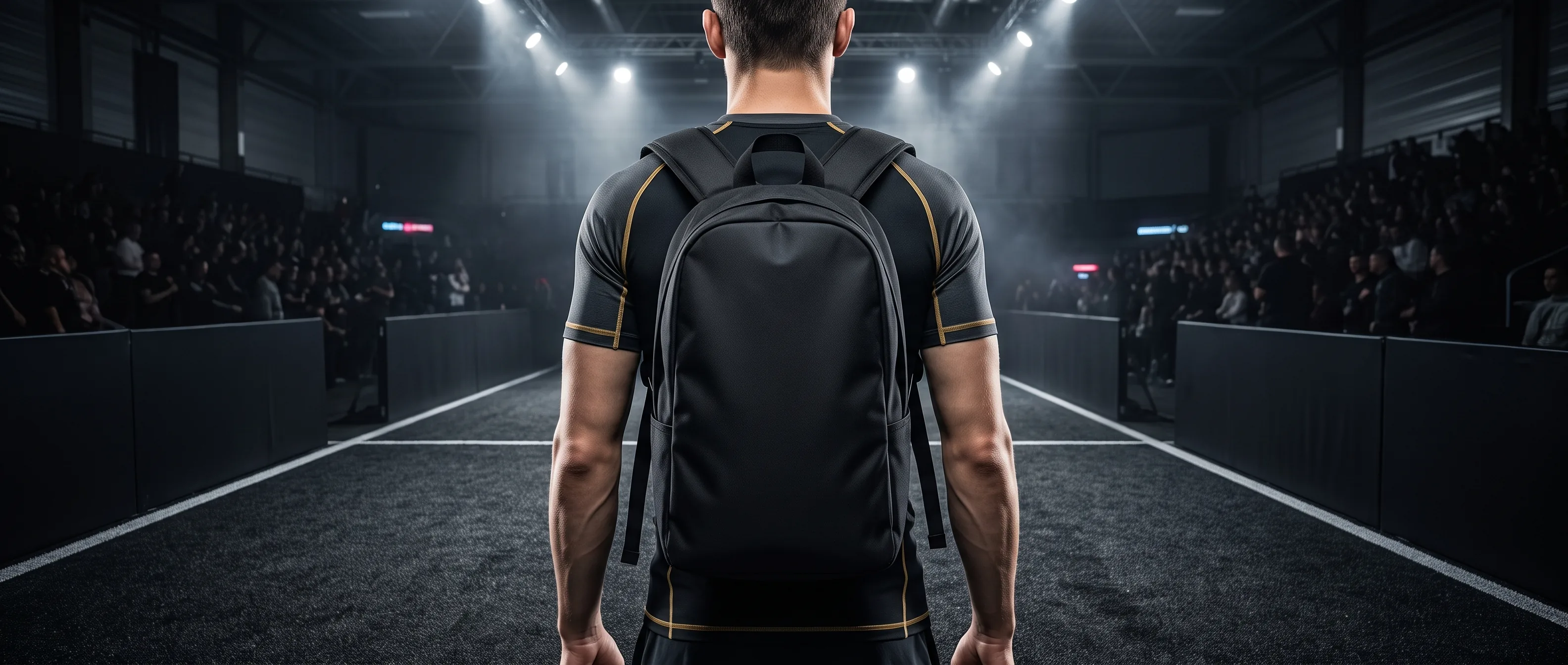
- The HYROX bag drop rule, quoted on the official HYROX FAQ, is one bag per athlete, no larger than a cabin-size bag, with everything inside it, dropped 45 to 60 minutes before that athlete's start.
- Section 11.2 of the official Season 26/27 rulebook states that changing rooms and a secure bag drop are available at the venue, and that the organiser accepts no responsibility for any lost or stolen bags or items.
- HYROX does not define "cabin-size" in centimetres or inches on its US, UK or Nordics FAQ, so there is no published number for a backpack to be measured against.
- An athlete cannot keep returning to a dropped HYROX bag, so anything needed between the start line and the finish line has to be on the athlete from the start.
- The official HYROX US shop's bag range was PUMA only when checked in August 2026, and the Built For Athletes collaboration was listed on the HYROX shop serving the UK instead.
- The PUMA x HYROX 46L backpack was listed at $162.00 on PUMA's US site and $160.00 on the official HYROX US shop on the same day in August 2026, so the live product page, not an article, is the price authority.
- A HYROX race is eight rounds, each a 1 km run followed by one functional workout station, covering 8 km of running and 8 workout stations according to the official Season 26/27 rulebook, which leaves one wet race kit to pack rather than a weekend's worth.
- For scale on carrying load, the HYROX Farmers Carry is 200 m at 2 x 35 lb (16 kg) for Open Women and 2 x 53 lb (24 kg) for Open Men, according to the official Season 26/27 rulebook, and a loaded backpack is lighter and carried a great deal further.
Search for a HYROX backpack and you get shops. What you rarely get is the rule that decides which bag you are allowed to bring. HYROX caps you at one bag per athlete, no larger than a cabin-size bag, dropped at the bag drop 45 to 60 minutes before your start. Everything has to fit inside it, and once it is dropped you cannot keep going back to it. That constraint should drive the purchase, not the litre count on the product page.
What the HYROX bag drop rule actually says
Each athlete may bring one bag, no larger than a cabin-size bag, and everything must fit inside it because loose items are not accepted. The bag has to be securely closed with all liquids sealed, and it should be dropped 45 to 60 minutes before your race since there may be queues. HYROX does not state that size limit in centimetres or inches.
The official wording, from the HYROX FAQ: "Drop your bag off 45-60 minutes before your race, as there may be queues. Each athlete can bring one bag, no larger than a cabin-size bag. Please ensure everything fits inside your bag; loose items will not be accepted. Make sure your bag is securely closed and all liquids are tightly sealed."
The identical sentence appears word for word on the US, UK and Nordics regional FAQs, which is why it is safe to treat as the general rule rather than a regional quirk. Always confirm against the athlete guide for your specific event.
Note what is missing. "Cabin-size" is never defined in centimetres or inches anywhere on those FAQs. There is no published number to measure a bag against, so no article, including this one, can honestly tell you a particular pack meets the limit. Read the manufacturer's stated dimensions, check the athlete guide for your event, and buy something that is obviously a normal carry-on.
The bag drop is secure, and the liability is still yours
The rulebook covers the other half of this, and it is the part that should decide what you put in the bag at all. Section 11.2, Changing Rooms and Bag Drop Area, of the official Season 26/27 rulebook states: "Changing rooms and a secure bag drop will be available at the venue. However, the organiser accepts no responsibility for any lost or stolen bags or items."
Read those two sentences together. A secure bag drop exists, so you do not need to solve storage yourself or talk somebody into minding your kit. The liability, though, sits with you. That is the argument for leaving the things you cannot replace at home, keeping the small valuables on your person in a pocket that seals, and treating the bag as somewhere for clothes, shoes and food rather than for a passport, a laptop or car keys you have no second set of. It is also, quietly, the case for zip pulls you can bring together and lock.
One bag, nothing loose
The "no loose items" line is the sharpest part of the rule and the one that quietly eliminates a lot of kit bags. A shoe bag clipped to the outside, a foam roller strapped under the lid, a jacket tied through a handle: none of that is inside the bag. It has to close, and close securely, with anything liquid sealed inside it. A pack with a full-perimeter zip beats a bigger bag that gapes.
What you cannot do once the bag is dropped
HYROX states that you will not be able to keep going back to your bag once it has been dropped off, and that race essentials like your timing chip and energy gels should stay with you. That is not a formality. The one fixed point you pass on every round is the ROXZONE, the central transition zone athletes run through between every run and station, and it is a transition corridor, not a place you visit your kit.
The nutrition rule closes the other door. Per the official FAQ, you can only take water or energy gels with you if they are on your person from the start of the race, and athletes cannot accept any beverage or nutritional product from anyone, spectators included, except at the aid stations during the race. So a friend on the barrier cannot pass you a gel, and HYROX also states it cannot store bags for spectators because of space limitations, which means that friend cannot mind your spare kit either. Whatever you need between the start line and the finish line travels in a pocket, a belt or a waistband.
Why HYROX bags are so big
The honest answer has very little to do with race day. A HYROX race is eight rounds, each a 1 km run followed by one functional workout station, so an athlete covers 8 km of running and 8 workout stations according to the official Season 26/27 rulebook, and finishes soaked through. That is one wet kit to bag up, not a reason to buy 46 litres.
The capacity is about the weekend around the race. Most athletes travel to events, which means a second full set of clothes, a spare pair of trainers, a laptop and everything a night away needs, all in the one bag that also has to work as the race bag. On top of that, the kit you raced in goes home soaked, pressed up against everything else you own. Big bags solve a travel problem and a wet-kit problem, then get photographed on the concourse and read as race equipment.
Which points at the counterintuitive conclusion: if you race locally and drive home, a large pack is the wrong buy. Size for the travel weekend if you travel. Size for a single day if you do not.
Which bag your race day actually needs
Almost every backpack guide sorts by brand. The useful sort is by the day you are about to have, because that is what decides volume, whether you need somewhere to seal wet kit, how far you carry the thing, and whether you care about a zip you can lock. Find the row that matches you and read across.
| If this is your race day | What your bag has to do | Why that is the constraint |
|---|---|---|
| You are flying or driving in and staying over | Carry a second full set of clothes, a spare pair of shoes and a night away, seal soaked kit away from all of it, and take a lock | The bag is doing two jobs at once, carry-on and race bag, and the kit you raced in goes home wet against everything you packed dry. Your travel valuables also sit in it all day, and the rulebook's section 11.2 puts responsibility for anything lost or stolen on you. |
| You race locally and drive home the same day | Hold one day of kit, with somewhere for wet clothes; nothing more | Buying capacity for a travel weekend you are not having is the most common overbuy in this category. |
| You are racing solo with nobody in the arena for you | Hold everything you are not wearing, close on its own without anything clipped outside, and hold nothing you could not stand to lose | There is no one to hand a jacket, a bottle or a wallet to, so the bag absorbs all of it. The venue bag drop is described as secure in section 11.2 of the rulebook, but the same section puts responsibility for lost or stolen items on you. |
| Someone is with you all day and can hold kit | Be smaller than you think, but still hold what you want waiting for you afterwards | Their hands are not storage; anything you want at the finish still has to be in your own bag. |
| Your heat is early in the morning | Swallow warm layers you shed at the last minute, and be packable the night before | Arena mornings are cold and the pack you assembled while awake is the one you actually race with. |
| Your heat is in the afternoon | Work as a day bag first: food, fluid and something to sit on the floor with for hours | You are in the venue far longer before you race than after, so most of the bag's working life that day is waiting. |
| You want to change before you spend time in the Finisher area | Keep a full dry change of clothes separated from the wet compartment | The change of clothes is the bulkiest single item you carry and the one thing that must not touch soaked kit. |
| You are carrying kit for a doubles partner as well | Roughly double the volume, or split it across two bags between you | Two people's wet race kit plus two changes of clothes is where a 35 litre pack stops closing. |
| You want to leave a phone, keys or a wallet in the bag | Have zip pulls you can bring together and lock, or a sealed pocket small enough to stay on you instead | Section 11.2 of the rulebook calls the bag drop secure and, in the same breath, says the organiser accepts no responsibility for lost or stolen items. That risk is yours to price. |
Two rows will usually contradict each other, and the travel row wins when it does. A pack sized for the weekend can carry a local day badly; a pack sized for a local day cannot carry the weekend at all.
What actually has to fit inside a HYROX backpack
Work backwards from the load rather than from a checklist. The bag has five jobs, and they pull in different directions.

- The kit you race in. Worn, so it occupies the bag only on the way home, wet.
- A full change of clothes. The bulkiest single item, and the one that has to stay dry and separate from everything soaked.
- Footwear. Often two pairs, at least one of them damp or chalky. See below.
- Fuel and fluid. A bottle you can find without unpacking, plus whatever you eat before and after.
- The small things that must stay on you. Timing chip, wristband, gels. These never make it into the bag on race morning.
That is the packing problem in outline. The sequencing of the day around it, when to arrive, when to eat, when to warm up and when to drop the bag, is covered in full in our HYROX race day guide.
The items that travel on you, not in the bag
Timing chip, wristband and any gel or fluid you intend to take. HYROX is explicit that essentials like the chip and gels should stay with you because you cannot return to the bag, and that gels and water only count as yours if they are on your person from the start. That means a pocket that seals or a waistband you have actually run in before. Race morning is not the time to find out your shorts have no pocket.
Shoes are the awkward cargo
Footwear is what separates a decent race bag from a general daypack. You may carry two pairs, one for travel and one to race in, and at least one comes home damp, chalky or both. Without somewhere to isolate them they go in against your dry change of clothes. That is the practical case for a separate shoe compartment or a drybag, and it is a storage argument rather than a performance one. Which shoes belong in there is a different question, covered in our guide to the best HYROX shoes and, for the branded option, the PUMA HYROX shoe range.
The features that earn their place in a HYROX backpack
Below are the features the two official product listings state, and what each one does for a race weekend. Every claim in this table is the manufacturer's or the official shop's own published wording. No independent testing sits behind any of it.
| Feature | Why it matters at a HYROX event | Where it is stated |
|---|---|---|
| Separate zippered shoe compartment | Keeps damp or chalky trainers off a dry change of clothes. | Listed for the BFA x Hyrox 35L on the official HYROX Shop product page. Not listed on either PUMA page. |
| Detached drybag included | Somewhere to seal soaked race kit for the trip home. | Listed for the BFA x Hyrox 35L on the official HYROX Shop product page. |
| Hook-and-loop patch panel | The reason these bags all look alike on the concourse. | PUMA describes a front panel with hook-and-loop "to attach your HYROX badges". The official shop listing for the BFA 35L describes a large hook and loop section for patches, with patches included. |
| Laptop compartment up to 17 inches | Travel, not race day. Relevant if the bag doubles as your carry-on. | PUMA states up to 17 inches for the 46L backpack. The official shop listing states a shock absorbing laptop compartment up to 17 inches for the BFA 35L. |
| Padded adjustable straps and a sternum strap | You may walk a long way from parking to venue with the bag loaded. | PUMA lists adjustable padded shoulder straps, a padded back panel and a sternum strap. The official shop listing for the BFA 35L lists adjustable sternum and waist straps. |
| Water bottle pockets | A bottle you can reach without opening the main compartment. | PUMA lists a zipped water bottle pocket. The official shop listing for the BFA 35L lists two side bottle holders. |
| Coated or water-resistant fabric | The bag sits on a wet arena floor next to a few hundred others. | PUMA lists a top panel, lining and bottom in polyester with a PU coating. The official shop listing for the BFA 35L describes water resistant and rip proof fabric. |
| Opens flat for packing | Makes a full change of clothes easier to load and find. | The official shop listing for the BFA 35L states the backpack opens flat to 18 degrees. |
The patch panel is the real reason these bags look alike
Both official bags carry a hook-and-loop panel on the front. PUMA's own product copy describes a front panel with hook-and-loop and says it is there "to attach your HYROX badges". The official HYROX Shop listing for the Built For Athletes 35L describes a large hook and loop section to showcase patches and says patches are included with all backpacks. A shared design convention, not a performance claim, is what produces a concourse full of near-identical black packs. How patches are earned or handed out is not something any of the pages checked here establishes, so treat what you read about that as community lore until an official source says otherwise.
The official HYROX backpacks and what is published about them
This is not a ranking. It is what the official channels publish about the three bags they sell, read directly from those pages in August 2026.
| Bag | Stated capacity | Stated dimensions | Listed price and where |
|---|---|---|---|
| PUMA x HYROX Backpack | 46L | H56cm x W29cm x D20cm (PUMA) | $162.00 on PUMA's US site; $160.00 on the official HYROX US shop. Both checked August 2026. |
| PUMA x HYROX Daily 34L Backpack | 34L | H46cm x W29cm x D18cm (PUMA) | $122.00 on PUMA's US site; $120.00 on the official HYROX US shop. Both checked August 2026. |
| BFA x Hyrox 35L Backpack | 35L, per the product name | 48cm height, 32cm width, 24cm depth (official HYROX Shop) | No price shown on the official HYROX Shop product page when checked August 2026. |
Two honest caveats belong under that table. First, no independent HYROX-specific durability testing exists for any of these bags. Nobody at RoxTribe has handled them. Every figure above is the manufacturer's or the retailer's own published specification, read off the page and attributed. Second, this page deliberately does not tell you whether any of these clears the cabin-size limit, because HYROX publishes no number to clear.
Then the prices, which are the more useful lesson. On the same day, the same 46L backpack was listed at $162.00 on PUMA's own US site and $160.00 on the official HYROX US shop. Neither is wrong and neither is "the price". The 34L Daily showed the same two-dollar split. The UK HYROX shop lists the 46L at £130.00 and the 34L Daily at £100.00, separate figures for a separate market rather than a conversion of anything above. If two official channels disagree on one day, a number typed into an article months ago is not something to plan a purchase around.
What the official US shop does and does not carry
Checked in August 2026, the bags category on the official HYROX US shop returned seven products, all PUMA branded: a 46L backpack, a 34L daily backpack, a waistbag, a shopper, a wash bag, a drybag and a grip bag. The Built For Athletes collaboration appears on the HYROX shop serving the UK rather than the US one. That is an observation dated to the check rather than a permanent state of affairs, so start from your own regional HYROX shop.
Do you actually need a HYROX-branded backpack?
No. The published rule constrains size and closure and says nothing about brand. Any bag that closes securely, is no larger than a cabin-size bag and holds everything inside it satisfies it, and a training pack you already own probably does. This article has no basis for claiming the branded packs outperform a general training pack, because no independent comparative testing of them exists.
What the branded bags buy you is worth naming honestly. Mostly it is the patch panel, which is the thing most people are really purchasing. The Built For Athletes bag adds a shoe compartment and a drybag, which solve a genuine wet-kit problem. And there is the community signal of turning up with the same pack as everyone else, which is a perfectly reasonable thing to want. If the budget matters more, put the money elsewhere and read what a HYROX race actually costs to see where gear sits against entry fees and travel.
One last thing to weigh before buying on capacity alone: the walk from parking to arena with a loaded bag is longer than people expect, and the strap system decides whether that matters. For scale, the HYROX Farmers Carry is 200 m at 2 x 35 lb (16 kg) for Open Women and 2 x 53 lb (24 kg) for Open Men, according to the official Season 26/27 rulebook. Your bag is lighter, and you carry it a great deal further. Division loads for every station are in our weight standards tool, and the wider format rules sit in our HYROX rules guide.
A note on prices and specs
Every figure on this page was read directly from the linked page in August 2026 and is attributed to the page it came from. Prices vary by region and retailer and change without notice, capacity and dimensions are the manufacturer's own stated numbers rather than measured ones, and product ranges rotate. Where a source could not be read, the figure was left out rather than filled in from somewhere else. The linked page is always the authority, and the athlete guide for your event is the authority on the bag drop.
References
- HYROX US FAQ: official bag drop rules, the cabin-size limit, spectator bag storage and the on-course nutrition rule.
- HYROX UK FAQ: the regional FAQ carrying the identical bag drop wording, checked August 2026.
- HYROX Nordics FAQ: the regional FAQ carrying the identical bag drop wording, checked August 2026.
- PUMA x HYROX Backpack product page: stated capacity, dimensions, materials, features and US price.
- PUMA x HYROX Daily 34L Backpack product page: stated capacity, dimensions and US price for the Daily, checked August 2026.
- Official HYROX Shop (US), bags category: the US official-shop bag range and prices.
- Official HYROX Shop listing for the BFA x Hyrox 35L Backpack: its stated dimensions and feature list.
- HYROX Singles rulebook: the race format and division standards referenced above, plus section 11.2 on changing rooms and the bag drop area.